Sitting Bull Quotes
I have killed, robbed, and injured too many white men to believe in a good peace. They are medicine, and I would eventually die a lingering death. I had rather die on the field of battle. Look at me, see if I am poor, or my people either. The whites may get me at last, as you say, but I will have good times till then. You are fools to make yourselves slaves to a piece of fat bacon, some hard-tack, and a little sugar and coffee.
Vestal, Stanley. Sitting Bull, Champion of the Sioux: A Biography. Houghton Mifflin Company, 1932, p. 111.


Thai society had been polarized and very large peaceful demonstrations (by the Yellow Shirts) were calling for the resignation of the government which although very corrupt and controlled by a single very rich family which had extensive support of the rural and poor (the Red Shirts). This quotation illustrates how a peaceful protest could lead to violence and terrorism. This Red Shirt leader, rather than lose, would lead violence in the streets like the Brown Shirts of the pre WWII Germany. If the violence fails, he was willing to go underground and become a terrorist movement.

Little Wolf led 300 Cheyenne off the Reservation. The soldiers followed but never could catch the Indians. Little Wolf made good the escape to Montana where he was allowed to stay. Later, he worked as a scout for the Army.

British colonial economics imported raw materials to England which then exported them back to the colonies as manufactured goods. Gandhi correctly calculated that by minimizing purchase of English cloth, colonial control of India would not be as profitable. Gandhi not only called for the boycott, but called on Indians to spin their own cloth, set an example be spinning himself, and his Congress party adopted the spinning wheel as its logo and symbol which continues today. Narcotics, was at the time not only legal, but British economic interests controlled much of the world narcotics trade. Gandhi’s call for a boycott of narcotics was as much an economic tactic as it was a health measure.


This was written more than a year before the American Revolution Battles began. It took time to ship the men and supplies to America and the British did not handle that task with much efficiency. See {636926} for another of the King’s statements.

The critic observed that the South would not give up their slaves voluntarily and that and that vigorous abolition pressure on the South would lead to war and asked Angelina if she would want a civil war. Grimke’s response was predictive of what happened—the most terrible was in U. S. History to end the most terrible cruelty and persecution in American history. Note that she herself was willing to die to end slavery. See {629094}.

He advocated no cooperation with the British Colonial Administration which depended on Indian officials, administrators, clerks and other workers. The boycott strategy never worked in this case, but civil disobedience did. Boycott did work against the apartheid regime in South Africa a half century later however.


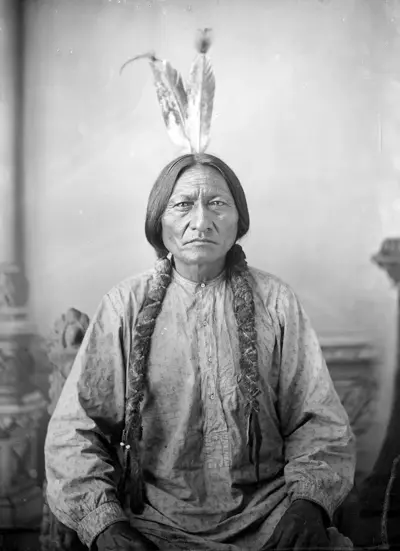
Sitting Bull was a Hunkpapa Lakota leader who led his people during years of resistance against United States government policies. He was killed by Indian agency police on the Standing Rock Indian Reservation during an attempt to arrest him, at a time when authorities feared that he would join the Ghost Dance movement.
