Mao Zedong Quotes
The Kuomintang is now pursuing a policy of blockhouse warfare, feverishly constructing their ‘tortoise-shells’ as though they were iron bastions. Comrades! Are they really iron bastions? Not in the least! Think of the palaces of the feudal emperors over thousands of years, were they not powerful with their walls and moats? Yet they crumbled one after another the moment the masses arose. The tsar of Russia was one of the world's most ferocious rulers, yet when the proletariat and the peasantry rose in revolution, was there anything left of him? No, nothing. His bastions of iron? They all crumbled. Comrades! What is a true bastion of iron? It is the masses, the millions upon millions of people who genuinely and sincerely support the revolution. That is the real iron bastion which no force can smash, no force whatsoever. The counter-revolution cannot smash us; on the contrary we shall smash it. Rallying millions upon millions of people round the revolutionary government and expanding our revolutionary war, we shall wipe out all counter-revolution and take over the whole of China.
The Kuomintang was the anti-Communist political party controlled by Chaing Kai Chek and the major opponent of the Communists. It took more than another decade but Mau and the Communists with the vast support of the majority of the masses, did indeed take over all of China. At the time few thought that they would ever do it.
Mao Tse-Tung, 1893-1976, Chairman, Communist Party, China, Be Concerned With The Well-Being Of The Masses: Pay Attention To Methods Of Work, January 27, 1934
Sourced by: Eigen's Political and Historical Quotations

These tactics were revolutionary in China and the rest of the world. They were unexpected and were very effective. The non communists however were corrupt, exploitative, and divided. The communist revolution in China might well have not succeeded had the capitalist forces not been so corrupt and badly led.
The non-communist forces of China were always struggling with each other for power. Attempts by non-communist reformers were defeated by autocrats, warlords, major landlords, and various religions organizations and denominations which were all fighting each other.
Many Communist Party officials saw the red army as only a fighting unit. Mao had a larger vision and that vision contributed greatly to the success of the communist revolution. However, long after the revolution the Red Army, even into the 21st century, was so involved with affairs at all levels it was an economic, intellectual and political force of its own.
Chaing Kai Chek seemed to have the Red Army on the run with far more guns, planes & men. However while Chaing thought he was chasing the Communists, the Red Army traveled through 11 major Chinese provinces, helping the peasants to harvest their crops, build their homes, care for their sick & get indoctrinated in Communist political philosophy. In comparison, the Chaing forces abused the peasants, corruptly stole from them & brought no improvement in their living standard, sense of hope or fairness. Massive retreat became massive victory as so much of China had a Chance to compare the communists with the Kuomintang & unfortunately chose communism as Chaing and the Kuomingtang was such a poor example of capitalism-corrupt, ineffectual and heartless. At the same time, Mao and the other communist leaders were brilliant in their use of the retreating army to improve the lot of the peasants and left their biggest supporters as they were driven to the next province and repeated the process.


Many foreign armies, including troops of the United States, had surrounded Russia. Most had no specific instructions or purpose but they all wanted to protect their interests from the chaotic Russian situation as well as from each other who might use the Russian weakness to establish their foothold.

In 1921 an Paul E. De Mott, an American Quaker famine relief worker in Germany was arrested as a "Bolshevik" and murdered without trial. American correspondents heard about the crime and asked for a statement from the chief American diplomat in Germany.
In 1927 there was a Peasant Uprising in the Hunan Province of China. Young Mau went there and wrote a report.


Mengustu seized power in a coup. However his Marxist Dictatorship was very unpopular and a civil war soon started. The poorly armed opposition used guerrilla warfare insurgency techniques. Since the government was hated by most people there was much support for the guerrilla in the villages and countryside. Mengustu adopted a policy of genocide. The areas of the country which were sympathetic to the revolutionaries were then systematically starved by the government withholding food. There was a bad agricultural crop but international donors including the United States provided much food aid. However this was withheld by the government from the areas where there was any support for the freedom fighters. Over 1 million Ethiopian citizens were starved to death. This quotation was one of the important documents that proved that there was a systematic government policy to commit genocide—in this case to “drain the sea”. After the revolution was successful, Mengustu was convicted of Crimes Against Humanity but escaped to Zimbabwe where he was given sanctuary by his fellow dictator, Robert Mugabe. There is a technical issue of whether or not this was genocide in that the exterminated people were not of one race, religion or ethnic group, but the people who were residents of the areas which were giving “aid and comfort” to the freedom fighters.
This is a very noteworthy quotation. The reason is that in America, the extreme right wing accuses liberals of being communists or supporters of communism. However, here one of the two major Communists in the world, condemns liberalism and states that liberals are the enemy of communism.
The occasion for the speech was the 60th birthday of Russian Premier, Joseph Stalin.


The Boxers were against Western and Christian influence. The Government was too weak to protect the foreigners or the Chinese Christians. So the Western Powers used their soldiers and diplomats to defend the Western Enclaves and Christian Churches not unlike the situation with the Taliban in Afghanistan a century later.
He was trying to divert heroic attention to the traditional Chinese heroes who for the most part, were terrible examples of rulers although they may have attained power, enlarged the Chinese Empire, or won many battles.

This is another example where our intelligence analysis was totally wrong. It also shows that intelligence being influenced by ideology and politics has a long history in America as elsewhere.
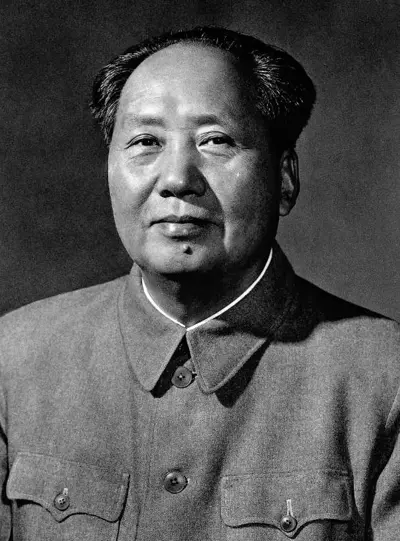
Mao Zedong, also known as Chairman Mao, was a Chinese communist revolutionary who was the founder of the People's Republic of China (PRC), which he ruled as the chairman of the Chinese Communist Party from its establishment in 1949 until his death in 1976. Ideologically a Marxist–Leninist, his theories, military strategies, and political policies are collectively known as Maoism.
