Mao Zedong Quotes
The Party and the masses have to be placed on a war footing, criticizing the Nationalists by means of a machine gun
Mao Tse-Tung 1893-1976, Chairman (Communist Party of China), Mao’s Speech, 1926 Quoted in the Wilson Quarterly, 2006
Sourced by: Eigen's Political and Historical Quotations


He was a virulent anti communist and an opponent and foe of Chiang Kai-shek who he regarded as too moderate.

The non-communist forces of China were always struggling with each other for power. Attempts by non-communist reformers were defeated by autocrats, warlords, major landlords, and various religions organizations and denominations which were all fighting each other.


Vladimir Lenin. While Lenin was of this view, Stalin and other hard liners disagreed. They not only imposed their brand of communism on their own people via force with terrible consequences for any dissidents, but the Soviet Army imposed Communism on most of the states of Eastern Europe, and those states in turn used their Armies and secret police to impose it on their own citizens.

For years the Nationalist Military under Chiang Kai-shek and other Generals like Ma Hongkui had murdered suspected communist politicians, and in the Civil War with the communists rarely took any prisoners. The Communists in turn, “tried” and executed landlords and other major capitalists who had previously in their view treated the peasants badly and were responsible for much starvation. Neither side had any scruples about ignoring human rights and committing war crimes.

The occasion for the speech was the 60th birthday of Russian Premier, Joseph Stalin.


This has been the case ever since WWII. In the Great March where the Communists avoided capture by the Nationalists, the army, the party, and many of the people were in a single amalgam living on the move. The positive and fair behavior of the Communist army during the Great March did a great deal to convince the Chinese peasants that the Communists were not corrupt and greedy as were most of the Nationalist officials they ran into. From a strict military point of view, there was little for the Army to do for defense and national security since the overthrow of the Nationalists. So they have been great supporters of development of the nation after the revolution, but by the 21st century had developed some of their own corruption and built companies to produce funds for the army (and some of its leaders personally.


This was a fairly unique notion. In Russia the army never played this role to the same degree. The Long March in Chinese History blended and amalgamated the people and the army in a way that was unique in World History.

Before American entry into the War with Japan, Chiang Kai-shek and the Soongs maintained that they were fighting the Japanese but it was not generally true. They were fighting Mao and his Communists while Mao was fighting the Japanese. By 1942, under pressure from the United States and Russia, the Nationalists and Communists agreed to a truce so that they could both fight against Japan. Based on the promises made to President Roosevelt by Madam Chiang, the Soongs, and Chiang himself, there was an expectation of extensive military attacks against the Japanese. The U. S. then sent a large amount of military aid to Chiang Kai-shek, but there did not appear to be any significant attacks against the Japanese other than those mounted by the Communists. Magruder, General Marshall’s emissary to Chiang Kai-shek was instructed to investigate. When the war ended, Chiang Kai-shek used the assets he was saving in to attack Mao and his communists just as he had done before the truce. Magruder had been right. However, just as Chiang could not defeat the militarily inferior Communists before the truce, he could not do so after. Soon Mao turned the tables and drove Chiang Kai-shek and his Nationalists out of Mainland China. President Roosevelt had brilliantly judged the ability of England, Russia, and Yugoslavia to fight the Germans, but as this quotation and {641677} shows, he listened to the wrong people. He had been sold a “bill of goods” by the China Lobby, the Soongs and Chiang Kai-shek.


He was the Deputy Director when he made this statement. He had managed Covert Operations before that.

Rival to Mao. This quotation is historically important because it shows how intensively the Chinese Communists concentrated on organizing the fringe and unpopular groups of society to the point where the struggle was between Chiang Kai-shek’s Nationalists and everybody else. The Chinese Communist coalition included many who had not idea of what communism was but knew that Chiang Kai-shek and the Nationalists were not very good for them or the people they knew.

The major problem at the time was not the capitalist in the industrial revolutionary sense of the word as there was little industry. China as an agrarian society but the vast majority of the land was owned by relatively few wealthy families. It was close to a feudal system and that was the target for the Communists and their revolution. There was a very small proletariat. Their methods were brutal, but they executed the landlords and the class warfare ended quickly. Sun Yat-sen was not able to solve the land problem, nor was Chiang Kai-shek as most of his major supporters were landowners of warlords who controlled the landowners.
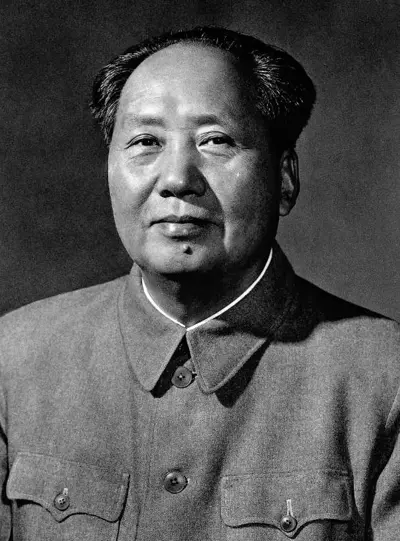
Mao Zedong, also known as Chairman Mao, was a Chinese communist revolutionary who was the founder of the People's Republic of China (PRC), which he ruled as the chairman of the Chinese Communist Party from its establishment in 1949 until his death in 1976. Ideologically a Marxist–Leninist, his theories, military strategies, and political policies are collectively known as Maoism.
