Mao Zedong Quotes
In difficult or critical times some comrades often have doubts about the survival of Red political power and become pessimistic. The reason is that they have not found the correct explanation for its emergence and survival. If only we realize that splits and wars will never cease within the White regime in China, we shall have no doubts about the emergence, survival and daily growth of Red political power.
The non-communist forces of China were always struggling with each other for power. Attempts by non-communist reformers were defeated by autocrats, warlords, major landlords, and various religions organizations and denominations which were all fighting each other.
Mao Tse-Tung, 1893-1976, Chairman, Communist Party, China, Why Is It That Red Political Power Can Exist In China?, 1928
Sourced by: Eigen's Political and Historical Quotations

Chaing Kai Chek seemed to have the Red Army on the run with far more guns, planes & men. However while Chaing thought he was chasing the Communists, the Red Army traveled through 11 major Chinese provinces, helping the peasants to harvest their crops, build their homes, care for their sick & get indoctrinated in Communist political philosophy. In comparison, the Chaing forces abused the peasants, corruptly stole from them & brought no improvement in their living standard, sense of hope or fairness. Massive retreat became massive victory as so much of China had a Chance to compare the communists with the Kuomintang & unfortunately chose communism as Chaing and the Kuomingtang was such a poor example of capitalism-corrupt, ineffectual and heartless. At the same time, Mao and the other communist leaders were brilliant in their use of the retreating army to improve the lot of the peasants and left their biggest supporters as they were driven to the next province and repeated the process.

The Kuomintang was the anti-Communist political party controlled by Chaing Kai Chek and the major opponent of the Communists. It took more than another decade but Mau and the Communists with the vast support of the majority of the masses, did indeed take over all of China. At the time few thought that they would ever do it.

Rival to Mao. This quotation is historically important because it shows how intensively the Chinese Communists concentrated on organizing the fringe and unpopular groups of society to the point where the struggle was between Chiang Kai-shek’s Nationalists and everybody else. The Chinese Communist coalition included many who had not idea of what communism was but knew that Chiang Kai-shek and the Nationalists were not very good for them or the people they knew.

Vladimir Lenin


The Menshevik Party was the Communist Opposition to the Bolshevik Party. Unlike the Mensheviks, the Bolsheviks seized as much power as they could and then denied anyone else a share.

Commenting on political parties in Cuba:


In 1927 there was a Peasant Uprising in the Hunan Province of China. Young Mau went there and wrote a report. Mao and other young communist leaders had a much more acute appreciation of sloganeering than their older revolutionary comrades. Even into the 3rd millennium, the same “Down with Imperialism” slogan could be heard in many part of the world, long after the Soviet Union collapsed and China and become capitalistic.

Durruti’s and other Republican columns were advancing on Saragossa on the Aragon front to free it from the Fascists. Durruti’s army was made up of idealist libertarians and anarchists who also didn’t much like straight communists because they would restrict individual freedom. The regular communist army was more conservative and wanted to coordinate and attack and wait for planning and more coordination between the columns. The libertarians pushed ahead with the others following and they took Saragossa

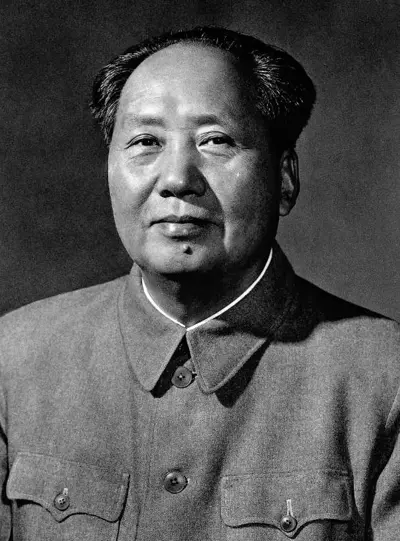
Mao Zedong, also known as Chairman Mao, was a Chinese communist revolutionary who was the founder of the People's Republic of China (PRC), which he ruled as the chairman of the Chinese Communist Party from its establishment in 1949 until his death in 1976. Ideologically a Marxist–Leninist, his theories, military strategies, and political policies are collectively known as Maoism.
