Mao Zedong Quotes
Who are our enemies? Who are our friends? This is a question of the first importance for the revolution. The basic reason why all previous revolutionary struggles in China achieved so little was their failure to unite with real friends in order to attack real enemies.
Mao Tse-Tung, 1893-1976, Chairman, Communist Party, China, Analysis Of The Classes In Chinese Society, March 1926
Sourced by: Eigen's Political and Historical Quotations


He had just lost another battle.

The Kuomintang was the anti-Communist political party controlled by Chaing Kai Chek and the major opponent of the Communists. It took more than another decade but Mau and the Communists with the vast support of the majority of the masses, did indeed take over all of China. At the time few thought that they would ever do it.
These tactics were revolutionary in China and the rest of the world. They were unexpected and were very effective. The non communists however were corrupt, exploitative, and divided. The communist revolution in China might well have not succeeded had the capitalist forces not been so corrupt and badly led.
The non-communist forces of China were always struggling with each other for power. Attempts by non-communist reformers were defeated by autocrats, warlords, major landlords, and various religions organizations and denominations which were all fighting each other.
There had been a Chinese Revolution in 1911, but although there were changes at the seat of government and in urban areas, the rural areas where most of the people lived changed little if at all. The revolution failed as a result of it became a revolution without reform.


He led an Islamic rebellion against the Quinn Dynasty which ended in his beheading in 1873. Since the Christians were also a minority, he tried to form an alliance with them. Hatred of Christians is not endemic to Islam—politics affect the situation also. His tomb is shown in the graphic.

Mengustu seized power in a coup. However his Marxist Dictatorship was very unpopular and a civil war soon started. The poorly armed opposition used guerrilla warfare insurgency techniques. Since the government was hated by most people there was much support for the guerrilla in the villages and countryside. Mengustu adopted a policy of genocide. The areas of the country which were sympathetic to the revolutionaries were then systematically starved by the government withholding food and attacked by allies who he armed.

The occasion for the speech was the 60th birthday of Russian Premier, Joseph Stalin.


In 1927 there was a Peasant Uprising in the Hunan Province of China. Young Mau went there and wrote a report.
Many Communist Party officials saw the red army as only a fighting unit. Mao had a larger vision and that vision contributed greatly to the success of the communist revolution. However, long after the revolution the Red Army, even into the 21st century, was so involved with affairs at all levels it was an economic, intellectual and political force of its own.
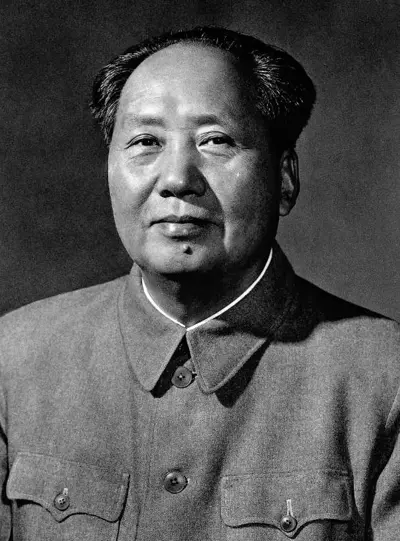
Mao Zedong, also known as Chairman Mao, was a Chinese communist revolutionary who was the founder of the People's Republic of China (PRC), which he ruled as the chairman of the Chinese Communist Party from its establishment in 1949 until his death in 1976. Ideologically a Marxist–Leninist, his theories, military strategies, and political policies are collectively known as Maoism.
