Mao Zedong Quotes
… the Chinese Red Army is an armed body for carrying out the political tasks of the revolution…. the Red Army should certainly not confine itself to fighting; besides fighting to destroy the enemy's military strength, it should shoulder such important tasks as doing propaganda among the masses, organizing the masses, arming them, helping them to establish revolutionary political power and setting up Party organizations. The Red Army fights not merely for the sake of fighting but in order to conduct propaganda among the masses, organize them, arm them, and help them to establish revolutionary political power. Without these objectives, fighting loses its meaning and the Red Army loses the reason for its existence.
Many Communist Party officials saw the red army as only a fighting unit. Mao had a larger vision and that vision contributed greatly to the success of the communist revolution. However, long after the revolution the Red Army, even into the 21st century, was so involved with affairs at all levels it was an economic, intellectual and political force of its own.
Mao Tse-Tung, 1893-1976, Chairman, Communist Party, China, On Correcting Mistaken Ideas In The Party, December 1929
Sourced by: Eigen's Political and Historical Quotations


These tactics were revolutionary in China and the rest of the world. They were unexpected and were very effective. The non communists however were corrupt, exploitative, and divided. The communist revolution in China might well have not succeeded had the capitalist forces not been so corrupt and badly led.
The Kuomintang was the anti-Communist political party controlled by Chaing Kai Chek and the major opponent of the Communists. It took more than another decade but Mau and the Communists with the vast support of the majority of the masses, did indeed take over all of China. At the time few thought that they would ever do it.

Many foreign armies, including troops of the United States, had surrounded Russia. Most had no specific instructions or purpose but they all wanted to protect their interests from the chaotic Russian situation as well as from each other who might use the Russian weakness to establish their foothold.


Germany, after its defeat in WWI was going through massive demonstrations and strikes. The government kept issuing bulletins that “Order Prevails” and the like. Luxemburg’s rhetoric and writing was so damaging to the government that they had her assassinated shortly after this statement.

Comintern was upset by the American Socialist Party because the party had rejected the 21 Conditions for Affiliation and withdrew their intent to join the Third International. To Comintern, the Socialist Party was a party of “bourgeois socialism.”


In 1921 an Paul E. De Mott, an American Quaker famine relief worker in Germany was arrested as a "Bolshevik" and murdered without trial. American correspondents heard about the crime and asked for a statement from the chief American diplomat in Germany.

The non-communist forces of China were always struggling with each other for power. Attempts by non-communist reformers were defeated by autocrats, warlords, major landlords, and various religions organizations and denominations which were all fighting each other.
There had been a Chinese Revolution in 1911, but although there were changes at the seat of government and in urban areas, the rural areas where most of the people lived changed little if at all. The revolution failed as a result of it became a revolution without reform.

Lev Davidovich Bronstein. This is the intellectual origin of the concept of the single party revolutionary state.

Vladimir Lenin


This has been the case ever since WWII. In the Great March where the Communists avoided capture by the Nationalists, the army, the party, and many of the people were in a single amalgam living on the move. The positive and fair behavior of the Communist army during the Great March did a great deal to convince the Chinese peasants that the Communists were not corrupt and greedy as were most of the Nationalist officials they ran into. From a strict military point of view, there was little for the Army to do for defense and national security since the overthrow of the Nationalists. So they have been great supporters of development of the nation after the revolution, but by the 21st century had developed some of their own corruption and built companies to produce funds for the army (and some of its leaders personally.
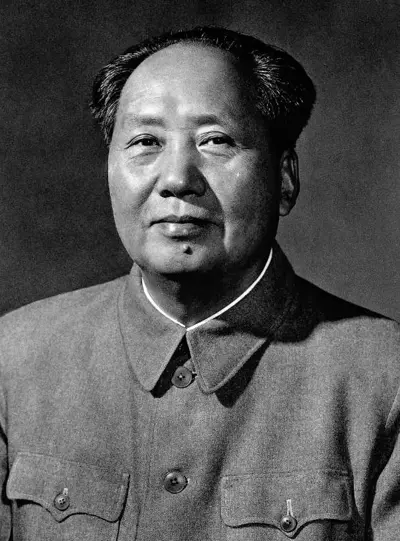
Mao Zedong, also known as Chairman Mao, was a Chinese communist revolutionary who was the founder of the People's Republic of China (PRC), which he ruled as the chairman of the Chinese Communist Party from its establishment in 1949 until his death in 1976. Ideologically a Marxist–Leninist, his theories, military strategies, and political policies are collectively known as Maoism.
