Empress Dowager Cixi Quotes
Now they have started the aggression, and the extinction of our nation is imminent. If we just fold our arms and yield to them, I would have no face to see our ancestors after death. If we must perish, why not fight to the death?
the Western Powers & Japan
Tzu-Hsi, 1834-1908, [Cixi], Empress Dowager of China, Quoted in Keith Laidler, The Last Empress: The She-Dragon of China, 2003
Sourced by: Eigen's Political and Historical Quotations


The Chinese were massacred when the Japanese invaded with atrocities against civilians that were inconceivable until Hitler began his in Europe. However, there were many Chinese we worked against the Japanese including the Communists who made a truce with Chiang (see {636322}) so that they could oust the Japanese invaders.

Japan and 7 Western countries had sent military troops to China ostensibly to protect “foreigners” who were the victims of the irrational violence of the Boxer Rebellion--{641726} and {641727}. The Chinese government was unwilling and/or unable to suppress the Boxers--{641838}. Regardless of the justification, this was an act of war—an invasion contrary to international law. The Chinese national forces were not only too weak to take on the Boxers but were no match for the 8 powers’ well equipped military forces. None-the-less, the Empress decided to fight. In the early fighting the Chinese Imperial forces killed the German Minister to China, Baron von Ketteler, thus precipitating full scale war.

He always appeared in a military uniform after that.


Ataturk was a young major at the time commanding troops of a weak and corrupt Ottoman regime. However a combined English and French (the strongest military powers in Europe) invasion of the Gallipoli Peninsula threatened to capture the Turkish capital, Constantinople. Ataturk alone rallied the Turkish defenders and fought the invaders to a standoff in long drawn out battle with huge casualties on both sides. Ataturk became a national hero. Although Ataturk thereafter was very reluctant to use military force or endanger troops, the thing he always thought worth the supreme sacrifice (including his own) was the independence and sovereignty of the nation. See {584502} for his continuing belief in this type of sacrifice.

At that point the Japanese were losing the war on every front. It is not clear whether Hirohito would actually have done such and not tried to escape in the end, however he certainly expected his subjects, military and civilian to do so. That expectation and the behavior of the Japanese troops fighting to the death on many islands was a powerful factor in leading Truman, Marshall and other key American leaders to use the Atomic Bomb. See Marshall: {641063}

Most Canadians supported the English despite the letter.

Response to an offer by Commodore Preble to exchange prisoners.

This line was used in the WPA Federal Theater Project. The play was closed down, because the State Department was distressed that the Federal Theater quoting heads of State might be insulting to the world leaders. Mussolini was another character in the play and he was depicted as the boorish thug that he turned out to be. It was that which offended the government officials who closed the show before it could open. FDR used a similar line 6 years later. See {32529} . Dolores Ibarruri in the Spanish Civil War is quoted with a similar phrase at about the same time. See {604321}

This statement is perhaps the greatest and most eloquent description of the United States exceptionalism and its behavior in WWII. Such a statement could only come from a non-American.

The Prime Minister, Neville Chamberlain, preceded him with the announcement of declaration of war against Germany, but it was left up to the Foreign Minister to explain the implications. This was the first time in history that a nation had used radio to communicate such momentous events to its population.


Ataturk had been a military hero, but was very much opposed to war and military adventurism not unlike the Dwight Eisenhower and Colin Powell type leaders. However, the one thing that he thought worth the sacrifice of his own and other Turkish lives was Turkish independence and sovereignty. Historically, the Ottoman Empire which Ataturk finally ended, had dominated half of Europe and all of the Mid East at the cost of sovereignty of other nations and Ataturk saw no more important virtue with dying for than national sovereignty. See {125322} and {584501}.
The poem was written for and inscribed upon a monument. The Atheists in Foxholes Monument was donated to Alabama Freethought Association, Inc. by the Freedom From Religion Foundation. It is located adjacent to the Willa Mae Whatley Auditorium, in Fearn Park at Lake Hypatia, Alabama.


He was never shot by the people, but executed after a military coup.
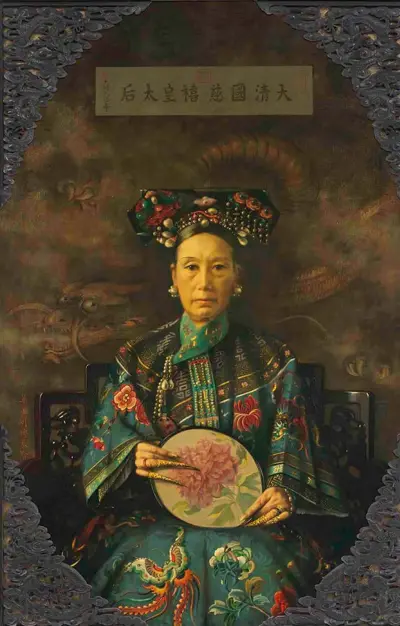
Empress Dowager Cixi was a Chinese empress dowager and regent who was the de facto supreme ruler of China in the late Qing dynasty for 47 years, from 1861 until her death in 1908. Of the Manchu Yehe Nara clan, she was elected as a concubine of the Xianfeng Emperor in her adolescence and gave birth to a son, Zaichun, in 1856. After the Xianfeng Emperor's death in 1861, the young boy became the Tongzhi Emperor, and she became the Empress Dowager. Cixi ousted a group of regents appointed by the late emperor and assumed regency, which she shared with Empress Dowager Ci'an. Cixi then consolidated control over the dynasty when she installed her nephew as the Guangxu Emperor at the death of the Tongzhi Emperor in 1875, contrary to the traditional rules of succession of the Qing dynasty that had ruled China since 1644.
