Jacob Rees-Mogg Quotes
The House of Commons has the undoubted rights to expel members for misconduct. This is an absolute authority which cannot be challenged in any court, as it derives from the twin concept of the High Court of Parliament being the most senior court in the land and of each House's right to regulate its own affairs.
Rees-Mogg, Jacob. Parliamentary Debates (Hansard). Great Britain: House of Commons, 2014.


This is the justification of virtually all legislatures that exempt their members from general requirements of law or grant them special privileges. Occasionally, the justification is warranted; most often, not.


In the English system the checks and balances of the American system are not present. Historically in England the Monarch and the Parliament acted as checks upon each other. With a Constitutional Monarch there is no institutional check on Parliament. The checks are their restraint--respect for precedent--and the voters. The Prime Minister is a member of Parliament and has no powers other than what Parliament gives him/her. The courts in England are under Parliament and the upper house, the House of Lords is the equivalent of the highest court—but it may always be overruled by the parliament itself.


The Czar, a total autocrat, was out of touch with most of the civilized world. Under much pressure from his advisors who realized that there was much unhappiness with an autocracy, the Czar made this reform which seemed a major concession and was very much welcomed by the people. However, it had relatively little practical effect. The Duma could not make laws, they could only ratify those made by the Czar and his ministers. However, few members of the Duma were willing to vote against a measure that the Czar wanted. It had no practical effect on improving the standard of living and the economic development of a backward empire.

This clause was a throwback to the days before the separation of powers where the legislature could imprison anyone they thought contemptuous or interfering with their deliberation. Contrast this with the earlier constitution of Massachusetts which forbade the legislature from acting as a judge or prosecutor. See {616750} and {616749}. Also this was a clear invasion of freedom of the press and freedom of speech provided by the Bill of Rights. However, at the time, it was not clear that the Federal Constitution was binding on State Governments on State Matters. Modern law is still ambiguous on this general point, but not on freedom of speech and the press which is currently definitely binding on the states.

The issues of check and balances in the American constitution were radical by world standards of the day. However, it was by no means an new concept and as this quotation illustrates was discussed and debated in England, but although England was far ahead of almost all other countries with respect to eliminating absolute power, they never took it as far as the Americans did. That took a revolution.

He was considered Massachusetts’ greatest Colonial orator.


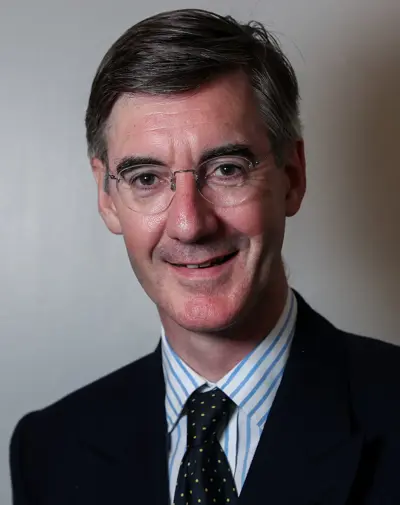
Jacob William Rees-Mogg is a British politician serving as Leader of the House of Commons and Lord President of the Council since 2019, and who has served as Member of Parliament (MP) for North East Somerset since 2010. A member of the Conservative Party, Rees-Mogg is a social conservative.
