Christopher Gadsden Quotes
The House of Commons, refused to receive the addresses of the colonies, when the matter was pending; besides, we hold our rights neither from them nor from the Lords.
Bancroft, George. History of the United States, from the Discovery of the American Continent. Vol. 5, Little, Brown and Company, 1860, p. 335.


The Stamp Act had caused much consternation among the colonies. The Continental Congress had gone into session to draft a petition to the King asking that the Act not be enforced. This letter described the chalenge before them. See {589421} for one of the more contentious passages the delegates had to work out.

The colonists in America had no representatives in Parliament. Galloway who opposed armed rebellion against Britain {621966} admitted that the British treatment of America was wrong but saw other solutions. It will never be known if any of them might have worked. The world would have been very different had they been tried.


This was the first proposal for a united American government. It provided for a “President-General” and a unicameral “Grand Council” with representation proportional to population.


This clause was a throwback to the days before the separation of powers where the legislature could imprison anyone they thought contemptuous or interfering with their deliberation. Contrast this with the earlier constitution of Massachusetts which forbade the legislature from acting as a judge or prosecutor. See {616750} and {616749}. Also this was a clear invasion of freedom of the press and freedom of speech provided by the Bill of Rights. However, at the time, it was not clear that the Federal Constitution was binding on State Governments on State Matters. Modern law is still ambiguous on this general point, but not on freedom of speech and the press which is currently definitely binding on the states.

The issues of check and balances in the American constitution were radical by world standards of the day. However, it was by no means an new concept and as this quotation illustrates was discussed and debated in England, but although England was far ahead of almost all other countries with respect to eliminating absolute power, they never took it as far as the Americans did. That took a revolution.
Two years later with bipartisan support Speaker Joseph Cannon was stripped of his party and the Rules Committee was created.

At that time the king not only called Parliament into session but terminated the session and set the agenda. In this case, Charles I didn't want royal activities regarding taxation to be debated much less legislated upon. As the speaker rose to leave the chair, he was forcibly held in place by two members as the house voted by acclamation to condemn the taxes and even the merchants who paid them. This was perhaps the first legislative tax revolt in history.


Some of the Patriots of Early America realized that the oppressions of British rule were coming from Parliament and initially took the position that only the King could make laws for the colonies and not Parliament. Therefore, they were as Englishmen challenging illegal English laws. Most American hostility was directed at Parliament and not the King. However, once there was any physical resistance, King George came down with such a heavy hand that American hatred transferred to him. For related quotes on the King/Parliament issue, see {639145}, {639144}, {639142}, {639141}, {639140}, & {639137}


A number of the British Parliament were opposed to using force to get America to accept British taxation and other rules. They thought the trade with America was excellent for both, and the military advantage of the combination was superior to any force on earth. To upset that over who had the right to tax and under what conditions seemed foolish. They counseled negotiations. It was thought at the time that Lord North, the Prime Minister, was perceived to be a hard liner who would not back down regarding America. This quotation describes papers that the professor found that proved that Lord North was not one of the hawks and did not want to send troops to America. However, the King was insistent as he and his hawkish advisors felt that England and the king would be weakened if the world could see America flouting the king. It was a “domino theory” of the effect on all the colonies. North wanted to resign but the king thought him the only competent man in the kingdom who could manage the government and would not allow North’s resignation. The Prime Minister, as a loyal servant of the King, executed the policy he thought unwise and used his political skill to marshal and maintain a majority for a hard line in Parliament. Apparently, he tried to resign over America on several occasions. The world would be very different place had he successfully resigned.

Ramsay was discussing the events leading up to the American Revolution. He and many English historians believe that had the British repealed a few if the hated taxes and given America some representation in Parliament, the conflict could easily have been avoided. Ramsay was the first major historian of the American Revolution.


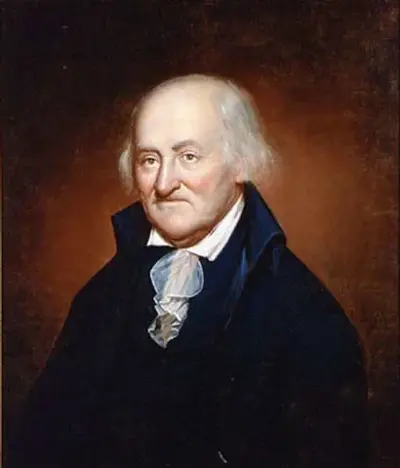
Christopher Gadsden was the principal leader of the South Carolina Patriot movement during the American Revolution and a soldier, politician and slave owner from South Carolina. He was a delegate to the Continental Congress, a brigadier general in the Continental Army during the American Revolutionary War, Lieutenant Governor of South Carolina, a merchant, and the designer of the Gadsden flag.
