David Ramsey Quotes
The repeal of a few acts of parliament, would at this time have satisfied America. But confident of victory, the ministers were deaf to petitions and remonstrances
Ramsay was discussing the events leading up to the American Revolution. He and many English historians believe that had the British repealed a few if the hated taxes and given America some representation in Parliament, the conflict could easily have been avoided. Ramsay was the first major historian of the American Revolution.
David Ramsey, 1749–1815, Historian & Member of the Continental Congress (SC), History of the American Revolution, 1807
Sourced by: Eigen's Political and Historical Quotations

This is the same man who introduced the Stamp Act 12 years before which started the whole problem in America. See {74956}.

The French were carefully watching the events in the American Colonies.

This was not quite having representation in Parliament, but the King and the Government would have none of it. We could only speculate on the Americans would have accepted this scheme if it had been offered.

Ministers refers to the Government Ministers, not to clergy.

The colonists in America had no representatives in Parliament. Galloway who opposed armed rebellion against Britain {621966} admitted that the British treatment of America was wrong but saw other solutions. It will never be known if any of them might have worked. The world would have been very different had they been tried.

This was one of the first and is considered the best of the Colonial writings against taxation without representation. Despite this, Dulany is not well known in American history because when the Revolution finally came he was a loyalist.

This quotation shows that the dissent leading to the American Revolution did not emerge suddenly in 1776 after the Battle of Bunker Hill. Dissent, sedition and even violence was documented here in 1774. Salem at the time was the second largest port in the colony and the customs tax collectors—Loyalist Americans—were run out of Salem.

Of the 13 colonies, the 3 Middle Atlantic States, were the least enthusiastic about an armed revolution against England. Jersey—Now New Jersey—was the most recalcitrant then with Benjamin Franklin’s son as Governor. See {634108} for an explanation of why that was.

He was acting as French Foreign Secretary at the time.
Americans were by no means united in wanting to take up arms against Britain. Relatively few of the loyalist quotations have come down to us, but here is one. It also illustrates why some Americans wanted complete independence: So that they could escape their debts to English merchants. Most however had more noble and unselfish motives. As a matter of fact, the American Revolution is unusual in the sense that there were so many men of substance who sacrificed much of their material wealth for the American ideal. There were also the rogues and opportunists as Galloway describes.

Fox was one of the opposition leaders who were opposed to the heavy handed policies that the British King and Government had used.

2nd Earl of Guilford. Britain had a double standard of how they would fight wars and battles. If the contention was a rebellion, more mild military means would be used. But if a foreign war, they would use all means. For example, the use of mercenaries would not be used in most rebellions. With this letter, Lord North was escalating the American Revolution into a “foreign war”. As a result, not only would mercenaries be used, but so would Indian allies whose mode of war was not as restrained as the British troops. It also allowed for emancipating slaves and inviting them to take up arms. With this quotation, the American Revolution was raised to a new and more serious military level. See {634115} for the instructions to implement this policy.

At the beginning of the dispute between America and England, the issue was the raising of internal American taxes by Parliament without any American representation in Parliament. The issue escalated and when the British began using force, independence then became the American objective.
This was the first proposal for a united American government. It provided for a “President-General” and a unicameral “Grand Council” with representation proportional to population.
The professor did not agree with these reasons and took the position that England was foolish in their use of military force. However, in America we rarely hear the English side of the dispute that led to war between England and her American colonies.
Some of the Patriots of Early America realized that the oppressions of British rule were coming from Parliament and initially took the position that only the King could make laws for the colonies and not Parliament. Therefore, they were as Englishmen challenging illegal English laws. Most American hostility was directed at Parliament and not the King. However, once there was any physical resistance, King George came down with such a heavy hand that American hatred transferred to him. For related quotes on the King/Parliament issue, see {639145}, {639144}, {639142}, {639141}, {639140}, & {639137}

The clergy of the colonies were split on the American Revolution, but those clergy who supported the revolution made a huge contribution to the individual American’s intellectual view of the legitimacy of Parliament’s making laws governing the American Colonies. The anti-British clerics called for action while other forces of colonial America urged caution.

The message was conveyed by the Secretary of State, Sir George Calvert (Lord Baltimore). Parliament and the British King were jockeying for position in their relative powers. King James took the position that Parliament could NOT make laws that affected the American Colonies. Parliament disagreed. Later, some of the American patriots would use this quotation to claim that they were only subject to the King and not to Parliament. For related quotes on the King/Parliament issue, see {639144}, {639143}, {639142}, {639141}, {639140}, & {639137}

His advice was not taken. The result was as Franklin predicted.
A number of the British Parliament were opposed to using force to get America to accept British taxation and other rules. They thought the trade with America was excellent for both, and the military advantage of the combination was superior to any force on earth. To upset that over who had the right to tax and under what conditions seemed foolish. They counseled negotiations. It was thought at the time that Lord North, the Prime Minister, was perceived to be a hard liner who would not back down regarding America. This quotation describes papers that the professor found that proved that Lord North was not one of the hawks and did not want to send troops to America. However, the King was insistent as he and his hawkish advisors felt that England and the king would be weakened if the world could see America flouting the king. It was a “domino theory” of the effect on all the colonies. North wanted to resign but the king thought him the only competent man in the kingdom who could manage the government and would not allow North’s resignation. The Prime Minister, as a loyal servant of the King, executed the policy he thought unwise and used his political skill to marshal and maintain a majority for a hard line in Parliament. Apparently, he tried to resign over America on several occasions. The world would be very different place had he successfully resigned.
The professor was lecturing to British university students about 75 years after the American Revolution. The “American War” is the term the British use for the American Revolution.
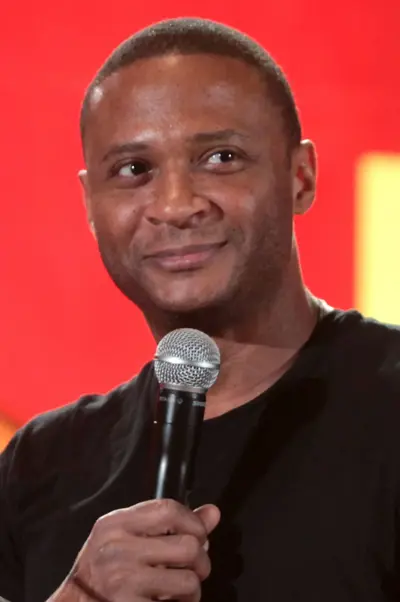
David Paul Ramsey is an American actor, director, and martial artist, best known for his roles in the CW series Arrow as John Diggle/Spartan, Anton Briggs on the Showtime TV series Dexter, and the film Mother and Child (2009) as Joseph.
