William Smyth Quotes
Lord North, after the affair at Saratoga, from the beginning of the year 1778, made every effort to procure from the king permission to resign. These efforts were continually repeated for a long period, but in vain : the king could not give up the idea of coercing America, and therefore could not part with the only man who was, he thought, fit to manage the House of Commons.
A number of the British Parliament were opposed to using force to get America to accept British taxation and other rules. They thought the trade with America was excellent for both, and the military advantage of the combination was superior to any force on earth. To upset that over who had the right to tax and under what conditions seemed foolish. They counseled negotiations. It was thought at the time that Lord North, the Prime Minister, was perceived to be a hard liner who would not back down regarding America. This quotation describes papers that the professor found that proved that Lord North was not one of the hawks and did not want to send troops to America. However, the King was insistent as he and his hawkish advisors felt that England and the king would be weakened if the world could see America flouting the king. It was a “domino theory” of the effect on all the colonies. North wanted to resign but the king thought him the only competent man in the kingdom who could manage the government and would not allow North’s resignation. The Prime Minister, as a loyal servant of the King, executed the policy he thought unwise and used his political skill to marshal and maintain a majority for a hard line in Parliament. Apparently, he tried to resign over America on several occasions. The world would be very different place had he successfully resigned.
William Smyth, 1765–1849, English Historian, Lectures on Modern History, published 1854
Sourced by: Eigen's Political and Historical Quotations

Some of the Patriots of Early America realized that the oppressions of British rule were coming from Parliament and initially took the position that only the King could make laws for the colonies and not Parliament. Therefore, they were as Englishmen challenging illegal English laws. Most American hostility was directed at Parliament and not the King. However, once there was any physical resistance, King George came down with such a heavy hand that American hatred transferred to him. For related quotes on the King/Parliament issue, see {639145}, {639144}, {639142}, {639141}, {639140}, & {639137}


Many American colonists had relatives and friends in England, and Paine argued that American independence would help and not het the English people.

This is the same man who introduced the Stamp Act 12 years before which started the whole problem in America. See {74956}.

Some of the Patriots of Early America realized that the oppressions of British rule were coming from Parliament and initially took the position that only the King could make laws for the colonies and not Parliament. Therefore, they were as Englishmen challenging illegal English laws. Most American hostility was directed at Parliament and not the King. However, once there was any physical resistance, King George came down with such a heavy hand that American hatred transferred to him. For related quotes on the King/Parliament issue, see {639145}, {639143}, {639142}, {639141}, {639140}, & {639137}

Fox was one of the opposition leaders who were opposed to the heavy handed policies that the British King and Government had used.

While the official battles of the American Revolution did not begin until 1776, parts of the American colonies were in a de facto state of rebellion and the British could not enforce their laws. See {636925} for another of the King’s statements.
The American plan was to capture Quebec and add that province to the 13 colonies. See {636940} . However, the American officers botched the invasion and did not attack as soon as they arrived when the British had almost no troops to defend Quebec.

This was written more than a year before the American Revolution Battles began. It took time to ship the men and supplies to America and the British did not handle that task with much efficiency. See {636926} for another of the King’s statements.

Wilkes was a strong advocate for the American cause—so much so that some in Parliament tried to deny him his seat in Parliament for his disloyal point of view.

See {636935}for the policy decision that triggered this order.

In the English political system the Executive Branch and the Legislative Branch are the same. In the House of Commons, the Front Benches are reserved for the Cabinet Ministers. The argument here is that when politicians become ministers, their career and party success often become more important than the welfare of the country.


2nd Earl of Guilford. Britain had a double standard of how they would fight wars and battles. If the contention was a rebellion, more mild military means would be used. But if a foreign war, they would use all means. For example, the use of mercenaries would not be used in most rebellions. With this letter, Lord North was escalating the American Revolution into a “foreign war”. As a result, not only would mercenaries be used, but so would Indian allies whose mode of war was not as restrained as the British troops. It also allowed for emancipating slaves and inviting them to take up arms. With this quotation, the American Revolution was raised to a new and more serious military level. See {634115} for the instructions to implement this policy.
The New England Restraining Act 1st Marquess of Bath
2nd Earl of Guilford. This bill cut off all trade with the American Colonies. It was meant as pressure to cease the rebellion. It did not work.
At that time, Russia and Germany were autocracy, and the ruler could simply take the English money and force the soldiers to fight in a war they had not stake in nor understood.

Some of the Patriots of Early America realized that the oppressions of British rule were coming from Parliament and initially took the position that only the King could make laws for the colonies and not Parliament. Therefore, they were as Englishmen challenging illegal English laws. Most American hostility was directed at Parliament and not the King. However, once there was any physical resistance, King George came down with such a heavy hand that American hatred transferred to him. For related quotes on the King/Parliament issue, see {639145}, {639144}, {639143}, {639141}, {639140}, & {639137}


The professor did not agree with these reasons and took the position that England was foolish in their use of military force. However, in America we rarely hear the English side of the dispute that led to war between England and her American colonies.

Earlier, his father had also castigated the ministers over their inept hard-line handling of the American Revolution. See {641505} .

Ramsay was discussing the events leading up to the American Revolution. He and many English historians believe that had the British repealed a few if the hated taxes and given America some representation in Parliament, the conflict could easily have been avoided. Ramsay was the first major historian of the American Revolution.

The French were carefully watching the events in the American Colonies.

The “abrupt departure” referred to the Tories. The phraseology is today almost comical were it not so serious a matter. This first New Hampshire Constitution was a very short one developed quickly out of necessity.
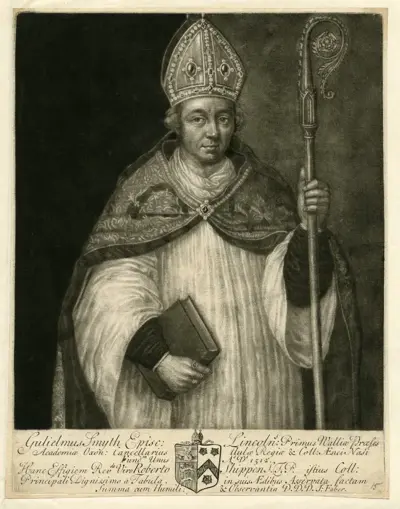
William Smyth (or Smith) was Bishop of Coventry and Lichfield from 1493 to 1496 and then Bishop of Lincoln until his death. He held political offices, the most important being Lord President of the Council of Wales and the Marches. He became very wealthy and was a benefactor of a number of institutions. He was a co-founder of Brasenose College, Oxford and endowed a grammar school in the village of his birth in Lancashire.
