Edward Coke Quotes
The law of the realm cannot be changed but by Parliament.
Coke, Edward. The Second Part of the Institutes of the Laws of England. W. Clarke and Sons, 1817, p. 619.

In the English system there is no “separation of powers”. Parliament makes the laws and its ministers execute them. The highest judges are members of Parliament (the House of Lords) as well. So Lord Bereford was in the legislature when the statute was debated and passed.

The Czar, a total autocrat, was out of touch with most of the civilized world. Under much pressure from his advisors who realized that there was much unhappiness with an autocracy, the Czar made this reform which seemed a major concession and was very much welcomed by the people. However, it had relatively little practical effect. The Duma could not make laws, they could only ratify those made by the Czar and his ministers. However, few members of the Duma were willing to vote against a measure that the Czar wanted. It had no practical effect on improving the standard of living and the economic development of a backward empire.

In the English system the checks and balances of the American system are not present. Historically in England the Monarch and the Parliament acted as checks upon each other. With a Constitutional Monarch there is no institutional check on Parliament. The checks are their restraint--respect for precedent--and the voters. The Prime Minister is a member of Parliament and has no powers other than what Parliament gives him/her. The courts in England are under Parliament and the upper house, the House of Lords is the equivalent of the highest court—but it may always be overruled by the parliament itself.

It passed with 70 percent of the vote. It was triggered by a case in New Jersey where a Muslim man assaulted and raped his wife, and the Judge found that he did not have the “Criminal Intent” because he was brought up under Sharia law which allows a husband for beat a wife and force her to have sexual relations if she refused. The New Jersey appellate court overturned the judge’s decisions, but the Oklahoma advocates for the Question argued that this initiative would be sure that no judge in Oklahoma would make a similar judicial decision.


This is the earliest surviving attempt of the Romans to formulate a legal code.

On the Fugitive Slave Act: As one of the leading American Catholic intellectuals during the 19th Century, Brownson’s opinions went far in keeping Catholics from joining the side of the abolitionists. However, just a few years later his tone would change and he would become one of the few Catholic writers to refuse to defend slavery, see {610710}. While the majority of Catholics refused to join the abolition movement, they often did so because abolitionism was closely tied to anti-Catholicism, see Gordon {611392} or Shaftesbury {611106}. Other reasons included Irish immigrants fearful of competition from Black labor and the fear of liberal individualism and social disorder, which was prevalent in 19th century Catholic thought. For a further explanation on the relationship between American Catholics and slavery, see McGreevy {612036}.

This was written shortly before he assumed the crown.


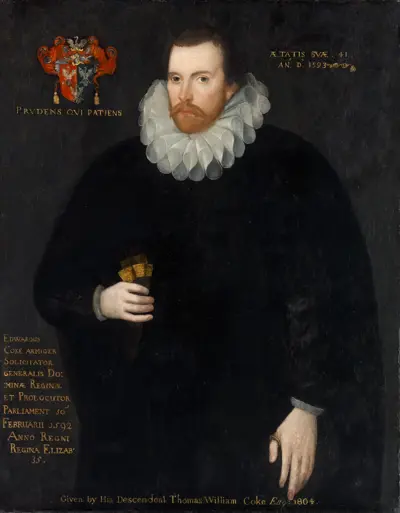
Sir Edward Coke SL was an English barrister, judge, and politician who is considered to be the greatest jurist of the Elizabethan and Jacobean eras.
