John Marshall Harlan Quotes
An act of Congress is binding upon all as much as if it were included … in the Constitution itself.
John Marshall Harlan, 1833-1911, U. S. Supreme Court Justice, Opinion in the Northern Securities Company Merger Case, March 14, 1904
Sourced by: Eigen's Political and Historical Quotations


In the English system there is no “separation of powers”. Parliament makes the laws and its ministers execute them. The highest judges are members of Parliament (the House of Lords) as well. So Lord Bereford was in the legislature when the statute was debated and passed.

On the Fugitive Slave Act: As one of the leading American Catholic intellectuals during the 19th Century, Brownson’s opinions went far in keeping Catholics from joining the side of the abolitionists. However, just a few years later his tone would change and he would become one of the few Catholic writers to refuse to defend slavery, see {610710}. While the majority of Catholics refused to join the abolition movement, they often did so because abolitionism was closely tied to anti-Catholicism, see Gordon {611392} or Shaftesbury {611106}. Other reasons included Irish immigrants fearful of competition from Black labor and the fear of liberal individualism and social disorder, which was prevalent in 19th century Catholic thought. For a further explanation on the relationship between American Catholics and slavery, see McGreevy {612036}.


Franklin and many Americans believed that the Colonial Legislatures were independent legislative bodies and need not follow the instructions of the Colonial Governors even though they came from the British Government in London. Franklin replied "This is new doctrine to me."" 1st Marquess of Stafford


This concept of balance of power and the equal role of the judiciary is actually quite rare. Even in Parliamentary democracies the parliament can override any court interpretation. In England, the upper legislative house, the House of Lords, actually serves as the nation’s highest or supreme court. And these “Law Lords” can override all regular judicial bodies.

This is the earliest surviving attempt of the Romans to formulate a legal code.


The view that the Supreme Court was the final arbiter of constitutional controversies was not held in early America.

In 1949 the NATO treaty was signed. There was concern that a phrase in the treaty authorizing signatories to take "such action as it deems necessary, including the use of armed force" would undermine Congress's powers:


In the English system the checks and balances of the American system are not present. Historically in England the Monarch and the Parliament acted as checks upon each other. With a Constitutional Monarch there is no institutional check on Parliament. The checks are their restraint--respect for precedent--and the voters. The Prime Minister is a member of Parliament and has no powers other than what Parliament gives him/her. The courts in England are under Parliament and the upper house, the House of Lords is the equivalent of the highest court—but it may always be overruled by the parliament itself.


When asked for his position on abortion, candidate Bush answered:. Nine years later, President Bush proposed a constitutional amendment to overturn the Supreme Court's ruling on flag desecration.


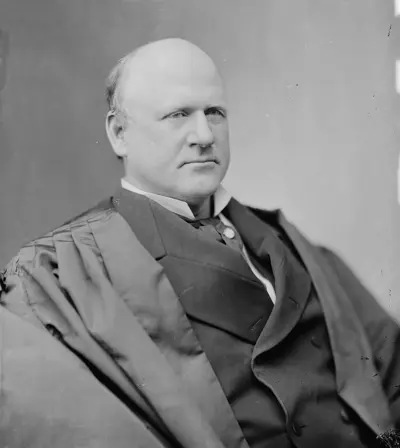
John Marshall Harlan was an American lawyer and politician who served as an associate justice on the U.S. Supreme Court. He is often called "The Great Dissenter" due to his many dissents in cases that restricted civil liberties, including the Civil Rights Cases and Plessy v. Ferguson. Many of Harlan's views expressed in his notable dissents would become the official view of the Supreme Court starting from the 1950s Warren Court and onward. His grandson John Marshall Harlan II was also a Supreme Court justice.
