Granville Leveson-Gower Quotes
You Americans have wrong ideas of the nature of your constitution. The instructions given to colonial governors were the law of the land and colonial legislatures have no right to ignore them.
Franklin and many Americans believed that the Colonial Legislatures were independent legislative bodies and need not follow the instructions of the Colonial Governors even though they came from the British Government in London. Franklin replied "This is new doctrine to me."" 1st Marquess of Stafford
Granville Leveson-Gower, 1721–1803, , British Member of Parliament (Tory), Member of the Cabinet, President of the Privy Council, Statement to Benjamin Franklin in London, 1757
Sourced by: Eigen's Political and Historical Quotations

In the English system the checks and balances of the American system are not present. Historically in England the Monarch and the Parliament acted as checks upon each other. With a Constitutional Monarch there is no institutional check on Parliament. The checks are their restraint--respect for precedent--and the voters. The Prime Minister is a member of Parliament and has no powers other than what Parliament gives him/her. The courts in England are under Parliament and the upper house, the House of Lords is the equivalent of the highest court—but it may always be overruled by the parliament itself.

Some of the Patriots of Early America realized that the oppressions of British rule were coming from Parliament and initially took the position that only the King could make laws for the colonies and not Parliament. Therefore, they were as Englishmen challenging illegal English laws. Most American hostility was directed at Parliament and not the King. However, once there was any physical resistance, King George came down with such a heavy hand that American hatred transferred to him. For related quotes on the King/Parliament issue, see {639145}, {639144}, {639142}, {639141}, {639140}, & {639137}

The colonists in America had no representatives in Parliament. Galloway who opposed armed rebellion against Britain {621966} admitted that the British treatment of America was wrong but saw other solutions. It will never be known if any of them might have worked. The world would have been very different had they been tried.


Though not very dramatic or succinct, this is a very important quotation in American History. The original drafters of the Constitution concentrated on limiting the powers of the executive—the role of the King. But the Congress had no limits placed on them. In Britain, to this day, the Parliament can do whatever they wish as there is no restraint on them other than their prudence and reasonableness. Madison used the example of the Alien and Sedition Acts—huge infringements on the rights of Americans—to show why the legislative branch must also be more restrained and limited. And that was the logic behind adding the Bill of Rights to our Constitutions.


See John Marshall's later (1803) use of the concept and term "repugnant." {606483}

Jefferson’s fears were later reinforced by John Marshall in Marbury v. Madison {606468}


This was the first proposal for a united American government. It provided for a “President-General” and a unicameral “Grand Council” with representation proportional to population.


This concept of balance of power and the equal role of the judiciary is actually quite rare. Even in Parliamentary democracies the parliament can override any court interpretation. In England, the upper legislative house, the House of Lords, actually serves as the nation’s highest or supreme court. And these “Law Lords” can override all regular judicial bodies.

Hatch was the chairman of the Senate Judiciary Committee at the time.


The message was conveyed by the Secretary of State, Sir George Calvert (Lord Baltimore). Parliament and the British King were jockeying for position in their relative powers. King James took the position that Parliament could NOT make laws that affected the American Colonies. Parliament disagreed. Later, some of the American patriots would use this quotation to claim that they were only subject to the King and not to Parliament. For related quotes on the King/Parliament issue, see {639144}, {639143}, {639142}, {639141}, {639140}, & {639137}

Note that in addition to getting rid of the authority of the King, New York—over a decade before the Bill of Rights and the First Amendment, provided for a ban on an established church or favoring one Christian sect over another. Even then New York was a multi religious and multi ethnic society with its strong Dutch tradition along with the English tradition. New York did not go as far as the First Amendment would do later in terms of freedom of religion. NY only mentioned Christian sects. However they did implement separation of church and state and an establishment clause. See {621429} for another clause that ensures separation of church and state.

This was not quite having representation in Parliament, but the King and the Government would have none of it. We could only speculate on the Americans would have accepted this scheme if it had been offered.

This was the case where the Supreme Court reversed its earlier opinion and declared the Income Tax Unconstitutional.
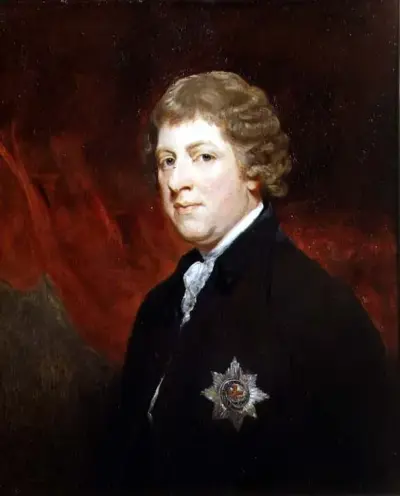
Granville Leveson-Gower, 1st Marquess of Stafford, PC, known as Viscount Trentham from 1746 to 1754 and as The Earl Gower from 1754 to 1786, was a British politician from the Leveson-Gower family.
