Samuel Chase Quotes
If the Federal Legislature should, at any time, pass a Law contrary to the Constitution of the United States, such Law would be void.
Samuel Chase, 1741-1811, American revolutionary leader and U.S. Supreme Court Justice, Instructions to Pennsylvania Grand Jury, April 12, 1800
Sourced by: Eigen's Political and Historical Quotations

Marshall did not crate this concept or some its phraseology out of whole cloth. See Rufus King {610245} for a Constitutional Convention basis for the statement.

In a 1949 dissenting opinion in Terminiello v. Chicago Jackson claimed the majority view would “convert the Bill of Rights into a suicide pact.”


See John Marshall's later (1803) use of the concept and term "repugnant." {606483}
Marshall is famous for, as Chief Justice, establishing the principle that the Judiciary can override Congress and the Executive in determining Constitutionality. However, as this quotation illustrates this principle had been discussed in open debate on the ratification of the Constitution. It was not simply a grab for power by a Chief justice; he uttered this quotation long before he ever suspected he would be a judge but actually spent much of his career in the executive and legislative branch of government.


When asked for his position on abortion, candidate Bush answered:. Nine years later, President Bush proposed a constitutional amendment to overturn the Supreme Court's ruling on flag desecration.


One of the conundrums of our constitutional system is who has the last word as to what the Constitution means. Essentially it is the judicial branch headed by the Supreme Court. But there are those who believe that the current popular majority should have a say in what is or is not constitutional. If so the legislative branch should have the last word. Still others say that the President is the only person elected by ALL the people, so his opinion most reflects the will of the public. And then there are most who argue that the Constitutional system was created just to avoid the power of currently popular majorities, and the courts should decide based on the Constitution itself. So the statement has very little meaning except that Phillips thinks that the courts have too much power. Whoever gets to decide what is or is not Constitutional will be accused of being “over” the Constitution by those who don’t like the decisions. In our system, that is the courts.

The view that the Supreme Court was the final arbiter of constitutional controversies was not held in early America.


President John Adams Alien and Sedition Acts were amongst the worst laws ever passed in America. It totally violated the First Amendment but at the time the Supreme Court had not ruled on the laws which prohibited criticizing the government. Ironically, it was Adams’s son, John Quincy Adams who finally led the repeal effort.


The president was asked if he supported the Supreme court's school desegregation decision:
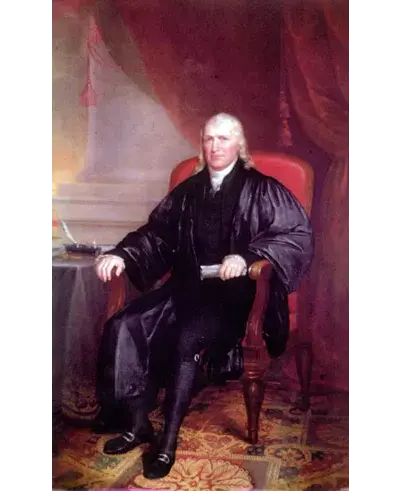
Samuel Chase was an Associate Justice of the United States Supreme Court and a signatory to the United States Declaration of Independence as a representative of Maryland. He was impeached by the House of Representatives on grounds of letting his partisan leanings affect his court decisions but was acquitted by the Senate and remained in office.
