John Adams Quotes
I was very strenuous for retaining and insisting on it [law of nature], as a resource to which we might be driven by Parliament much sooner than we were aware.
Adams, John. The Works of John Adams, Second President of the United States. Vol. 2. Boston: Charles C. Little and James Brown, 1850. p. 374.

In the English system the checks and balances of the American system are not present. Historically in England the Monarch and the Parliament acted as checks upon each other. With a Constitutional Monarch there is no institutional check on Parliament. The checks are their restraint--respect for precedent--and the voters. The Prime Minister is a member of Parliament and has no powers other than what Parliament gives him/her. The courts in England are under Parliament and the upper house, the House of Lords is the equivalent of the highest court—but it may always be overruled by the parliament itself.

In the English system there is no “separation of powers”. Parliament makes the laws and its ministers execute them. The highest judges are members of Parliament (the House of Lords) as well. So Lord Bereford was in the legislature when the statute was debated and passed.


At that time the king not only called Parliament into session but terminated the session and set the agenda. In this case, Charles I didn't want royal activities regarding taxation to be debated much less legislated upon. As the speaker rose to leave the chair, he was forcibly held in place by two members as the house voted by acclamation to condemn the taxes and even the merchants who paid them. This was perhaps the first legislative tax revolt in history.

He was considered Massachusetts’ greatest Colonial orator.


The Governor had warned the Board of Trade about the American reaction to the Stamp Act. He took the position that is was unconstitutional in the sense that it was contrary to Magna Carter. His and other warnings were ignored.


The wooden mace, covered with gold leaf and topped by a gold crown, symbolizes the authority of the King or Queen of Great Britain. The mace rests on the Treasury bench in the House of Commons during each session of Parliament.


Several years before the Battle of Bunker Hill, revolutionary activity had already broken out in the American colonies—See {634132} for an example. This law gave the British authorities much more “clout” in dealing with the “seditious” American activities. It protected English law enforcement officials from being tried in local Colonial courts for murder or assault in putting down insurrections. George Washington and other Patriots were outraged over this law. See {634131}.

Fox was one of the opposition leaders who were opposed to the heavy handed policies that the British King and Government had used.

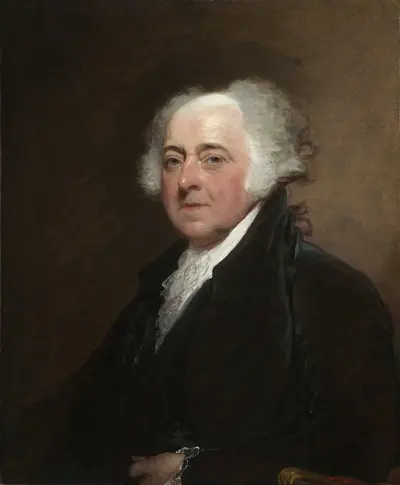
John Adams Jr. was an American statesman, attorney, diplomat, writer, and Founding Father who served as the second president of the United States from 1797 to 1801. Before his presidency, he was a leader of the American Revolution that achieved independence from Great Britain, and he served as the first vice president of the United States. Adams was a dedicated diarist and regularly corresponded with many important figures in early American history, including his wife and adviser Abigail Adams and Thomas Jefferson.
