Board of Trade Quotes
The Stamp Act is an act of parliament, and as such ought to be observed. This house, sir, has too great a reverence for the supreme legislature of the nation, to question its just authority: it by no means appertains to us to presume to adjust the boundaries of the power of parliament
The Governor had warned the Board of Trade about the American reaction to the Stamp Act. He took the position that is was unconstitutional in the sense that it was contrary to Magna Carter. His and other warnings were ignored.
Board of Trade, British Governing Body for Colonial America, Letter to Massachusetts Governor Francis Bernard, October 25, 1765
Sourced by: Eigen's Political and Historical Quotations

This is one of the most fascinating documents of the American Revolution. The British Parliament had passed the very unpopular Stamp Act, a form of tax that required a government stamp, which had to be paid for, to be placed on all legal documents from leases to wills. Governor Bernard opposed the Stamp Act and was trying to have the Colonies exempted (See {613881}). The assembly while apparently advocating obedience to the law and warning the Governor of the possibility of Colonists boycotting legal instruments, actually laid out the strategy and the legal defense for a boycott and provided a revolutionary blueprint for colonists to follow.

In the English system the checks and balances of the American system are not present. Historically in England the Monarch and the Parliament acted as checks upon each other. With a Constitutional Monarch there is no institutional check on Parliament. The checks are their restraint--respect for precedent--and the voters. The Prime Minister is a member of Parliament and has no powers other than what Parliament gives him/her. The courts in England are under Parliament and the upper house, the House of Lords is the equivalent of the highest court—but it may always be overruled by the parliament itself.

The colonists in America had no representatives in Parliament. Galloway who opposed armed rebellion against Britain {621966} admitted that the British treatment of America was wrong but saw other solutions. It will never be known if any of them might have worked. The world would have been very different had they been tried.

The Stamp Act had caused much consternation among the colonies. The Continental Congress had gone into session to draft a petition to the King asking that the Act not be enforced. This letter described the chalenge before them. See {589421} for one of the more contentious passages the delegates had to work out.

He was considered Massachusetts’ greatest Colonial orator.

In the English system there is no “separation of powers”. Parliament makes the laws and its ministers execute them. The highest judges are members of Parliament (the House of Lords) as well. So Lord Bereford was in the legislature when the statute was debated and passed.

In this instance Pitt and a few others were arguing against the Stamp Act. They were accused of fomenting rebellion by advocating the same position of the rebellious colonists. Criticism of government policy is often castigated by claiming that enemies of the nation will take aid and comfort by the criticism and be encouraged in their conflict. In this case it was the Stamp Act. In more modern times those members of Congress in America who opposed the Iraq War and wanted withdrawal of U. S. troops were accused of aiding, comforting and encouraging the enemy. It is the favorite tactic of governments under attack for its foreign policy.

At that time the king not only called Parliament into session but terminated the session and set the agenda. In this case, Charles I didn't want royal activities regarding taxation to be debated much less legislated upon. As the speaker rose to leave the chair, he was forcibly held in place by two members as the house voted by acclamation to condemn the taxes and even the merchants who paid them. This was perhaps the first legislative tax revolt in history.

Washington, though a military officer at the time, was very concerned with protecting the rights of citizens from abuse by the military for he had seen much of the abuse. The third amendment for example was later written to protect people from the military. The Constitution also requires that Congress make such rules for the military. Note that Washington, our first senior military officer at the time, wanted Congress to make detailed rules for the conduct of soldiers. In the 20th and 21st century, as the imperial presidency developed, there was a political view that only the military officers and the Commander in Chief should make the rules and regulations for the soldiers. However, there was no question but that the Founding Fathers saw this as a legislative branch function. Congress and Presidents have contested for this power every since.

Franklin and many Americans believed that the Colonial Legislatures were independent legislative bodies and need not follow the instructions of the Colonial Governors even though they came from the British Government in London. Franklin replied "This is new doctrine to me."" 1st Marquess of Stafford

This was one of the first elucidations of this principle which became so important for the American union and Revolution. The 1754 debate was over Franklin's public effort for a Colonial Federation (see {37005}, {37006}, & {583424}). Shirley liked the idea but thought that the King of England should appoint the members of a Colonial Congress. This was Franklin's counter, arguing that each colony should elect its own members.


The clergy of the colonies were split on the American Revolution, but those clergy who supported the revolution made a huge contribution to the individual American’s intellectual view of the legitimacy of Parliament’s making laws governing the American Colonies. The anti-British clerics called for action while other forces of colonial America urged caution.
At the beginning of the dispute between America and England, the issue was the raising of internal American taxes by Parliament without any American representation in Parliament. The issue escalated and when the British began using force, independence then became the American objective.

This is the same man who introduced the Stamp Act 12 years before which started the whole problem in America. See {74956}.

Some of the Patriots of Early America realized that the oppressions of British rule were coming from Parliament and initially took the position that only the King could make laws for the colonies and not Parliament. Therefore, they were as Englishmen challenging illegal English laws. Most American hostility was directed at Parliament and not the King. However, once there was any physical resistance, King George came down with such a heavy hand that American hatred transferred to him. For related quotes on the King/Parliament issue, see {639145}, {639144}, {639142}, {639141}, {639140}, & {639137}

Though not very dramatic or succinct, this is a very important quotation in American History. The original drafters of the Constitution concentrated on limiting the powers of the executive—the role of the King. But the Congress had no limits placed on them. In Britain, to this day, the Parliament can do whatever they wish as there is no restraint on them other than their prudence and reasonableness. Madison used the example of the Alien and Sedition Acts—huge infringements on the rights of Americans—to show why the legislative branch must also be more restrained and limited. And that was the logic behind adding the Bill of Rights to our Constitutions.
The patriot legal position did shift over time. Like many grass roots political movements, the Americans had morality and justice on their side and did not think through the implications of their arguments when they opposed the Stamp Act. After the Revolution Leonard had to leave and he went to English Bermuda where he was rewarded for his loyalty with the position of Chief Justice.


Ramsay was discussing the events leading up to the American Revolution. He and many English historians believe that had the British repealed a few if the hated taxes and given America some representation in Parliament, the conflict could easily have been avoided. Ramsay was the first major historian of the American Revolution.

It was repealed the next year, but much damage had been done to the relationship between the American Colonists and the mother country. It set the tone for American transition to a desire for independence. . Fox, a conservative on most issues was an absolute radical on the issue of America. To aggravate the hawks in parliament, he used to dress in the colors of George Washington’s uniform to show his support once the war broke out.

The message was conveyed by the Secretary of State, Sir George Calvert (Lord Baltimore). Parliament and the British King were jockeying for position in their relative powers. King James took the position that Parliament could NOT make laws that affected the American Colonies. Parliament disagreed. Later, some of the American patriots would use this quotation to claim that they were only subject to the King and not to Parliament. For related quotes on the King/Parliament issue, see {639144}, {639143}, {639142}, {639141}, {639140}, & {639137}

It was not published and distributed widely until 1774. For related quotes on the King/Parliament issue, see {639145}, {639144}, {639142}, {639141}, {639140}, & {639137}
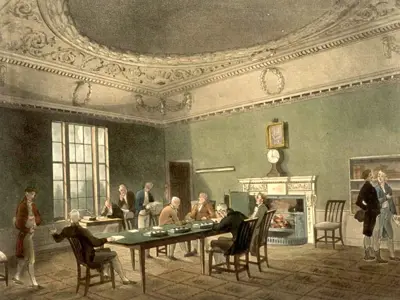
The Board of Trade is a British government body concerned with commerce and industry, currently within the Department for International Trade. Its full title is The Lords of the Committee of the Privy Council appointed for the consideration of all matters relating to Trade and Foreign Plantations, but is commonly known as the Board of Trade, and formerly known as the Lords of Trade and Plantations or Lords of Trade, and it has been a committee of the Privy Council of the United Kingdom. The board has gone through several evolutions, beginning with extensive involvement in colonial matters in the 17th Century, to powerful regulatory functions in the Victorian Era, to virtually being dormant in the last third of 20th century. In 2017, it was revitalised as an advisory board headed by the International Trade Secretary who has nominally held the title of President of the Board of Trade, and who at present is the only privy counsellor of the board, the other members of the present board filling roles as advisers.
