Benjamin Franklin Quotes
It is supposed an undoubted right of Englishmen not to be taxed but by their own consent given through their representatives.
This was one of the first elucidations of this principle which became so important for the American union and Revolution. The 1754 debate was over Franklin's public effort for a Colonial Federation (see {37005}, {37006}, & {583424}). Shirley liked the idea but thought that the King of England should appoint the members of a Colonial Congress. This was Franklin's counter, arguing that each colony should elect its own members.
Benjamin Franklin, 1706-1790, Member of the Continental Congress & the Constitutional Convention, Governor of Pennsylvania, President of the Pennsylvania Assembly, U.S. Minister to France, Postmaster General of the American Colonies, Open letter debate with Massachusetts Colonial Governor William Shirley, September 1754
Sourced by: Eigen's Political and Historical Quotations

Coping with the French and their Indian allies was a problem for all the American colonies and Franklin was the strongest voice for some kind of union or federation for not only mutual defense, but to facilitate commerce by having some uniform currency and basic laws of trade to promote the mutual economy. The 6 Iroquois tribes had years ago formed the Iroquois nation complete with a formal constitution that maintained tribal identity but also enabled unified action if any were attacked and provided mutual assistance on a number of economic areas. They became the strongest, wealthiest, healthiest and most sophisticated nation of North America before European colonization and unlike many other Indians with a few exceptions–see {21747} for an example–got along very well with the English colonists. Franklin was a great admirer and wanted to use some of their Constitutional provisions in the American Constitution 36 years later, but at the time tried to embarrass many American's into forming a union with language like this quote. Actually, he did not think of them as savages at all, but most Americans who knew little about them did, and Franklin was never above using people's prejudices to get them to buy into one of his political ideas.

The American Revolution’s ideas spread. This Cahier was the consensus of the Clergy of Blois in 1789. There were cahiers of several provinces of France—some by the clergy, some by the nobles. What is fascinating is the emergence of many of the pre-Revolutionary French concepts. The example of the American revolution and its principles was known throughout the educated classes of France.


The colonists in America had no representatives in Parliament. Galloway who opposed armed rebellion against Britain {621966} admitted that the British treatment of America was wrong but saw other solutions. It will never be known if any of them might have worked. The world would have been very different had they been tried.
Some of the Patriots of Early America realized that the oppressions of British rule were coming from Parliament and initially took the position that only the King could make laws for the colonies and not Parliament. Therefore, they were as Englishmen challenging illegal English laws. Most American hostility was directed at Parliament and not the King. However, once there was any physical resistance, King George came down with such a heavy hand that American hatred transferred to him. For related quotes on the King/Parliament issue, see {639145}, {639144}, {639142}, {639141}, {639140}, & {639137}

This is the same man who introduced the Stamp Act 12 years before which started the whole problem in America. See {74956}.


The Governor had warned the Board of Trade about the American reaction to the Stamp Act. He took the position that is was unconstitutional in the sense that it was contrary to Magna Carter. His and other warnings were ignored.
This was in effect a “Real Estate Promotional Document. Democracy, self government, and the right to set their own taxes were major selling points. See {611572} and {611571} for other “features.”


Sealed under duress and later repudiated by the King with Papal assistance. This, before Magna Carta, was a common occurrence especially by the military. In many countries, even in modern times, this restriction does not exist. The resentment developed from this practice was a major factor in the Chinese people turning in the Nationalist government in favor of the Communists after WWII. Mao Tse-Tung's soldiers always paid for what they took or used if not donated freely. Not so Chiang's military." John Lackland
The arbitrary tax that Britain had imposed in tea in America was protested, not only in Boston. This meeting and its report was held the day before the Boston Tea Party. There was concern and distress in many parts of the colonies.


At the beginning of the dispute between America and England, the issue was the raising of internal American taxes by Parliament without any American representation in Parliament. The issue escalated and when the British began using force, independence then became the American objective.

Though not very dramatic or succinct, this is a very important quotation in American History. The original drafters of the Constitution concentrated on limiting the powers of the executive—the role of the King. But the Congress had no limits placed on them. In Britain, to this day, the Parliament can do whatever they wish as there is no restraint on them other than their prudence and reasonableness. Madison used the example of the Alien and Sedition Acts—huge infringements on the rights of Americans—to show why the legislative branch must also be more restrained and limited. And that was the logic behind adding the Bill of Rights to our Constitutions.

The colony created out of a political dispute with the Massachusetts Bay Colony, was created when in June of 1636, Hooker and his entire congregation, driving their cattle and carting their belongings, left Massachusetts and set out for the Connecticut Valley, founding Hartford and a new colony. The following year the constitution was written and ratified. It was in many ways similar to the Massachusetts legal system except that it was written and could not easily be changed. However, there were two important historical innovations. First, while Massachusetts had limited voting rights to members in good standing of the Puritan Church, The Fundamental Orders provided for separation of church and state and allowed others (males only) to vote as well. See {624151}. The other innovation was that this appears to be the first introduction of term limits in America. It limited the Governor to a single term, unlike Massachusetts where Governor Winthrop was a fixture.

This quotation is very important because it illustrates in the first of our great national political debates, the same views held by extreme, right wing anti-government, and Tea Party adherents regarding government in general and taxation in particular. See {634235} and {634234} for more of his arguments at the Ratification Convention.

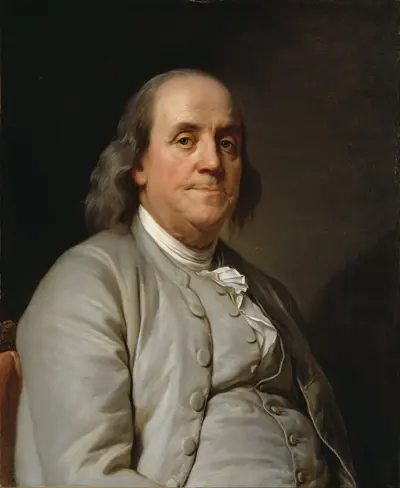
- Born: January 17, 1706
- Died: April 17, 1790
- Nationality: American
- Profession: Politician
Benjamin Franklin FRS FRSA FRSE was one of the Founding Fathers of the United States. A polymath, he was a leading writer, printer, political philosopher, politician, Freemason, postmaster, scientist, inventor, humorist, civic activist, statesman, and diplomat. As a scientist, he was a major figure in the American Enlightenment and the history of physics for his discoveries and theories regarding electricity. As an inventor, he is known for the lightning rod, bifocals, and the Franklin stove, among other inventions. He founded many civic organizations, including the Library Company, Philadelphia's first fire department, and the University of Pennsylvania.
