Thomas Hooker Quotes
Fundamental Orders of Connecticut
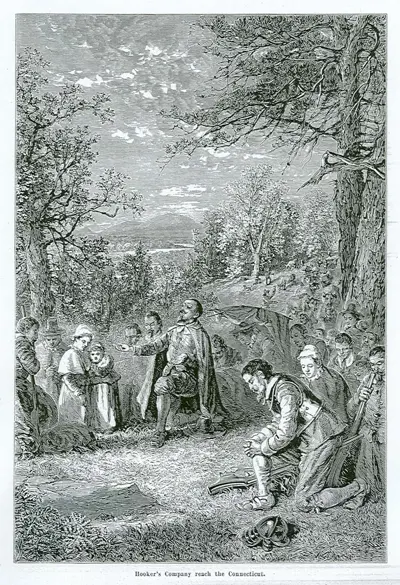
The colony created out of a political dispute with the Massachusetts Bay Colony, was created when in June of 1636, Hooker and his entire congregation, driving their cattle and carting their belongings, left Massachusetts and set out for the Connecticut Valley, founding Hartford and a new colony. The following year the constitution was written and ratified. It was in many ways similar to the Massachusetts legal system except that it was written and could not easily be changed. However, there were two important historical innovations. First, while Massachusetts had limited voting rights to members in good standing of the Puritan Church, The Fundamental Orders provided for separation of church and state and allowed others (males only) to vote as well. See {624151}. The other innovation was that this appears to be the first introduction of term limits in America. It limited the Governor to a single term, unlike Massachusetts where Governor Winthrop was a fixture.
Thomas Hooker, 1586–1647, Puritan Minister & Founder of the Hartford Connecticut Colony, Constitution for the Connecticut Colony (The World’s First Written Constitution), 1637
Sourced by: Eigen's Political and Historical Quotations

Hooker had been a citizen of the Massachusetts Bay Colony when a disagreement broke out that would have profound implications for America. Governor Winthrop wanted to limit the right of voting to members in good standing of the Puritan Church. Hooker, although a Puritan minister himself, dissented and insisted that suffrage be for all regardless of religious affiliation. In June of 1636, Hooker and his entire congregation, driving their cattle and carting their belongings, left Massachusetts and set out for the Connecticut Valley, founding Hartford and a new colony.


The message was conveyed by the Secretary of State, Sir George Calvert (Lord Baltimore). Parliament and the British King were jockeying for position in their relative powers. King James took the position that Parliament could NOT make laws that affected the American Colonies. Parliament disagreed. Later, some of the American patriots would use this quotation to claim that they were only subject to the King and not to Parliament. For related quotes on the King/Parliament issue, see {639144}, {639143}, {639142}, {639141}, {639140}, & {639137}

Some of the Patriots of Early America realized that the oppressions of British rule were coming from Parliament and initially took the position that only the King could make laws for the colonies and not Parliament. Therefore, they were as Englishmen challenging illegal English laws. Most American hostility was directed at Parliament and not the King. However, once there was any physical resistance, King George came down with such a heavy hand that American hatred transferred to him. For related quotes on the King/Parliament issue, see {639145}, {639144}, {639142}, {639141}, {639140}, & {639137}

This was one of the first elucidations of this principle which became so important for the American union and Revolution. The 1754 debate was over Franklin's public effort for a Colonial Federation (see {37005}, {37006}, & {583424}). Shirley liked the idea but thought that the King of England should appoint the members of a Colonial Congress. This was Franklin's counter, arguing that each colony should elect its own members.

Ingersoll was considered to be the greatest orator and political thinker of his day, but his overt atheistic views curtailed his elected political career.

Lopez had come from Portugal and had been living in Rhode Island for 9 years and was active in shipping, whaling and candle making. He, and another Jew, Issac Elizer, petitioned the Rhode Island Superior Court for naturalization and citizenship rights. The court turned them down and they appealed to the Rhode Island Assembly—then not only the legislature but the highest court in the colony. The assembly came up with a compromise. The Jews were allowed to continue to live and work in Rhode Island but they could not hold public office or vote. They told the Superior Court to reconsider the case however as Lopez and Elizer were model citizens—but for religion just the kind the colony wanted. This case and many others were known to the founding fathers who were determined to put a stop to the practice of conditioning voting and office holding rights on adhering to the particular sect of the majority of the colony. Lopez and Elizer then appealed again to the Superior Court.


This resolution was the trigger that began the debate which became the Declaration of Independence.
The code provided for trial by jury and for proportional taxation on property. It was called “The Duke’s Laws” in recognition of the English Duke of York from whom authority in the colony then derived as the English supplanted the Dutch.
While he thought a people had a right to have a king, he also made radical statements regarding the British and their monarchy. See {633999}. The right of a people to have a king was also stated by the President of Harvard in that period— {633996}.

Frederick the Great. He and many other Europeans thought that England had been so preoccupied with the American rebellion that she was ignoring Europe and other traditional foreign policy interests of theirs.

“There” referred to the new American Colonies. He was advocating mobilizing the poor and destitute of England and sending them to America to provide manpower for a needed workforce and to be soldiers in the event of wars. The poor have historically been used indiscriminately for military manpower needs until Post WWII America where the military technology began to require minimum standards of intelligence and literacy. With the all volunteer military and higher standards, the majority of the military in America has been from the lower socioeconomic classes.
He was pushing the idea of getting the poor and destitute of England to go to the American colonies where a labor force was needed. “Fry” was a term for offspring — children.
_0_thumbnail_47x47.jpg)

Ministers refers to the Government Ministers, not to clergy.


- Born: July 5, 1586
- Died: July 7, 1647
- Nationality: English
- Profession: Congregationalist Minister
Thomas Hooker was a prominent English colonial leader, who founded the Colony of Connecticut after dissenting with Puritan leaders in Massachusetts. He was known as an outstanding speaker and an advocate of universal Christian suffrage.
