Benjamin Franklin Quotes
It would be a very strange thing if six nations of ignorant savages [the Iroquois] could be capable or forming a scheme for such a union ... and yet that a like union should be impracticable for ten or a dozen English colonies, to whom it is more necessary.
Coping with the French and their Indian allies was a problem for all the American colonies and Franklin was the strongest voice for some kind of union or federation for not only mutual defense, but to facilitate commerce by having some uniform currency and basic laws of trade to promote the mutual economy. The 6 Iroquois tribes had years ago formed the Iroquois nation complete with a formal constitution that maintained tribal identity but also enabled unified action if any were attacked and provided mutual assistance on a number of economic areas. They became the strongest, wealthiest, healthiest and most sophisticated nation of North America before European colonization and unlike many other Indians with a few exceptions–see {21747} for an example–got along very well with the English colonists. Franklin was a great admirer and wanted to use some of their Constitutional provisions in the American Constitution 36 years later, but at the time tried to embarrass many American's into forming a union with language like this quote. Actually, he did not think of them as savages at all, but most Americans who knew little about them did, and Franklin was never above using people's prejudices to get them to buy into one of his political ideas.
Benjamin Franklin, 1706-1790, Member of the Continental Congress & the Constitutional Convention, Governor of Pennsylvania, President of the Pennsylvania Assembly, U.S. Minister to France, Postmaster General of the American Colonies, Letter to James Parker, 1751
Sourced by: Eigen's Political and Historical Quotations

The French were at the time much more aggressive traders and the Iroquois Nation had fixed agrarian communities and were very involved in trading. And the French King controlled the military in North America and had ordered the construction of a series of forts to protect their trading interests from the British. However, military affairs in British Colonial America were left to the colonies, all of whom were very parochial and didn't want to raise taxes for much. Benjamin Franklin, one of the Colonial delegates at the conference, had been urging some kind of a federation of the American colonies–{583422} & {35007}. He had used the Iroquois as a model as the 6 tribes had a unified military among other common governmental aspects. However, no colony wanted to give up any of its sovereignty to others or a Federation. Under the prodding of Franklin and the Iroquois, 7 Colonial Delegations agreed to a plan, mostly devised by Franklin�the Albany Plan�for a centralized governmental structure. The Albany Plan was never implemented but it started the process of unification discussion of the Colonies which would stimulate the Articles of Confederation and the Continental Congress.

This was one of the first elucidations of this principle which became so important for the American union and Revolution. The 1754 debate was over Franklin's public effort for a Colonial Federation (see {37005}, {37006}, & {583424}). Shirley liked the idea but thought that the King of England should appoint the members of a Colonial Congress. This was Franklin's counter, arguing that each colony should elect its own members.


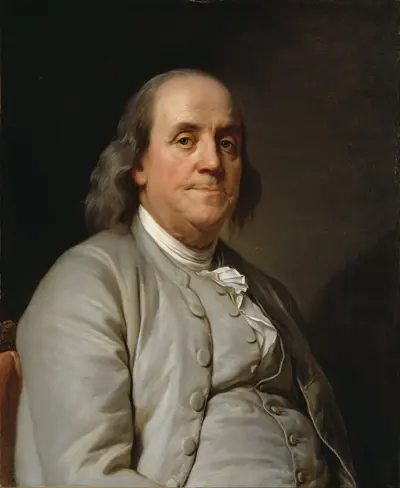
Benjamin Franklin FRS FRSA FRSE was one of the Founding Fathers of the United States. A polymath, he was a leading writer, printer, political philosopher, politician, Freemason, postmaster, scientist, inventor, humorist, civic activist, statesman, and diplomat. As a scientist, he was a major figure in the American Enlightenment and the history of physics for his discoveries and theories regarding electricity. As an inventor, he is known for the lightning rod, bifocals, and the Franklin stove, among other inventions. He founded many civic organizations, including the Library Company, Philadelphia's first fire department, and the University of Pennsylvania.
