DeWitt Clinton Quotes
It becomes not us, if we value the characters of our forefathers; it becomes not the civilized nations of Europe who have had American possessions, to inveigh against the merciless conduct of the savage (Scalping). His appetite for blood was sharpened and whetted by European instigation, and his cupidity was enlisted on the side of cruelty by every temptation. In the wars between France and England and their colonies, their Indian allies were entitled to a premium for every scalp of an enemy. In the war preceding 1703, the government of Massachusetts gave twelve pounds for every Indian scalp; in that year the premium was raised to forty pounds, but in 1722 it was augmented to one hundred pounds.
Clinton was a founder of the society and considered an excellent historian. When giving this presentation he had documentation and academic references for each of the statements.
DeWitt Clinton, 1769-1828, Vice President of the United States (NY), U. S. Senator (Anti-Federalist Republican, NY), Mayor of New York City, Governor of New York, Peace Party candidate for President of the United States, “Father of Free Public Schools", Speech to the New York Historical Society, December 6, 1811
Sourced by: Eigen's Political and Historical Quotations

This argument, condemned by many Englishmen, was essentially, it is moral to do whatever you God made you able to do a principle that was refuted in Christianity, Judiasm and most other religions. See {620562} for Clinton’s history of white encouragement of Indian scalping.

The Indian allies of the French scalped some American colonists which for some whites was akin to the modern reaction to terrorist atrocities. The British and Americans then justified the scalping of their Indian allies as simple retaliation. While Indians had scalped before the whites ever came, the whites accelerated the practice. There was an economic element to scalping. The French “paid” their Indian allies in arms, blankets, trinkets and alcohol by the scalp as it was a crude way of “performance measurement.” Not to be outdone, the English adopted the same custom with the French allied Indians as targets. In North Carolina, for example, the “volunteer” rangers were paid the enormous rate of 10 pounds a scalp.

The French had launched a sneak attack on the English settlement at Schenectady, NY. The English had not provided enough security to Schenectady and now considered withdrawing from the upstate area. Contrary to the popular conception of all the Indians being invaded by the Whites and fighting it, here these Indians were urging the English to hang on and stay in the area. The Mohawk were one of the tribes of the Iroquois confederation which were very sophisticated, somewhat democratice, and very powerful economically and militarily. To them, the English were good trading partners and unlike the French tended to conform with Iroquis norms, rules and mores. It also illustrated the closeness of the alliance of these Indians with the English against the French in the French & Indian Wars.

Oliver was the judge who tried the British Soldiers after the Boston Massacre. Most Americans believe that scalping was an Indian barbarity. Although it was new to the European colonists who came to America, they quickly adopted the practice and had similar cultural and macho symbols associated with scalps. This is one of the many eyewitness descriptions of the Whites and their scalping. The barbarity was practiced by White and Indian alike.

Roger’s Rangers of the French & Indian War were the first using unconventional warfare and invented the “deep raid” when they went in stealth all the way to Quebec and defeated the Abnaki Indians in their home village rather than defend against the Indians’ French coordinated attacks on upper York State. Rogers was portrayed by Spencer Tracy in the film Northwest Passage depicting the raid. All the men were killed but the women and children were captured and released with the exception of 5 teenagers who the Rangers took with them. This was one of the first formal “Rules of War” in what was otherwise a viciously uncivilized war.
Some of the Indian tribes who were allied with the French, raided the farms and settlements of upper New York State, committing many atrocities. Amhurst allowed Rogers Rangers to carry the war to the enemy; the Rangers traveled to St. Francis in Canada and attacked the Indian tribe in their home village, killing all the men, and despite Amhurst’s orders, some of the women. The other women and children were released. This was the first successful American commando raid. Rogers had almost no casualties in the raid, but lost many men to starvation and disease on the long trek home.


Howe had written Franklin attempting to stave off a American break with England. Franklin, with the approval of the Continental Congress, replied.

Coping with the French and their Indian allies was a problem for all the American colonies and Franklin was the strongest voice for some kind of union or federation for not only mutual defense, but to facilitate commerce by having some uniform currency and basic laws of trade to promote the mutual economy. The 6 Iroquois tribes had years ago formed the Iroquois nation complete with a formal constitution that maintained tribal identity but also enabled unified action if any were attacked and provided mutual assistance on a number of economic areas. They became the strongest, wealthiest, healthiest and most sophisticated nation of North America before European colonization and unlike many other Indians with a few exceptions–see {21747} for an example–got along very well with the English colonists. Franklin was a great admirer and wanted to use some of their Constitutional provisions in the American Constitution 36 years later, but at the time tried to embarrass many American's into forming a union with language like this quote. Actually, he did not think of them as savages at all, but most Americans who knew little about them did, and Franklin was never above using people's prejudices to get them to buy into one of his political ideas.

Hobson, like Mark Twain in America, was a major critic of imperialism.


The Catawabas fought in the South with the English against the French and Spanish. In this case they asked for “military assistance” which was provided in terms of the fort which was built and provision of powder and ammunition. Later the Catawabas sided with the Americans in the Revolution.

Jean the Good. It was not uncommon for wealthy nobles who were about to be defeated on the field of battle to offer bribes to the opposition soldiers to take them to their lines or headquarters. However, the leaders of the Army wanted to have charge of the important prisoners and the terms of their potential ransom. In this case the English knights started fighting amongst themselves as to who would take and ransom the French King, when two high ranking English nobles who had been dispatched by the Prince of Wales to look for the French King. They ordered the knights to desist their internal fighting, and the French King was delivered to the Prince of Wales.


The allies had differences in desirable strategy alternatives. Russia was facing the German Army on its Eastern front and causing huge German casualties but were paying for them in large loss of Russian life—civilian and military (The Russians suffered 22 million deaths as a result of WWII.) Stalin wanted to open a second front in France which would force the Germans to move some divisions from the Russian front, thereby relieving some of the pressure.

For a man of God, Davies was a military hawk of his day. See {599233} .

Logan was considered a great orator by Indians and whites alike. See {620551} .

Clinton was a founder of the society.
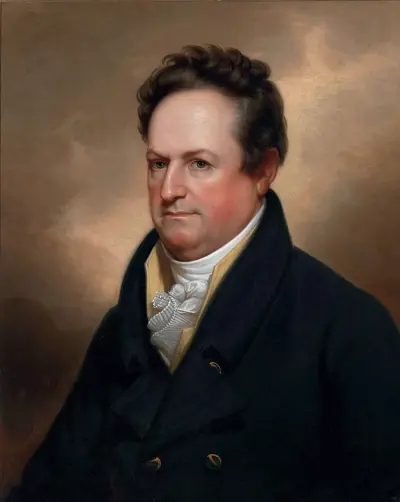
- Born: March 2, 1769
- Died: February 11, 1828
- Nationality: American
- Profession: Politician
DeWitt Clinton, whose name was almost always spelled De Witt during his lifetime and until the late 20th century, was an American politician and naturalist. He served as a United States Senator, Mayor of New York City, and as the sixth Governor of New York. In this last capacity, he was largely responsible for the construction of the Erie Canal. Clinton was a major candidate for the American presidency in the election of 1812, challenging incumbent James Madison.
