Keshub Chunder Sen Quotes
The education that you give to the upper classes will not uproot idolatry and prejudice, for it is amongst the masses that the error and prejudice will always maintain their power, and while you do not uproot those prejudices from the hearts of the masses, a handful of educated Hindus will never be able successfully to reform the country.
Keshub Chunder Sen, 1838-1888, Indian religious and social reformer, Speech, Metropolitan Tabernacle, Newington Butts, London on May 24, 1870
Sourced by: Eigen's Political and Historical Quotations


… an army of Gatsbys wanting not to overturn the social order but only to belong to the upper crust.
Many in India viewed them as radicals because they were demanding so much change and reform. However, Deb’s view was they only wanted sufficient change to allow them to move into the higher strata of India.

The Emperor was then only 20 years old and it is doubtful that this was actually written by him personally or even that he was the originator or driver of this policy—probably the strongest statement regarding education of any nation in history. Nonetheless, it is a great quotation on the role of education in the nation. He even ordained that all girls should be educated—an achievement which had not been achieved by the majority of countries 140 years later in 2012. Most incredible about this quotation is that the Emperor made everything else of importance subordinate to the education of children." Meiji the Great


At the time English democracy was still suspect especially among the aristocracy.


This was the prevailing view in Europe at the time; it was less so in the United States, where there were so many people who owned their own land and farmed it or developed manufacturing facilities and hence were the mind AND the limbs of the enterprises. However, the upper classes tended to agree with the European view. The difference between the American and European views was one of class mobility. In America “limbs” who demonstrated capacities of “mind” were much more able to advance in America. However, even into the 21st century here was a general feeling of the upper class that the “minds” made the critical and impactful decisions. This is one of the reasons that executive and CEO pay advanced so rapidly when compared with workers (the “linbs”).


The Western style of education was extremely effective for the Hindus, but was much less successful for the Muslims. The result was that over time, the Hundus achieved success in the professions, civil service, arts and sciences while the Muslims did not, thus changing the then existing parity of the two groups. For more on the difficulty that the Muslims had with British public education, see {616919} & {616925}.

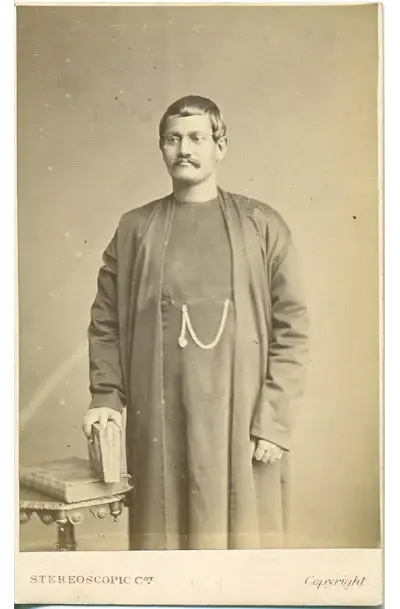
Keshub Chandra Sen was a Hindu philosopher and social reformer who attempted to incorporate Christian theology within the framework of Hindu thought. Born a Hindu in the Bengal Presidency of British India, he became a member of the Brahmo Samaj in 1857 but established his own breakaway "Bharatvarshiya Brahmo Samaj" in 1866 while the Brahmo Samaj remained under the leadership of Debendranath Tagore (who headed the Brahmo Samaj till his death in 1905). In 1878 his followers abandoned him after the underage child marriage of his daughter which exposed his campaign against child marriage as hollow. Later in his life he came under the influence of Ramakrishna and founded a syncretic "New Dispensation" inspired by Christianity, and Vaishnav bhakti, and Hindu practices.
