Mutsuhito Meiji Quotes
Centuries have elapsed since schools were first established.... Because learning was viewed as the exclusive province of the samurai and his superiors, farmers, artisans, merchants and women have neglected it altogether.... There shall, in the future, be no community with an illiterate family, nor a family with an illiterate person .... Hereafter ... every man shall, of his own accord, subordinate all other matters to the education of his children.
The Emperor was then only 20 years old and it is doubtful that this was actually written by him personally or even that he was the originator or driver of this policy—probably the strongest statement regarding education of any nation in history. Nonetheless, it is a great quotation on the role of education in the nation. He even ordained that all girls should be educated—an achievement which had not been achieved by the majority of countries 140 years later in 2012. Most incredible about this quotation is that the Emperor made everything else of importance subordinate to the education of children." Meiji the Great
Mutsuhito Meiji, 1852-1912, , Emperor of Japan, Declaration, 1872
Sourced by: Eigen's Political and Historical Quotations


Some find interest in the fact that Adams did not see education as raising the lower classes to be equal to that of the upper class. He chose the word “nearer.”


The Constitution, incredibly enough, never even mentioned education. But at one of the earliest opportunities available to Congress, it made this statement, the first on education by the United States government.

England in contrast did not even educate many men in arithmetic and accounting and women not at all with the sexist English culture of the day. English merchants were notorious for selling their business at low prices as they got older unless they had an adult son with an aptitude for the business. The Dutch, with educated women could have a wife run a business if the husband died or was disabled, and allow children to grow up, thus keeping the business in the family, but more important for Holland, keeping the business thriving.

In early America, as today, there was a substantial element of American society who distrusted intellectuals and education. They saw education as promoting inequality and leading to an aristocracy. Reading was actually attacked by many on the grounds that one’s thinking skills would atrophy. (Today we worry about TV eroding reading skills.) “Summum bonum” is Latin meaning “the Highest Good”.


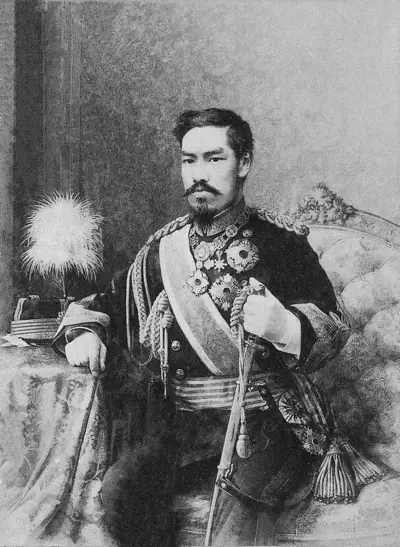
Emperor Meiji, also called Meiji the Great (明治大帝, Meiji-taitei), or Meiji the Good (明治聖帝, Meiji-seitei), was the 122nd Emperor of Japan according to the traditional order of succession, reigning from 3 February 1867 until his death on 30 July 1912, and the first monarch of the Empire of Japan. He presided over the Meiji era, a time of rapid change that witnessed Japan's transformation from an isolationist, feudal state to an industrialized world power.
