Bill Clinton Quotes
The Constitution says I must ask the Senate for consent and advice. The more advice, the more leaks.
William Clinton, 42nd President of the United States (Democrat, AR), May 16, 1994
Sourced by: Eigen's Political and Historical Quotations


Most legislative bodies have rules about when and under what conditions a vote is taken. Amendments, procedures, committees all have procedures where votes may be taken that could defeat a nomination or a proposed law but if those defeats fail, there still is not necessarily a law passed or a nomination confirmed. That has to be a separate vote, often called an “up or down vote.” One parliamentary mechanism for opposing a bill or a nomination is to keep voting on amendments and procedures and never have an up or down vote. This is actually true with the vast majority of the laws proposed in both houses of the Congress. Most never do have an up or down vote. Why Gerhatdt and other ask should judicial nominations be different from any law, or any other presidential nomination? Also see {588517} for another factor.


President Coolidge had nominated Charles Beecher Warren as Attorney General but the Senate with his own party in the majority rejected the nomination as Warren had been closely connected with the Sugar Trust. Coolidge, refused to accept the Senate decision and renominated Warren and threatened that if the Senate would not confirm Warren, be would give him a recess appointment after the Senate adjourned:. The statement was written for a Senate speech but never delivered as such. Warren was rejected by the Senate a second time, and the President indeed offered him a recess appointment, but Warren refused.


In response to Administration tactics to delay a vote on the Church-Cooper proposal to limit American involvement in Cambodia after June 30, 1970, Senator Cotton asserted:

1st Earl Lloyd-George of Dwyfor


The issue of how the federal judiciary would be selected was one of the more hotly debated issues during the Constitutional Convention.

At the time most legislatures never had recorded votes but instead often depended on voice votes and other methods. Edison’s invention was a huge failure. Transparency was not a popular concept amongst politicians as it still is not, but some standards have changed.

The need for some state secrecy was recognized from the beginning of the nation. The fight about it has been, since then, the extent and degree, and what justifies secrecy.

The notion of Executive Privilege developed over the years. Our first President thought nothing of giving the Senate access to all the papers and records regarding the negotiations of the treaty with Great Britain.

President Andrew Johnson had been impeached by the House of Representatives and was being tried in by the Senate. A majority of the Senators voted for conviction but the vote was 1 short of the two-thirds that were needed. Johnson remained in office. These were two of the charges against Johnson. A Century later Presidents commonly did both of these. George W. Bush made reappointment of Senate rejected nominees into an art form but after the Johnson trial, these were never to be considered reasons for impeachment again.


There were many critics who were concerned that the ITU was trying to regulate the Internet, but no one could be sure as the proceedings and meetings of the ITU are not publicly available. This is a classic UN problem. They see themselves as representing governments and not people. The Governments have the information and so they delude themselves into believing that they are transparent, when the reality is that for the individual they are totally opaque. Most critics who worry about UN regulation of the Internet, are just as concerned with what other countries are proposing than what there own government’s position is. And most governments themselves do not release the actual transcripts or proceedings of the ITC meetings but only documents giving their positions. This is an example of secrecy being promoted as transparency where the UN covers for member nations who want to maintain secrecy.
_0_thumbnail_47x47.jpg "Statue of Robert Hall in Leicester.")
For many people the implication of this quotation is that there should be no government secrets withheld from the citizens who have the right to examine. Others argue that government may have temporary secrets to protect against foreign enemies for example, but that these must be declassified very promptly so that the citizens can examine the actions of their government in time to replace the government if they are not satisfied. Almost all government officials tend to reject the first implication out of hand, and grudgingly accept the second with their discretion controlling when declassification should take place. The problem of America is twofold. There is much over-classification (material kept secret that should not be at all), and the time till declassification is long in general and truly absurd in many cases. For example, there are documents from WWII that by 2013 had still not been declassified. See {591444}, {641317}, and {589105} for exemplar views. William Jennings Bryan introduced this principle into the American political dialogue. See {641027}.
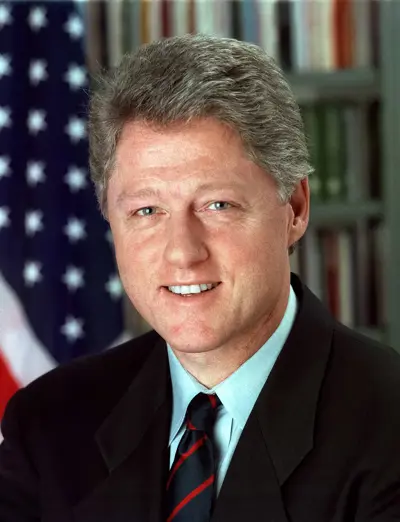
William Jefferson "Bill" Clinton is an American politician who was the 42nd President of the United States from 1993 to 2001. Clinton was previously Governor of Arkansas from 1979 to 1981 and 1983 to 1992, and the Arkansas Attorney General from 1977 to 1979. Clinton was born William Jefferson Blythe III – he changed to his stepfather's name at age 15.
