John Jay Quotes
It seldom happens in the negotiation of treaties…but that perfect secrecy and immediate dispatch are sometimes requisite…and there doubtless are many [people] who would rely on the secrecy of the president, but who would not confide in that of the Senate, and still less in that of a large popular assembly.
John Jay, 1745-1829, President of the Continental Congress, Governor of New York (Federalist), U. S. Foreign Secretary, First Chief Justice of the U. S. Supreme Court, The Federalist, No. 64
Sourced by: Eigen's Political and Historical Quotations

The notion of Executive Privilege developed over the years. Our first President thought nothing of giving the Senate access to all the papers and records regarding the negotiations of the treaty with Great Britain.


President George W. Bush initiated an invasion of Iraq based on the fact that Iraq was developing nuclear, chemical and biological weapons. After the invasion however, there were none of these weapons found and much evidence that there were not any at that point in time. By the time Congress, the body which is supposed to declare war, found out that the reason for the war was bogus, it was too late. We had already occupied the country and were in the midst of a civil war. The President either acted on bad intelligence or wanted to invade Iraq for other reasons and history may finally tell us which, but Fein sees the problem as too much secrecy in the executive branch.

This notion seems to have first been expressed by Edward S. Corwin in 1940


This is a great example of Presidential stonewalling of Congress. The legislative branch is often exercising its oversight role and demanding executive department documents which for various reasons the President does not want the Congress to see. In this case, almost all attorneys would have said that the Congress was entitled to see the documents. This set a precedent of de facto Executive Privilege for war time. However, Congress very often has used their power of demanding documents for political and ideological reasons and not for the better functioning of the government. In the Eisenhower administration the concept of Executive Privilege was formalized to protect President Eisenhower and officials in the Executive Branch from the abuses and excesses of Joseph P. McCarthy who was a fanatic, ideologue and an alcoholic at the same time. See {595900}.

From this quotation, {624648} and {615902} it is clear that the framers of the Constitution intended the treaty making powers to be shared by the President and the Senate. In practice, in modern times treaties are usually initially negotiated by diplomats under the supervision of the President and the Senate gets to concur or not in the ratification process. However, there have been a number of treaty failures including the League of Nations where the lack of coordination has resulted in a situation where the Senate had to accept or reject something which the President had negotiated and the Senate rejected the treaty.


Because the Senate has not ratified some international treaties, the United States does not participate in some international efforts to create international rules and law. The reason for non-ratification is generally given as potential loss of American sovereignty. At the same time, we spend billions of dollars trying to influence and shape the world along free market, democratic lines, and then are not able to participate in some of the most important forums where we could do just that. It is a constant dilemma and the Senate goes both ways depending on its mood, public opinion at the time and the political composition of the Senate. See {637031} and {637032}.


Indeed, the control is only one the medium term when after 4 years a President can be replaced by the voters. But a number of President’s have embarked upon foreign policies that was opposed by the majority of the population.


In general, Justice Jackson was correct. Almost all major Supreme Court decisions that have ruled against the Legislative Branch or the Executive Branch, have been, reversed by a future Supreme Court, reversed by new legislation, reversed by a subsequent Constitutional Amendment, reversed by science or technology, or acknowledged by future generations to be wrong but were now moot and needed no correcting. The greatest of the Supreme Court decisions have generally been those that upheld the Congress and the Executive.


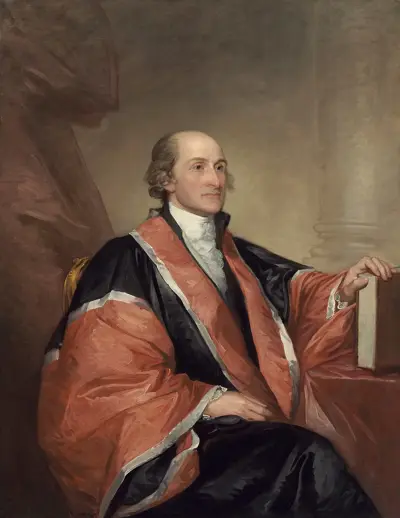
John Jay was an American statesman, patriot, diplomat, Founding Father, abolitionist, negotiator, and signatory of the Treaty of Paris of 1783. He served as the second Governor of New York and the first Chief Justice of the United States (1789–1795). He directed U.S. foreign policy for much of the 1780s and was an important leader of the Federalist Party after the ratification of the United States Constitution in 1788.
