Robert M. La Follette Quotes
If a President may thus with impunity violate one of the provisions of the Constitution, he may violate all of them. If he may override the Constitution in defiance of the Senate on this one occasion to appoint some unfit favorite to office, he may override it upon every occasion. He may make and consummate treaties without your consent. He may create new offices and order money paid out of the Treasury without your appropriation. He may declare war and plunge the United States into bloody conflict without your action and against your will.... The issue is joined. It is democracy against dictatorship. It is the Constitution of the United States against the whim of Calvin Coolidge.
President Coolidge had nominated Charles Beecher Warren as Attorney General but the Senate with his own party in the majority rejected the nomination as Warren had been closely connected with the Sugar Trust. Coolidge, refused to accept the Senate decision and renominated Warren and threatened that if the Senate would not confirm Warren, be would give him a recess appointment after the Senate adjourned:. The statement was written for a Senate speech but never delivered as such. Warren was rejected by the Senate a second time, and the President indeed offered him a recess appointment, but Warren refused.
Robert M. La Follette, 1855-1925, Governor of Wisconsin (Republican), U.S. Senator (Republican, WI), Presidential Candidate (Progressive), March 1925
Sourced by: Eigen's Political and Historical Quotations

This notion seems to have first been expressed by Edward S. Corwin in 1940


This concept of Presidential powers greatly expanded the traditional power of the Presidency. To one degree or another this became the view of every president who followed until George W. Bush who went one large step further. He maintained that the President could do that which was specifically prohibited by law if the purpose was to perform a Constitutional duty.


From this quotation, {624648} and {615902} it is clear that the framers of the Constitution intended the treaty making powers to be shared by the President and the Senate. In practice, in modern times treaties are usually initially negotiated by diplomats under the supervision of the President and the Senate gets to concur or not in the ratification process. However, there have been a number of treaty failures including the League of Nations where the lack of coordination has resulted in a situation where the Senate had to accept or reject something which the President had negotiated and the Senate rejected the treaty.


President Andrew Johnson had been impeached by the House of Representatives and was being tried in by the Senate. A majority of the Senators voted for conviction but the vote was 1 short of the two-thirds that were needed. Johnson remained in office. These were two of the charges against Johnson. A Century later Presidents commonly did both of these. George W. Bush made reappointment of Senate rejected nominees into an art form but after the Johnson trial, these were never to be considered reasons for impeachment again.


This letter was written shortly after the Constitution had been signed by the convention delegates. This difference between Adams and Jefferson would be at the heart of the first great partisan struggle in American history. Adams, as the second President, tried to increase and use the power of the Presidency. Jefferson opposed him, especially when Adams tried to run for a second term. The Adams-led Federalists were pitted against Jefferson’s Democratic Republicans in the first, and perhaps still the most bitter partisan struggle in American political history. The Jeffersonians accused Adams and the Federalists of trying to unravel the American Revolution and revert to a monarchy. The people not only sided with the Democratic Republicans, ousting Adams, but also turned out most of the Federalists. It was the end of the Federalist Party, and a new conservative party—without monarchial tendencies—the Whigs became the new opposition party.


President George W. Bush had ignored a federal law and tapped the phones of Americans without probable cause and a warrant issued by a court. The President’s defenders argued that the President, as Commander in Chief, has the Constitutional responsibility to lead the military and protect the nation. Intelligence gathering is part of military activity. Therefore the intelligence gathering is a Constitutional duty and the Congress, under the separation of powers doctrine, may not interfere with the President’s Constitutional Duty to conduct intelligence. Under this doctrine, the President need not obey laws that he believes impinge on his management of the war effort and the defense of the nation. Most legal scholars believe that this argument is nonsense, but the George W. Bush administration has stated the doctrine and it was the subject of much litigation.

One of the conundrums of our constitutional system is who has the last word as to what the Constitution means. Essentially it is the judicial branch headed by the Supreme Court. But there are those who believe that the current popular majority should have a say in what is or is not constitutional. If so the legislative branch should have the last word. Still others say that the President is the only person elected by ALL the people, so his opinion most reflects the will of the public. And then there are most who argue that the Constitutional system was created just to avoid the power of currently popular majorities, and the courts should decide based on the Constitution itself. So the statement has very little meaning except that Phillips thinks that the courts have too much power. Whoever gets to decide what is or is not Constitutional will be accused of being “over” the Constitution by those who don’t like the decisions. In our system, that is the courts.

Most legislative bodies have rules about when and under what conditions a vote is taken. Amendments, procedures, committees all have procedures where votes may be taken that could defeat a nomination or a proposed law but if those defeats fail, there still is not necessarily a law passed or a nomination confirmed. That has to be a separate vote, often called an “up or down vote.” One parliamentary mechanism for opposing a bill or a nomination is to keep voting on amendments and procedures and never have an up or down vote. This is actually true with the vast majority of the laws proposed in both houses of the Congress. Most never do have an up or down vote. Why Gerhatdt and other ask should judicial nominations be different from any law, or any other presidential nomination? Also see {588517} for another factor.

She was particularly critical of some of the current conservative politicians who were advocating retaliation against the judiciary because judicial decisions thwarted some of their fundamentalist preferences and preferred policies.
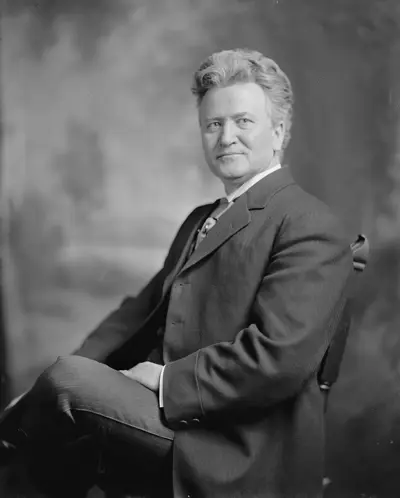
Robert Marion "Fighting Bob" La Follette Sr., was an American lawyer and politician. He represented Wisconsin in both chambers of Congress and served as the Governor of Wisconsin. A Republican for most of his career, he ran for President of the United States as the nominee of his own Progressive Party in the 1924 presidential election. Historian John D. Buenker describes La Follette as "the most celebrated figure in Wisconsin history."
