Robert Byrd Quotes
We cannot continue to claim that we are a nation of laws and not of men if our laws and, indeed, even the Constitution of the United States itself, may be summarily breached because of some determination of expediency or because the President says “trust me.”
Robert Byrd, 1917-2010, U. S. Congressman & U. S. Senator (Democrat, WV), Senate Majority & Minority Leader, Senate Speech, February 15, 2006
Sourced by: Eigen's Political and Historical Quotations

The Congress over the last century has ceded much of its Constitutional power to the President. Congress has much power to check the President, but just as Congress has not been very competent at legislating, oversight, and conducting hearings and investigations, it has not organized itself to use the powers it has very well.

President George W. Bush had ignored a federal law and tapped the phones of Americans without probable cause and a warrant issued by a court. The President’s defenders argued that the President, as Commander in Chief, has the Constitutional responsibility to lead the military and protect the nation. Intelligence gathering is part of military activity. Therefore the intelligence gathering is a Constitutional duty and the Congress, under the separation of powers doctrine, may not interfere with the President’s Constitutional Duty to conduct intelligence. Under this doctrine, the President need not obey laws that he believes impinge on his management of the war effort and the defense of the nation. Most legal scholars believe that this argument is nonsense, but the George W. Bush administration has stated the doctrine and it was the subject of much litigation.

Opinion in case against the government for illegal CIA activities. The defense had been that the President had authorized and ordered the operations in question.

Powell was the Secretary of State and Addington kept advising the administration that as long as the President was acting in defense of the country in his capacity as Commander in Chief, he did not have to obey any existing laws that had been Constitutionally passed which in the opinion of the President restricted or limited the President or the executive branch. Addington was an attorney and Assistant to the Vice President, but he was given much responsibility for administration policy. Powell the Secretary of State of the Administration could not have disagreed more and although most politicians including Republicans disagreed with the Addington thesis, Powell was one of the few Republicans to criticize the Addington position.


Senator Grimes thought that Andrew Johnson was a terrible President, but when the House of Representatives impeached President Johnson and he was tried before the Senate, Grimes voted for acquittal. His reason for the his vote was he thought that the Constitution did not provide for the removal if a President just because he has “Unacceptable.” Johnson survived removal from office by a single vote and had Grimes not been so principled about the Constitution, Johnson would have been removed from office. On the other hand, Johnson was a terrible President and many of the nations racial problems in later years emanated from his actions and inactions while in office.


In 1953 the Senator had proposed a Constitutional amendment that would severely curtail the treaty making powers of the President. President Eisenhower actively opposed Bricker and the right wing of his own party. The Senator was outraged. Despite Bricker’s complaining, the public and the Congress sided with the President.


President Coolidge had nominated Charles Beecher Warren as Attorney General but the Senate with his own party in the majority rejected the nomination as Warren had been closely connected with the Sugar Trust. Coolidge, refused to accept the Senate decision and renominated Warren and threatened that if the Senate would not confirm Warren, be would give him a recess appointment after the Senate adjourned:. The statement was written for a Senate speech but never delivered as such. Warren was rejected by the Senate a second time, and the President indeed offered him a recess appointment, but Warren refused.

He had been fired by the George W. Bush White House because he would not rush an indictment against a democratic politician to make the newspapers before the election that year thus being “loyal” to the party and administration.


This was an insult to the George W. Bush administration which had stretched the Constitution more so than any previous administration, had asserted Presidential powers that had never been asserted before and had had several of its more controversial policies and practices overturned by the Supreme Court.

Mormons were not only discriminated against but frequently robbed, murdered and ethnically cleansed from different parts of the country. In general the Federal Government did little or nothing regarding the plight of the Mormons.

This principle has been in force since the beginning of our republic. However, there was a suggested challenge to it by President Richard M. Nixon, and a substantial challenge by the George W. Bush Administration which took the position that as long as the President was engaged in carrying out a Constitutionally mandated function, like war or foreign policy, the President did not have to obey the existing laws and could direct his subordinates to violate the law. Bush lost in those areas which came to the courts and the Supreme Court made it clear that even the President, carry out his official duties, had no immunity from the laws of the nation.


In England, the King was above the law. However, impeachment was a tool that could be used against his favorite ministers. In debating the United State Constitution one of the first questions to be determined was whether impeachment could be a tool used against the President or like, England, only the other government officials. Franklin urged the President be included. See also Mason: {584246}.
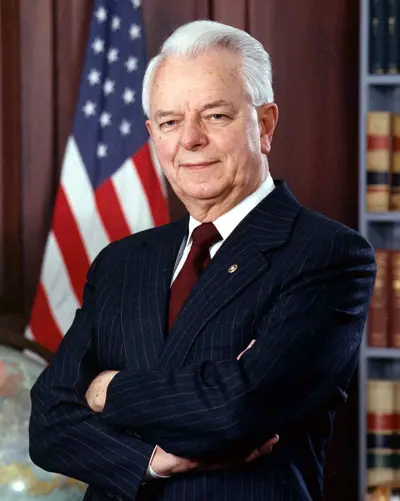
Robert Carlyle Byrd was an American politician who served as a United States Senator from West Virginia for over 51 years, from 1959 until his death in 2010. A member of the Democratic Party, Byrd also served as a U.S. Representative for six years, from 1953 until 1959. He remains the longest-serving U.S. Senator in history; he was the longest-serving member in the history of the United States Congress until surpassed by Representative John Dingell of Michigan. He was the last remaining member of the U.S. Senate to have served during the presidency of Dwight Eisenhower, and he was the last remaining member of Congress to have served during the presidency of Harry S. Truman. Byrd is also the only West Virginian to have served in both chambers of the state legislature and both chambers of Congress.
