Douglas MacArthur Quotes
No specific and tangible evidence has been uncovered with regard to exact activities which may connect him in varying degree with the political decisions of the Japanese Empire during the last decade. I have gained the definite impression from as complete a research as was possible to me that his connection with the affairs of state up to the time of the end of the war was largely ministerial and automatically responsive to the advice of his counselors….His indictment will unquestionably cause a tremendous convulsion among the Japanese people, the repercussions of which cannot be overestimated. He is a symbol which unites all Japanese. Destroy him and the nation will disintegrate…It is quite possible that a million troops would be required which would have to be maintained for an indefinite number of years.
none of a prosecutorial nature At the end of World War II, a major issue was whether to try the Japanese Emperor as a War Criminal. He had been the Commander and Chief of the Japanese Armed Forces, personally appointed virtually every military of civilian official of consequence—who served at his pleasure, had personally approved every major Japanese invasion (except some of the China incursions) and attack (including Pearl Harbor), personally allowed the execution of American captured prisoner of war flyers from the Doolittle raid on Tokyo, and was knowledgeable about most of the Japanese war crimes. However, General MacArthur thought him a stabilizing force in post-war Japan and never did a detailed investigation of his possible indictment. Instead he wrote this magnificently artfully worded telegram to General Eisenhower. MacArthur wanted to shock the Truman administration into allowing him to reduce the Emperor’s dictatorial powers but retain not only the monarchy but avoid indicting Hirohito. He succeeded, and there was no serious investigation of the Emperor as a possible war criminal despite many calls for Hirohito’s indictment from a few allied politicians {43748} and some American and allied veterans groups. Few could argue with the pragmatic result and the rehabilitation of Japan, but the justice of the decision—or lack thereof—has been debated since. See {43823}, {43824}, {603499}, {43831}, {603752}, {43841}, {601309}, {593777}, {43997}, {43999}, {594634}
Douglas MacArthur, 1880-1964, General of the U. S. Army and Supreme Commander of the U. N. forces in Korea, Chief of Allied Occupation Forces in Japan, Telegram to General Dwight Eisenhower, 1945
Sourced by: Eigen's Political and Historical Quotations

The last rhetorical question tried to refute the “defense” that the Emperor didn’t believe in the military incursions and the other atrocities committed by the Japanese even though he personally approved almost all of them.

Emperor Hirohito was never indicted at the behest of General MacArthur’s recommendations {605727}. Yet Bernard felt compelled to address the missing defendant’s guilt as did the English Judge {43999}

Allied calls for indictment of Emperor Hirohito. war crimes trials of Tojo and other Japanese leaders Senior officer responsible for investigating Japanese WWII war criminals. Fellers was the officer who had previously done the “research and investigation for his boss General Douglas MacArthur who had recommended no prosecution for the Emperor. See {605727}. Yonai was to get word to General Tojo and Admiral Shimada, already indicted as war criminals to minimize the role of the Emperor who had personally approved of Pearl Harbor and every major subsequent act of Japanese aggression. Shimada was “on board” but there were doubts about whether Tojo would go along with the deceptive exoneration of the Emperor.


This and many other statements have been used to refute the allegation made by some that the Japanese Emperor and Commander in Chief had no influence and control over the military and thus was not responsible for any war crimes.


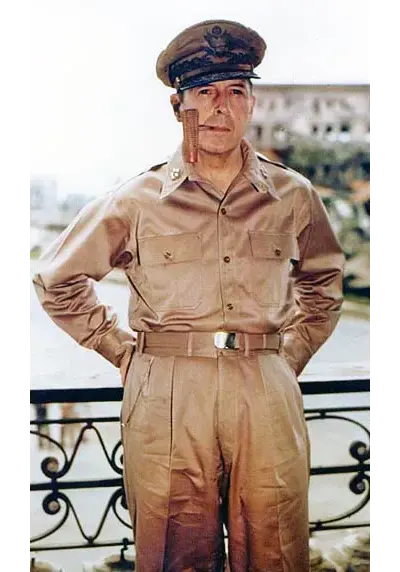
General of the Army Douglas MacArthur was an American five-star general and Field Marshal of the Philippine Army. He was Chief of Staff of the United States Army during the 1930s and played a prominent role in the Pacific theater during World War II. He received the Medal of Honor for his service in the Philippines campaign, which made him and his father Arthur MacArthur Jr. the first father and son to be awarded the medal. He was one of only five to rise to the rank of General of the Army in the U.S. Army, and the only one conferred the rank of field marshal in the Philippine Army.
