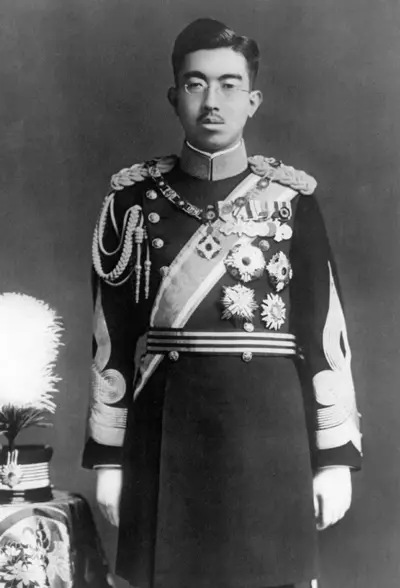
Hirohito Quotes
Today, however, the world is deeply troubled everywhere and disorder seems endless. As the disasters that humankind may suffer are immeasurable, we sincerely hope to bring about a cessation of hostilities and a restoration of peace, and have therefore ordered the government to ally with Germany and Italy, nations which share the same intentions as ourselves ….
Hirohito, 1901-1990, Emperor of Japan, Rescript, September 27, 1940
Sourced by: Eigen's Political and Historical Quotations
none of a prosecutorial nature At the end of World War II, a major issue was whether to try the Japanese Emperor as a War Criminal. He had been the Commander and Chief of the Japanese Armed Forces, personally appointed virtually every military of civilian official of consequence—who served at his pleasure, had personally approved every major Japanese invasion (except some of the China incursions) and attack (including Pearl Harbor), personally allowed the execution of American captured prisoner of war flyers from the Doolittle raid on Tokyo, and was knowledgeable about most of the Japanese war crimes. However, General MacArthur thought him a stabilizing force in post-war Japan and never did a detailed investigation of his possible indictment. Instead he wrote this magnificently artfully worded telegram to General Eisenhower. MacArthur wanted to shock the Truman administration into allowing him to reduce the Emperor’s dictatorial powers but retain not only the monarchy but avoid indicting Hirohito. He succeeded, and there was no serious investigation of the Emperor as a possible war criminal despite many calls for Hirohito’s indictment from a few allied politicians {43748} and some American and allied veterans groups. Few could argue with the pragmatic result and the rehabilitation of Japan, but the justice of the decision—or lack thereof—has been debated since. See {43823}, {43824}, {603499}, {43831}, {603752}, {43841}, {601309}, {593777}, {43997}, {43999}, {594634}
This is the quotation that came to define Chamberlain’s naivety for history and the icon of failed diplomacy. However to see the beginning of the sequence of events that would lead up to this statement, see {585940} when Chamberlain suggested the infamous meeting in Munich. There had been an interesting history to Chamberlain’s appeasement of Germany. 39 years earlier, Chamberlain’s father, then Britain’s Colonial Secretary, and advocated a natural alliance with Germany. See Joseph Chamberlain, 1836-1914: {585939}.
The Conclusion of the Russo-Japanese War. The treaty was negotiated and signed in Portsmouth New Hampshire. President Theodore Roosevelt was awarded the Nobel Peace Prize for his mediating efforts. The language was typical of a peace treaty where just before its signature the two nations and their emperors were vilifying and dehumanizing the other.
This seems to be the origin of the notion that democracies and republics are less likely to war with others than monarchies or dictatorships.
The first Bishop in Britain, sent by Pope Gregory in 597. This was in large part fulfilled in 607 when Ethelfrith led Saxon troops to Wales killing many including 200 priests who had been sent to pray for the Welsh.
America, England, Germany and France Many Japanese leaders predicted war between the Great Powers while America and its European Allies did not see the danger as clearly. Shortly after 1936, Hitler began the Second World War. Japan was indeed prepared. Hiranuma became one of the Japanese extremists and after WWII was convicted of war crimes and given a life sentence.
This was the 14th part of the Japanese reply to a previously made American peace proposal. The Japanese policy was to unite all of Asia into a co-prosperity sphere controlled by Japan where Japan would militarily conquer those Asian countries which did not “voluntarily” want to join. The Japanese were in the process of conquering China and the United States and Britain had embargoed oil and other material to Japan trying to pressure them to withdraw their troops from China and cease Japanese conquest by force. Japan believed that it was their right to conquer and control Asia and it was beneficial to the region, and that the U. S. and Britain had no right to curtail the expansion that Japan required to assure raw materials and other necessities. At the very time that these negotiations were on going, the Japanese fleet was sailing for the sneak attack on Pearl Harbor. The attack took place the very day this part of the Japanese reply was received.
She had gone to Europe where the 2nd World War was raging.
He was exactly right. Two decades later Germany had started WWII.
1st Earl Baldwin of Bewdley. Chamberlain was about to leave for the Munich Conference where his appeasement emboldened Hitler and the Germans and dashed all hope of peace. Baldwin was out of office, but his support of the Munich appeasement changed his image from that of a popular statesman, to a craven appeaser. See {626930} for Churchill’s view of Baldwin.
Theodore Roosevelt was the Presidential nominee. Johnson was a leader of some members of Congress some of whom were extreme isolationists and some of whom were Nazi sympathizers and Hitler admirers. When the Japanese attacked Pearl Harbor later that year, Germany, fulfilling its treaty with Japan, declared war on America, Johnson’s group no longer mattered. Before WWII most Republicans were opposed to Defense Spending and accused the Democrats of being war hawks. After WWII, they flip flopped and became more hawkish than the Democrats who they accused of being soft on defense for years thereafter. See {631380} for President Roosevelt’s different view.
- Born: April 29, 1901
- Died: January 7, 1989
- Nationality: Japanese
- Profession: Leader
Emperor Shōwa, better known in English by his personal name Hirohito (裕仁), was the 124th emperor of Japan according to the traditional order of succession, ruling over the Empire of Japan from 25 December 1926 until 2 May 1947, after which he was Emperor of the state of Japan until his death. He was succeeded by his fifth child and eldest son, Akihito. Hirohito and his wife, Empress Kōjun, had seven children, two sons and five daughters. By 1979, Hirohito was the only monarch in the world with the title "emperor." Hirohito was the longest-lived and longest-reigning historical Japanese emperor and one of the longest-reigning monarchs in the world.