Neville Chamberlain Quotes
I believe it is peace for our time.
This is the quotation that came to define Chamberlain’s naivety for history and the icon of failed diplomacy. However to see the beginning of the sequence of events that would lead up to this statement, see {585940} when Chamberlain suggested the infamous meeting in Munich. There had been an interesting history to Chamberlain’s appeasement of Germany. 39 years earlier, Chamberlain’s father, then Britain’s Colonial Secretary, and advocated a natural alliance with Germany. See Joseph Chamberlain, 1836-1914: {585939}.
Neville Chamberlain, 1869-1940, British Prime Minister (Conservative), Statement Referring to his negotiation of the Munich Pact which emboldened Hitler to begin World War II, September 1938
Sourced by: Eigen's Political and Historical Quotations

This was the week after he returned from his meeting with Hitler in Munich where he appeased the German Dictator. See {585941} for his famous naive statement.

This was very much a minority opinion at the time, and has much historical significance as he was the father of the British Prime Minister, Neville Chamberlain, 1869-1940, whose appeasement of Germany led to Word War II. . See {585941}.
That day, Hitler had made a very aggressive speech with ominous war threats. The Prime Minister sent this cable initiating a meeting in Munich which would do no good but would culminate with his famous naïve quotation that would define him for history. See {585941}.

The “fool” was Neville Chamberlain, 1869-1940, the British Prime Minister who refused to stand up to Hitler and instead negotiated a peace pact, returned home declaring that he had preserved peace. (See {585941}.) Then Hitler invaded more of Europe and WWII was begun. Ford was a Hitler admirer and pro-German (Hitler supported him for the American Presidency--{586988}—and awarded him a medal) but he thought that England had bungled the negotiations by sending someone who was very weak. In this sense his views were the same as most who were anti-Hitler.
Chamberlain’s policy was to appease Hitler and Germany to avoid war. Although he did not see Czechoslavkia as a critical British national interest and claimed he had secured peace {585941} , the reality was that he gave Germany room to start its aggression which would engulf all of Europe and much of the world. The British became the only bulwark against Hitler until the Russians stopped the Germans and America entered the war.

The reference to Munich was to the famous appeasement of Adolf Hitler and the Nazis by British Prime Minister Neville Chamberlain. See {585941}.


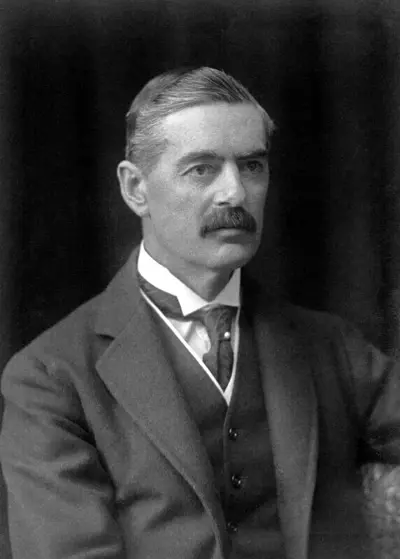
Arthur Neville Chamberlain FRS was Prime Minister of the United Kingdom and Leader of the Conservative Party from 1937 to 1940. He is best known for his foreign policy of appeasement, and in particular for his signing of the Munich Agreement on 30 September 1938, conceding the German-speaking Sudetenland region of Czechoslovakia to Germany. Following the German invasion of Poland on 1 September 1939, which marked the beginning of World War II, Chamberlain announced the declaration of war on Germany two days later and led the United Kingdom through the first eight months of the war until his resignation as prime minister on 10 May 1940.
