Douglas MacArthur Quotes
I always tell American visitors that the emperor is the most democratic person [in the Japanese leadership] but none of them believe me.
The Emperor had ruled Japan as a “living God” with complete dictatorial powers which had been restricted by the Constitution MacArthur had imposed on post-war Japan. It is not clear whether MacArthur actually believed his statement or was just trying to flatter the Emperor whose cooperation MacArthur eagerly sought despite calls for the war crimes indictment of Hirohito.
Douglas MacArthur, 1880-1964, General of the U. S. Army and Supreme Commander of the U. N. forces in Korea, Chief of Allied Occupation Forces in Japan, Statement to Japanese Emperor Hirohito, October 1946
Sourced by: Eigen's Political and Historical Quotations

The Egyptians had received the latest Russian radar and missiles. It’s planes outnumbered the Israeli Air Force 3 to 1. Within a year, the entire Egyptian Air Force was virtually destroyed. See {605729}
Actually, although the Emperor wanted to surrender, there was a military coup attempted to prevent his announcement being made to the Japanese people. Fortunately, it did not succeed, but he certainly had the alternative of fighting to the death. There were Japanese hard liners who believed that they could make the invasion of mainland Japan so costly in lives to the Allies that they could negotiate terms. The Atomic Bomb however, in the mind of the Emperor and other Japanese leaders rendered that strategy moot.

none of a prosecutorial nature At the end of World War II, a major issue was whether to try the Japanese Emperor as a War Criminal. He had been the Commander and Chief of the Japanese Armed Forces, personally appointed virtually every military of civilian official of consequence—who served at his pleasure, had personally approved every major Japanese invasion (except some of the China incursions) and attack (including Pearl Harbor), personally allowed the execution of American captured prisoner of war flyers from the Doolittle raid on Tokyo, and was knowledgeable about most of the Japanese war crimes. However, General MacArthur thought him a stabilizing force in post-war Japan and never did a detailed investigation of his possible indictment. Instead he wrote this magnificently artfully worded telegram to General Eisenhower. MacArthur wanted to shock the Truman administration into allowing him to reduce the Emperor’s dictatorial powers but retain not only the monarchy but avoid indicting Hirohito. He succeeded, and there was no serious investigation of the Emperor as a possible war criminal despite many calls for Hirohito’s indictment from a few allied politicians {43748} and some American and allied veterans groups. Few could argue with the pragmatic result and the rehabilitation of Japan, but the justice of the decision—or lack thereof—has been debated since. See {43823}, {43824}, {603499}, {43831}, {603752}, {43841}, {601309}, {593777}, {43997}, {43999}, {594634}

Allied calls for indictment of Emperor Hirohito. war crimes trials of Tojo and other Japanese leaders Senior officer responsible for investigating Japanese WWII war criminals. Fellers was the officer who had previously done the “research and investigation for his boss General Douglas MacArthur who had recommended no prosecution for the Emperor. See {605727}. Yonai was to get word to General Tojo and Admiral Shimada, already indicted as war criminals to minimize the role of the Emperor who had personally approved of Pearl Harbor and every major subsequent act of Japanese aggression. Shimada was “on board” but there were doubts about whether Tojo would go along with the deceptive exoneration of the Emperor.

Kishi was an ultra conservative who was one of the politicians who signed the Declaration of War against the U. S. and then served in the Japanese War Cabinet and was the Minister of Commerce and Industry. In the latter post he presided over and made policies about the utilization of slave labor and brutal and illegal treatment of prisoners of war. After Japan’s surrender he was jailed as a “Class A” war crimes suspect along with several other cabinet ministers. In 1948, General MacArthur decided not to prosecute the Cabinet Ministers as he had decided not to prosecute the Emperor Hirohito. His brother was the secretary to the prime minister’s cabinet who had arranged a job for him. However, all the people in government were now building a democratic government. Being a right wing pro military, pro empire politician was no longer feasible and he discovered all his ex-colleagues who hated democracy before were now extolling its virtues. He went with the flow, and reorganized his political constituency, and gained control of the Diet, but now they were all democrats. Then he became prime minister. He was an ardent anti-communist and the Cold War was raging so his previous right wing dictatorial, pro war positions and his war crimes were overlooked by MacArthur and the allies.
She was referring to the aftermath of the Iraq War.

Even some who bought the party line that the Emperor had personally not started the war or the other incursions, blamed the Emperor for his inaction.


In 1948 Japanese Emperor Hirohito convened the Japanese Diet. By tradition the Emperor would receive the bows and homage of the leaders of the upper and lower houses in a special audience room before the ceremony. Matsumoto did not so greet Hirohito provoking a scandal of sorts. However, in the past, Hirohito had been worshipped as a living God. When his subjects attended an audience, they would bow low and leave walking backwards or sideways so as never to insult the Emperor be showing him their backs. The court maneuver was known as the “crab walk.’ However, under the 1946 Constitution the Emperor had become a mortal, human “symbol” of the state. Matsumoto was purged from politics with the active assistance of the American Occupation authorities. No one was willing to take the new Constitution both literally and seriously.
The evidence pointed to the Emperor as being guilty of being responsible for war crimes. There were many who wanted to try the Emperor and if found guilty hang him. MacArthur was opposed to a trial for the Emperor as the practical consequence of a guilty verdict was too detrimental to his orderly occupation. The General’s view eventually prevailed, but only after material evidence and facts were withheld from Washington.


Many of the young men who were given this form to fill out, had never been in Japan and some did not even know there was an emperor there. Nonetheless the Japanese American divisions of enlistees were the most effective and most decorated fighting units for America while their parents who had not been born in America were still imprisoned in the internment camps. See {624010}.
Buleihi is one of the few Arab intellectuals who are not totally negative about Western colonialism and interference in the affairs of other countries who he believes benefit from the Western influence and have developed such an insularity that they will not be changed or modernized otherwise.
Lemay was the Air Force general who led the firebombing and other attacks on Japanese cites with far more casualties than were produced by the atomic bombs which his planes also delivered.

To this day, Japanese are generally very circumspect about criticizing the emperor and he is rarely the subject of public discussion.

This and many other statements have been used to refute the allegation made by some that the Japanese Emperor and Commander in Chief had no influence and control over the military and thus was not responsible for any war crimes.
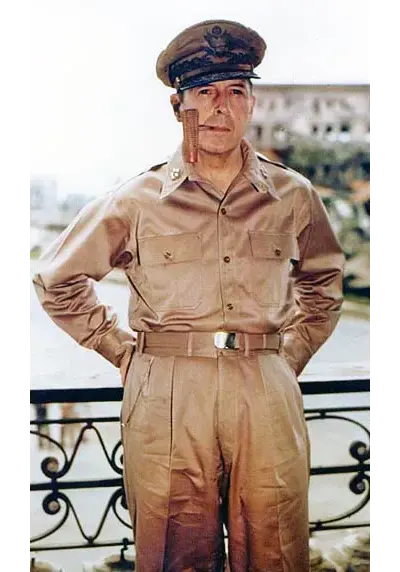
- Born: January 26, 1880
- Died: April 5, 1964
- Nationality: American
- Profession: Soldier
General of the Army Douglas MacArthur was an American five-star general and Field Marshal of the Philippine Army. He was Chief of Staff of the United States Army during the 1930s and played a prominent role in the Pacific theater during World War II. He received the Medal of Honor for his service in the Philippines campaign, which made him and his father Arthur MacArthur Jr. the first father and son to be awarded the medal. He was one of only five to rise to the rank of General of the Army in the U.S. Army, and the only one conferred the rank of field marshal in the Philippine Army.
