Eleanor Roosevelt Quotes
It is an interesting situation here because the conservative and progressive party are both conservative! They would ordinarily represent the people who would want to return, perhaps not to the militarism of prewar days but to many of the economic and social customs of pre-war days but, under the influence of our early occupation period, they passed a number of rather liberal social security laws and gave rights to trade unions, etc. At present they are trying to rescind the right to strike. I don't think anything has really crystallized in this country as yet. One sees much shifting back and forth and there are possibilities for much more.
Eleanor Roosevelt, 1884-1962, First Lady (Franklin Delano Roosevelt), U. S. Delegate to the United Nations, Describing Japan, Newspaper Column, My Day, June 20, 1953
Sourced by: Eigen's Political and Historical Quotations


Unlike the labor laws in their platform (see {590471}), these rights were never given the Soviet citizen. During Stalin’s reign, there was no longer even any pretense of Russians getting these rights.


Ironically, this view was also held by many of the capitalist “Captains of American Industry” who believed that all unions were revolutionist regardless of the views of the union’s membership or leadership. Even today, there are some who still equate trade unionism with communism and revolution. The majority of the unions and the left never believed that, but the extreme communists and extreme capitalists did than and some do today.


What if you are a conservative in a liberal environment? Then what you are conserving is liberalism.
His reference was to his experience as an undergraduate at Dartmouth, which he and associates views as a liberal organization, while others viewed it as a conservative bastion of the establishment.


There was a small conservative wing of the then Republican Party that was committed to rolling back the New Deal. In the early part of the 21st century this wing had grown in size and was very influential in the party. They tried, with President George W. Bush leading the effort, to privatize Social Security but most of the public was having none of it, and it didn’t get very far. It was a very good thing that it did not, as in the 2009 Economic Meltdown, the Stock Market value was cut in half.


So far as he was concerned, Republican moderates—his own party members—were liberals. Anyone who did not support the extreme Conservative agenda, was an enemy and a liberal. He and the Tea Party drove almost all the moderate Republicans out of the party.

The term “Chicken Hawk” was also used by Ron Paul in the Republican Presidential Nomination Debates in 2012. Of the 8 candidates in the debate, he was the only one opposed to military intervention abroad and he was the only candidate who had served in the military. Many Chicken Hawks not only never served but applied for deferments and used other techniques to avoid military service. The origin of the term is uncertain but it entered print in the late 1980s and was applies to Vice President Dan Quayle why was a strong war supporter but had used family connections to gain admission to the Indiana National Guard and thus avoid service in the Vietnam War,

Actually, there have been “paranoid” fear of opposition political viewpoints in America very often. In the early days of the Republic, the Federalists main concern was not England or other foreign enemies, but Jefferson’s Democratic Republicans. And those Jeffersonians were absolutely convinced that the greatest danger to America was the Federalists who would bring back a monarchy if they could. The Jacksonians triggered a similar polarization. The Civil War stemmed from this extreme. Even America’s most popular President, Franklin Delano Roosevelt, who was elected to 4 successive terms, was perceived as the major “enemy” of America along with his wife Eleanor and the other New Dealers.
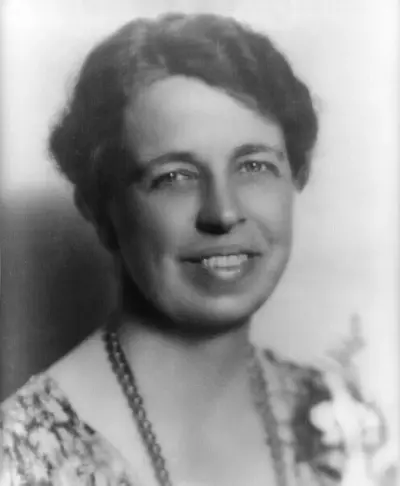
Anna Eleanor Roosevelt was an American political figure, diplomat and activist. She served as the First Lady of the United States from March 4, 1933, to April 12, 1945, during her husband President Franklin D. Roosevelt's four terms in office, making her the longest-serving First Lady of the United States. Roosevelt served as United States Delegate to the United Nations General Assembly from 1945 to 1952. President Harry S. Truman later called her the "First Lady of the World" in tribute to her human rights achievements.
