Roger B. Taney Quotes
No one will suppose that a government could have lasted a single year, if offenses against its laws could not have been punished without the consent of the state in which the culprit was found.
The issue was whether the Federal government could enforce a federal law against a citizen of a state if the state did not agree. There were some who argued that the State had the supreme authority over any citizen within the state. That view has been rejected and the Federal government may enforce its laws on anyone in any state regardless of the views of the state.
Roger B. Taney, 1777-1864, Chief Justice of the U. S. Supreme Court, U. S. Treasury Secretary, 1859
Sourced by: Eigen's Political and Historical Quotations


Prior to that the accepted phrase was “Law of Nations,” but soon after Bentham first used “International Law” it caught on and became widespread in the English Language. See Columbia Law Review, Vol. 5, No. 2, February 1905


Theodore Roosevelt was the Presidential nominee


And let the sheriffs who have arrested them bring them before the justice without any other summons.
This assize is generally considered to be the first written specification of due process in English Common Law.

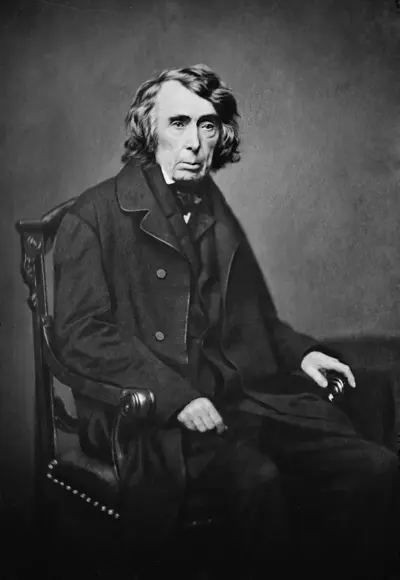
Roger Brooke Taney was the fifth Chief Justice of the United States, holding that office from 1836 until his death in 1864. He delivered the majority opinion in Dred Scott v. Sandford (1856), ruling that African Americans could not be considered citizens and that Congress could not prohibit slavery in the territories of the United States. Prior to joining the Supreme Court, Taney served as the United States Attorney General and United States Secretary of the Treasury under President Andrew Jackson.
