John F. Kennedy Quotes
… man holds in his mortal hands the power to abolish all forms of human poverty, and all forms of human life.
John F. Kennedy, 1917-1963, 35th President of the United States (Democrat, MA), John F. Kennedy: containing the public messages, speeches, and statements of the President, 1961-1963
Sourced by: Eigen's Political and Historical Quotations


There had been so much nuclear activity—military and civilian—that he thought it inevitable, either by intention or accident, that there would be some catastrophes. Chernobyl and the crash of a nuclear bomb equipped plane in Spain destroyed the two areas for years thereafter proved him prescient but fortunately none of the “incidents” were bad enough to affect millions of people significantly although the damage of Chernobyl is still being discovered.

The lecture was on radium and the radioactivity that scientists had recently discovered. This appears to be the first time a scientist suggested the possibility of using atomic energy to produce a powerful weapon. At the same time, note that he also mentioned the possible destruction of the earth. “Heavy matter” referred to the elements—many of which had not yet been discovered—that had larger atomic numbers than radium like uranium.


Any object that has been contaminated gradually loses its radioactive strength. It has a “half life”. This is the amount of time that it takes for the radiation in an object to lose half its strength. Different materials have different half lives. Nuclear waste from a power plant for example might have a half life of tens of thousands of years.

The fear of a nuclear accident is not based on the statistics or probability of death or injury. When a person chokes, it is only that person who may die. IF there is a nuclear power plant meltdown, millions of people can be injured or killed. It is the possible scale of the problem which makes most citizens fearful.


One new danger that nuclear powers add to the usual problems of conflict, is that a nuclear power, about to lose a war in a humiliating way, might just use his nuclear weapons in revenge. So much damage will be done that the victory turned out to have been a bad thing. So ironically, with a nuclear enemy. Your military dare not win to dominantly with conventional weapons.

Israel started it nuclear weapons program under Perez’s leadership. They do not admit that it is even in existence. Yet all their potential enemies in the Middle East realize that they have enough nuclear weapons capacity that if they are in danger of being overrun, they can literally destroy the attacking nation and all the countries that might be assisting that nation. Before Israel had developed this capability, some in the Middle East had as their objective to destroy the state of Israel and “drive the Jews into the sea”. No one believes that it is now possible to militarily defeat Israel without the attacking nations also being destroyed. For years, Israel has had the military might to conquer any nation in the Middle East and use their nuclear shield to protect them from any interference, but they have not done so demonstrating that the Israeli governments will not use nuclear weapons for any other purpose.

Nuclear fusion is different from nuclear fission that currently powers atomic power plants. Fusion is the process the sun uses to generate all its power. Scientists understand exactly how fusion works—it’s much simpler than fission, but actually creating a way of doing it on earth has been a very difficult challenge. The National Ignition Facility has been trying to produce a fusion reaction for a number of years with no success.
This was his last publication. He died of a heart attack as the magazine was being printed. Since this was written one other possible use of nuclear weapons has been suggested—namely, retaliation for a biological attack. From a policy point of view, maintaining an arsenal of biological weapons for retaliatory purposes is dangerous and use for retaliation of biological weapons is not very controllable and arguably less humane than a nuclear weapon. His point however still holds. We have to have a national defense policy against many threats and we have to have defense policies that handle all these without nuclear tactics is insufficient to handle any of the threats without causing more problems and we have other weapons and techniques that are just as, if not more, effective. They and systems under development have the major role in our current defense policy.

The origin of the United States refusal to rule first use out lies with the Cold War concern of a massive Russian Ground attack in European countries. Even with NATO, we could not deploy ground and air resources fast enough to prevent the takeover of entire countries. Then when we amassed the troops and airpower to counterattack, there would be massive civilian casualties of the invaded nations. So American strategy, at the insistence of our European Allies was to deter invasion. By renouncing first use, the Western Powers would almost invite the Russians to invade European nations. There was a similar fear of North Korea and China,
The Booklet told people that even under an atomic attack there would be many survivors and it was everyone’s job to increase the number of survivors by taking precautions like building fallout shelters and maintaining a supply of food and water at home and ducking under desks and tables if there was an atomic attack. The implication was that despite the great firepower of the then Hydrogen Bombs there would be great survivability. The suggestions for protection ranged from minimal likely effect to absurd. The Publication also bore the imprimatur of the Executive Office of the President for credibility and many people believed it.


No one knows whether or not Castro was really sincere in making this offer. The Russians rejected it of course. If they made a first strike on the United States, Russia would have been crippled completely by the retaliation, and they knew it. Castro knew that they knew it and might have been counting on the fact that the Russians would reject his heroic offer. Alternatively, he may have been enough of a fanatic to sacrifice his own life that that of every single Cuban.

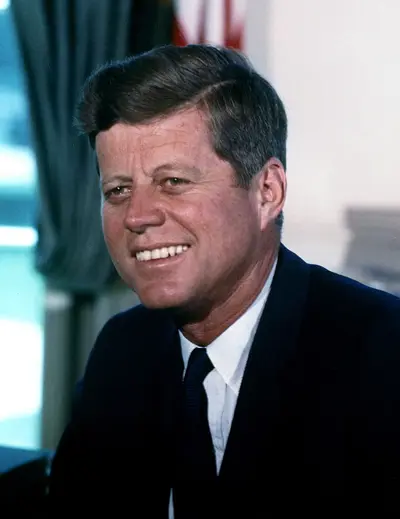
John Fitzgerald Kennedy, often referred to by his initials JFK, was an American politician who served as the 35th president of the United States from 1961 until his assassination in 1963. Kennedy served at the height of the Cold War, and the majority of his work as president concerned relations with the Soviet Union and Cuba. A Democrat, Kennedy represented Massachusetts in both houses of the U.S. Congress prior to becoming president.
