Wesley Clark Quotes
… losing hearts and minds can mean losing a war …
Clark had commanded the American and NATO forces in the Serbian War where all the military and political objectives were accomplished with heavy losses to the Serbian’s and none to the allied side—what many think was the most successful war in American History. Like Eisenhower in WWII one great challenge for Clark was the political and strategic one of keeping the coalition of all the allied governments working together. His perspective had been like Eisenhower’s and other officer’s perspectives in history, which was much wider and geopolitical than the views of most military officers.
Wesley Clark, U. S. General and NATO Commander, Candidate for the Democratic Presidential Nomination, “The Next War”, The Washington Post, September 16, 2007
Sourced by: Eigen's Political and Historical Quotations


The British, despite Clinton’s correct perception of its importance, could not capture the “hearts and minds” of the American colonists. The importance of the quotation lies in the fact that it appears to be the first time the phrase was used in a political context. Click http://politicalquotes.org/search/node/Hearts%20and%20Minds to see other, later, political quotations that use the phrase. See especially {628753} which became one of the most famous quotations to come out of the Vietnam War.


Clark had commanded the American and NATO forces in the Serbian War where all the military and political objectives were accomplished with heavy losses to the Serbian’s and none to the allied side—what many think was the most successful war in American History. Like Eisenhower in WWII one great challenge was the political and strategic one of keeping the coalition of all the allied governments working together. His perspective had been like Eisenhower’s which was much wider and geopolitical than most military officers.
Clark had commanded the American and NATO forces in the Serbian War where all the military and political objectives were accomplished with heavy losses to the Serbian’s and none to the allied side—what many think was the most successful war in American History. Like Eisenhower in WWII one great challenge was the political and strategic one of keeping the coalition of all the allied governments working together. His perspective had been like Eisenhower and other officers in history was much wider and geopolitical than most military officers.


This was only 10 months into Nixon's Presidency. He stepped up the war.
The line was delivered by Dustin Hoffman.

The quotation was given by Defense Secretary Donald Rumsfeld just prior to the war with Iraq, 2003.
Churchill saw before many others that technology and weaponry had changed the nature of warfare. At the time the military leadership of all the major powers were pursuing 19th century tactics with 20th century weaponry including mass bayonet charges against machine guns behind barbed wire. Churchill and other civilians, although they had legal control over the military, had little de facto tactical control. As a politician he became an itinerant meddler in military tactics thereafter.


Clark was particularly brilliant in the Serbian War, where he led America and NATO to a major victory without a single American being killed. There had never been a major war like it, where air power and negotiating carried the victory. And yet, that strategy was not very useful for Iraq and Afghanistan Wars. See {597899} for another of his quotations in this theme.


The Vietnam War was certainly not a victory for the U. S. Some saw it as our first defeat. While it was not ended on Johnson’s watch, he must certainly share that responsibility with Nixon and even JFK as these three all were responsible for our Vietnam failure. Johnson, ended up with what he feared most.


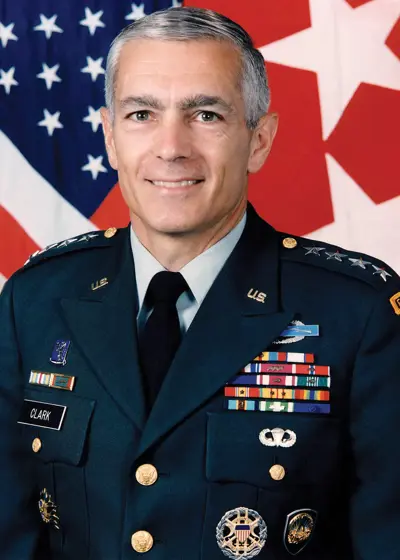
Wesley Kanne Clark, Sr. is a retired general of the United States Army. He graduated as valedictorian of the class of 1966 at West Point and was awarded a Rhodes Scholarship to the University of Oxford, where he obtained a degree in Philosophy, Politics and Economics. He later graduated from the Command and General Staff College with a master's degree in military science. He spent 34 years in the U.S. Army, receiving many military decorations, several honorary knighthoods, and the Presidential Medal of Freedom.
