Stanley A. McChrystal Quotes
Wars are won in people’s minds. The Army must think it won and the people decide.
Stanley A. McChrystal, Army General & Commander of Coalition Forces in Afghanistan, Quoted on PBS, The Charlie Rose Show, January 22, 2014
Sourced by: Eigen's Political and Historical Quotations


Clark had commanded the American and NATO forces in the Serbian War where all the military and political objectives were accomplished with heavy losses to the Serbian’s and none to the allied side—what many think was the most successful war in American History. Like Eisenhower in WWII one great challenge for Clark was the political and strategic one of keeping the coalition of all the allied governments working together. His perspective had been like Eisenhower’s and other officer’s perspectives in history, which was much wider and geopolitical than the views of most military officers.

The British, despite Clinton’s correct perception of its importance, could not capture the “hearts and minds” of the American colonists. The importance of the quotation lies in the fact that it appears to be the first time the phrase was used in a political context. Click http://politicalquotes.org/search/node/Hearts%20and%20Minds to see other, later, political quotations that use the phrase. See especially {628753} which became one of the most famous quotations to come out of the Vietnam War.

Commenting on the photo realistic technological achievement in Disney’s remake of The Lion King, David raises a warning about the ability for this technology to create deepfakes that are indistinguishable from reality.


The line was delivered by Dustin Hoffman.


This has been true in just about every conflict. In WWII however, there were a highly disproportionate ration of atrocities with those of the axis forces dwarfing those of the U. S. and its allies. Further, after the war, those allied atrocities that did take place were published. In addition, one basic difference is in the policies of the fighting forces and their governments as opposed to individual actions by soldiers. In WWII, the allied atrocities were of the latter type, but the axis atrocities involved both.


What is amazing about this quotation is that it shows the naivety of one of the most sophisticated politicians in the country. He and many politicians were really surprised that commercial consumer marketing techniques would work so well. He and many others thought that the issue of marketing political candidates was something that should be debated. Meanwhile, all the pragmatic politicians of both political parties jumped on the commercial marketing bandwagon, but the Republicans tended to master and execute the techniques more skillfully.

There was an interesting parallel to the Iraq and Afghanistan Wars. When American troops would explain their mission to locals, many were actually fearful of terms like democracy, freedom, education, development and modernity. Religious and cultural forces had made these concepts fearful and undesirable and while there were many who saw these as desirable, there were also many who perceived these as undesirable and even evil. The American military faced the same problem a century ago.


The conflict to which he was referring was the terrorism practiced by the Pakistan-supported Muslim fundamentalists in Kargil, India in 1999.
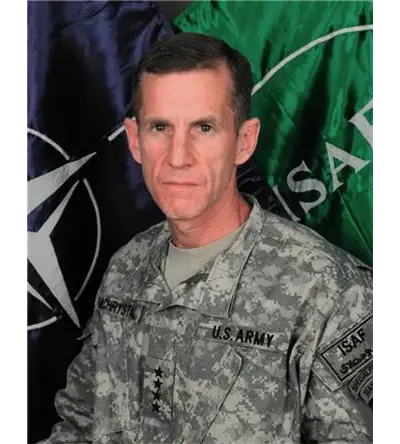
Stanley Allen McChrystal is a retired United States Army general best known for his command of Joint Special Operations Command (JSOC) in the mid-2000s. His last assignment was as Commander, International Security Assistance Force (ISAF) and Commander, United States Forces – Afghanistan (USFOR-A). He previously served as Director, Joint Staff from August 2008 to June 2009 and as Commander of JSOC from 2003 to 2008, where he was credited with the death of Abu Musab al-Zarqawi, leader of Al-Qaeda in Iraq, but also criticized for his alleged role in the cover-up of the Pat Tillman friendly fire incident. McChrystal was reportedly known for saying what other military leaders were thinking but were afraid to say; this was one of the reasons cited for his appointment to lead all forces in Afghanistan. He held the post from June 15, 2009 to June 23, 2010.
