Elwell Stephen Otis Quotes
The ignorant classes had been taught to believe that certain words such as "sovereignty," "protection," and so forth had peculiar meanings disastrous to their welfare and significant of future political domination, like that from which they had been recently freed.
There was an interesting parallel to the Iraq and Afghanistan Wars. When American troops would explain their mission to locals, many were actually fearful of terms like democracy, freedom, education, development and modernity. Religious and cultural forces had made these concepts fearful and undesirable and while there were many who saw these as desirable, there were also many who perceived these as undesirable and even evil. The American military faced the same problem a century ago.
Elwell Stephen Otis, 1838-1909, U. S. Army General, Military Governor for the Philippines, Quoted in Miller, Stuart Creighton, Benevolent Assimilation: The American Conquest of the Philippines, 1899-1903
Sourced by: Eigen's Political and Historical Quotations


There already was a revolutionary effort of Filipinos to obtain independence from Spain when the U. S. defeated the Spanish in the Spanish American War. The revolutionaries then split. Most trusted the United States and looked to America to help them set up an independent government. Others wanted all foreign forces out. They continued their insurrection against the Americans which produced atrocities on both sides. Finally the insurrection was defeated, and the Philippines have been independent ever since. This quotation was the policy justification that President McKinley used to justify the American involvement in the Philippines after the defeat of Spain.


1st Viscount Milner


The Colonel defined people capable of bearing arms as males and females over 20 years of age. Many were slaughtered. Fortunately, most of his officers and men did not follow this order but enough did to make it one of the most disgraceful events in American military history. Smith was court marshaled and found guilty but his punishment was to be cashiered from the army. There were many atrocities committed by the minorities of both sides in this brutal war. Military and Congressional Investigations caused the army manual to be revised military policies reformed.

The Philippine-American War was terribly brutal. In response to insurgent atrocities against American soldiers, some of the Americans also adopted brutal tactics including torture and mutilation. Washington had heard stories of this improper behavior in the part of some American troops and instructed the senior officers to investigate and discipline the men if the reports were true. Unfortunately some of the senior officers covered up the illegal and criminal behavior of some Americans. This quotation was taken from a New York Times report on a representative of the Red Cross who went to the Philippines at the invitation of the insurgents. He generally found serious atrocities by some of the soldiers on both sides but by no means all of the combatants. General Otis, the U. S. Commander tried to keep Blake out, and had him detained away from the battle areas for some weeks where he was “educated” about the enemy atrocities. Finally Blake got to the field and reached the insurgent commander who had invited him. His report generally praised the American troops, but spared no details when there were guilty of atrocities.

A few weeks after the Japanese sneak attack on Pearl Harbor, Japan invaded the Philippines and occupied the country. They thought that because of the original American occupation and some American war crimes in the American Philippines War, the people would welcome Japan, thinking that Japan had freed them from the United States domination. However, by that time, most of the Filipinos had become pro American and despite many posters like this one, the Japanese were hated by almost all of the Filipinos for their atrocities were much worse than the worst of the American army at the turn of the century. The American outrages were committed by a minority of the soldiers and officers while the Japanese atrocities were universal and institutional.


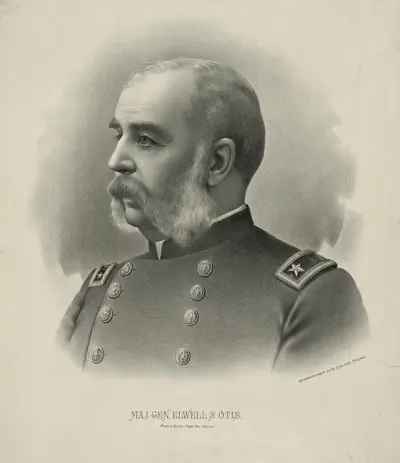
Elwell Stephen Otis was a United States Army general who served in the American Civil War, Indian Wars, the Philippines late in the Spanish–American War and during the Philippine–American War.
