Winston Churchill Quotes
Are there not other alternatives than sending our armies to chew barbed wire in Flanders. No doubt several hundred thousand men will be spent to satisfy the military mind in the point.
Churchill saw before many others that technology and weaponry had changed the nature of warfare. At the time the military leadership of all the major powers were pursuing 19th century tactics with 20th century weaponry including mass bayonet charges against machine guns behind barbed wire. Churchill and other civilians, although they had legal control over the military, had little de facto tactical control. As a politician he became an itinerant meddler in military tactics thereafter.
Winston Churchill, 1874-1965, British Prime Minister (Conservative), Arguing against simply sending masses of land troops to the European front, 1915
Sourced by: Eigen's Political and Historical Quotations


His balanced judgment and concern for American Casualties changed during the Iraq War over a decade later where he insisted on taking steady American casualties even after Saddam had been deposed and American troops were in the middle of a sectarian civil war.

Clark was particularly brilliant in the Serbian War, where he led America and NATO to a major victory without a single American being killed. There had never been a major war like it, where air power and negotiating carried the victory. And yet, that strategy was not very useful for Iraq and Afghanistan Wars. See {597899} for another of his quotations in this theme.

This was a precursor of the total war views of William Tecumseh Sherman and Ulysses S. Grant during the American Civil War half a century later.


The Congress had applauded his message vigorously.


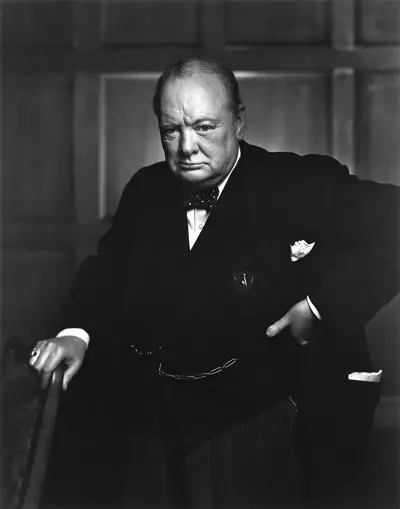
Sir Winston Leonard Spencer Churchill, KG, OM, CH, TD, DL, FRS, RA was the Prime Minister of the United Kingdom from 1940 to 1945, during the Second World War, and again from 1951 to 1955. Apart from two years between 1922 and 1924, Churchill was a Member of Parliament (MP) from 1900 to 1964 and represented a total of five constituencies. Ideologically an economic liberal and imperialist, he was for most of his career a member of the Conservative Party, as leader from 1940 to 1955. He was a member of the Liberal Party from 1904 to 1924. Churchill was also well known for his military career and as a historian, painter and writer, and among his many awards was the Nobel Prize in Literature.
