Montesquieu Quotes
The object of war is victory; that of victory is conquest; and that of conquest preservation.
Montesquieu, Charles de Secondat. The Spirit of the Laws. Translated and edited by Anne M. Cohler, Basia C. Miller, and Harold S. Stone, Cambridge University Press, 1989, p. 7.


The so called War on Terror had many lessons. President Obama and many of the military leaders in the Pentagon realized that just as we evolved the concept of a Cold War, a new concept was needed to deal on the long run with the Al Qaeda terrorists. Typically in war, the nation is fully mobilized with the surrender of the enemy the major objective. When peace is negotiated, there is some demobilization and other things begin to take precedence. However, given the non state highly decentralized nature of Al Qaeda, there is no way to ever negotiate peace because no Al Qaeda official can speak for any more than his immediate cell and cadre. They will likely never stop attacking in any foreseeable future since their motivation is ideological and religious. It doesn’t take full military mobilization to protect against individual acts of terrorism, and indeed arguably the large mobilization only gives the terrorists more nearby targets. So American leaders were evolving a state of high protection, surgical strikes and attacks on Al Qaeda leadership and cells, and at the same time a demobilization of many of the overseas ground troops. It is not a state of war yet there will be attacks from time to time against us and attacks by us on Al Qaeda, yet there cannot be an all out war which is de factor non winnable in toto, but is very controllable. For Stein and other hawks, this new state is unfathomable. If there is any attack on Americans or American interests to them we are either at war with full mobilization or have surrendered. The total number of American civillians killed in the 10 year war on terror has been less than 2 months of normal automobile crash deaths or 3 months worth of gun accidents, or one tenth of the deaths caused by flu in a single year.


In this case, he was referring to the situation with the Barbary Pirates who had an incredible extortion racket going in the Mediterranean. If nations would pay them an annual sum each year, they would not attack and seize merchant ships of that country and sell the ships and goods while holding the sailors for ransom. Jefferson favored and authorized war—a naval attack which for many reasons the European nations had not done (they just paid the tribute). Then a peace treaty was finally signed—the first American Treaty.

General Grant had the fort surrounded and the confederate general hoped to surrender the fort and allow him and his men to leave to fight again some other day. This was often agreed to so the military objective would be gained without the casualties of a battle. However, Grant and Lincoln did not simply want to gain forts and territory. They wanted to end the war. Those Confederates who survived the battle were taken prisoner and were out of the fight.


Kerry, a decorated, former Navy officer, was then a spokesperson for Vietnam Veterans Against the War.


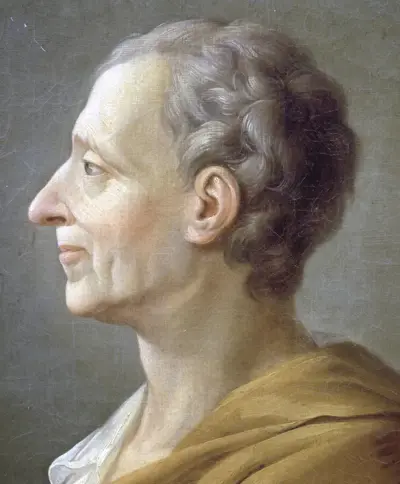
Charles-Louis de Secondat, Baron de La Brède et de Montesquieu, generally referred to as simply Montesquieu, was a French judge, man of letters, and political philosopher.
