Henry A. Kissinger Quotes
We fought a military war; our opponents fought a political one… The North Vietnamese used their armed forces the way a bull-fighter uses his cape — to keep us lunging in areas of marginal political importance.
Henry A. Kissinger, U.S. Secretary of State (Republican), U.S. National Security Advisor, Nobel Peace Laureate, "The Vietnam Negotiations", Foreign Affairs, Vol. 48, No. 2, January 1969
Sourced by: Eigen's Political and Historical Quotations


His hubris soon backfired as the Indians learned how to tactically cope with firearms. For example they soon learned that they would see the flash of the musket before the ball would discharge, so would lie down and the bullets would pass overhead. The muskets were effective as defensive weapons from behind barricades though not very accurate. Swords and pikes turned out to be more effective in most cases.


Not understanding this point has been the cause of much difficulty for military leaders from the war of 1812 through the Iraq war, the success or failure of the effort depended on a successful peace.


Clark had commanded the American and NATO forces in the Serbian War where all the military and political objectives were accomplished with heavy losses to the Serbian’s and none to the allied side—what many think was the most successful war in American History. Like Eisenhower in WWII one great challenge was the political and strategic one of keeping the coalition of all the allied governments working together. His perspective had been like Eisenhower’s which was much wider and geopolitical than most military officers.
Clark had commanded the American and NATO forces in the Serbian War where all the military and political objectives were accomplished with heavy losses to the Serbian’s and none to the allied side—what many think was the most successful war in American History. Like Eisenhower in WWII one great challenge for Clark was the political and strategic one of keeping the coalition of all the allied governments working together. His perspective had been like Eisenhower’s and other officer’s perspectives in history, which was much wider and geopolitical than the views of most military officers.


Although this may seem obvious to most, there has been, in recent years, an attempt by some to introduce the concept of proportionality into the war equation and definition of war crime. Defense after attack many argue should be proportional to the attack. So if Nation A shoots down a plane of Nation B, according to this logic Nation B is not supposed to invade nation A. Brecher points out the absurdity of the concept from a war point of view. It is however used by many to criticize the defenses against terrorism where modern weapons are used against terrorists and those that harbor them.


of the German tactics of Blitzkrieg Goering, Hitler and the other leading Nazis were quite open about their military aggression. Terrorism was admittedly used to persuade the next nation Germany would attack to capitulate rapidly.


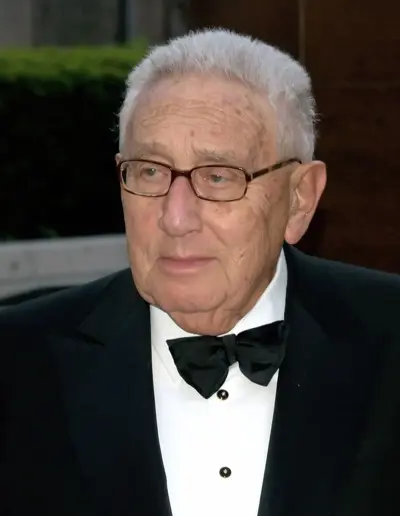
Henry Alfred Kissinger KCMG is an American politician, diplomat, and geopolitical consultant who served as United States Secretary of State and National Security Advisor under the presidential administrations of Richard Nixon and Gerald Ford. A Jewish refugee who fled Nazi Germany with his family in 1938, he became National Security Advisor in 1969 and U.S. Secretary of State in 1973. For his actions negotiating a ceasefire in Vietnam, Kissinger received the 1973 Nobel Peace Prize under controversial circumstances, with two members of the committee resigning in protest.
