James Connolly Quotes
Let us free Ireland! Never mind such base, carnal thoughts as concern work and wages, healthy homes, or lives unclouded by poverty. Let us free Ireland! The rackrenting landlord; is he not also an Irishman, and wherefore should we hate him? Nay, let us not speak harshly of our brother – yea, even when he raises our rent …. “With the Green Flag floating o’er us” and an ever-increasing army of unemployed workers walking about under the Green Flag, wishing they had something to eat. Same as now! Whoop it up for liberty!
Executed by the English for his part in the Easter Uprising. Most revolutionaries seeking independence become so focused on their revolution that they begin to believe that independence will solve all problems. Connelly was one of the more sophisticated ones who realized that many of the economic problems of Ireland had nothing to do with independence or the lack thereof.
James Connolly, 1868-1916, Founder, Irish Socialist Republican Party, Military Commander of Republican Forces in Dublin, Irish Founder of the Irish Socialist Republican Party, Co-Founder Industrial Workers of the World (IWW), Let Us Free Ireland!, 1899
Sourced by: Eigen's Political and Historical Quotations

Fitzhugh was a Southern iconoclast whose view of Northern labor was much like that of Karl Marx but who was an enthusiastic supporter of slavery.


Indian and Black slaves were outlawed very early in Connecticut, not on moral grounds of concern for the Indians and Blacks, but because of the negative effects on the white poor. Why would anyone pay the poor any more than the amortization costs of a slave? Therefore there was no way a poor white could make a living wage if slavery were to coexist.


The Irish landlords were a craven and greedy lot. See {639225}.

The Whites were the old nobility and conservatives who, after the Czar had been deposed, fought a civil war for control of Russia against the Reds—the Bolsheviks. The Whites were allied with the Cossacks, a particularly vicious, and cruel groups of traditional cavalry who previously had done much of the Czar’s dirty work. They were responsible for most of the Anti-Semitic pogroms, and their affiliation with the Whites pushed most Jewish Russians to the Reds.


Executed by the English for his part in the Easter Uprising.


1st Earl of Beaconsfield

For his seditious activities he was sentenced to penal servitude for life. He escaped and came to America where he entered politics

The nobles of the city were in rebellion and fought the English Prince of Wales. When the city was taken, the poor people as well as the nobles were executed for their part in the “rebellion.” However, the poor had no say in the matter, and it was not they who ordered the city gates shut and decided to undergo a siege, which in this case was not successful. Limoges was a heavily walled city, well provisioned for a siege, but the English had miners who undermined part of the city walls and crashed them into the moat and allowed the English to walk in easily.


The highway was planned to go through a poor neighborhood which had a high percentage of Black residents—all of whom would have to find other housing and move to make room for the highway. If the government plans a highway through a wealthy area, the cost to condemn and pay for the land will be much greater than if a poor neighborhood is acquired. For urban highways, the poor almost always bear a disproportionate share of the inconvenience while the major benefit inures to the wealthy and middle class. Abbot had been a labor organizer and a professional artist before he entered politics. The graphic is of his famous poster which by itself stopped the plans to build the highway very quickly.

He was elected to Parliament while in jail and never took his seat as he died of a hunger strike in jail.

Samuel Langhorne Clemens, 1835-1910
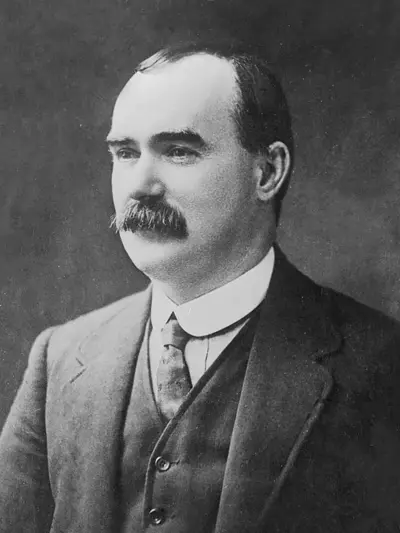
James Connolly was an Irish republican, socialist and trade union leader. Born in the Cowgate area of Edinburgh, Scotland, to Irish parents Connolly left school for working life at the age of 11, and became involved in socialist politics in the 1880s.
