Winston Churchill Quotes
It it had not been for the loyalty and friendship of Northern Ireland we should have been forcd to come to close quarters with Mr. De Valera of perish forever from the earth. However, with a restraint and poise ti which … history will find few parallels, His Majesty’s Government never laid a violent hand upon them … and we left the Dublin Government to frolic with the Germans … to their hearts’ content.
Under the treaty between Ireland and England that created the Irish free state, in case of war or other contingency, the Irish Free State was required to allow Great Britain to use specific seaports. However, De Valera hated the English, originally opposed the treaty, and was adamant that the Irish Free State be neutural in WWII. He therefore refused to fulfill the Irish obligation. Interestingly, although De Valera did not want to assist the British fighting the Germans, over 70,000 Irishmen went to England and Volunteered to fight on the British side. There were Irish batallions fighting on the allied side but the Irish Free State was neutural. De Valera made matters worse when he allowed German agents into the Irish Free State to try and go from there to England as well as set up observation posts to guide German bombers attacking the populated city of Belfast and other parts of Northern Ireland. The Allies were able to use the Northern Irish Ports but had the Germans blocked those, the British would have invaded the Port Areas of the Irish Free State to obtain what Ireland was required to supply.
Winston Churchill, 1874-1965, British Prime Minister (Conservative), Quoted in Jonathan Bardon, A History of Ireland
Sourced by: Eigen's Political and Historical Quotations

Under the treaty between Ireland and England that created the Irish free state, in case of war or other contingency, the Irish Free State was required to allow Great Britain to use specific seaports. However, De Valera hated the English, originally opposed the treaty, and was adamant that the Irish Free State be neutural in WWII. He therefore refused to fulfill the Irish obligation. For Churchill this was the last chance for De Valera to show that the Irish Free State was a real nation with rights and obligations. Interestingly, although De Valera did not want to assist the British fighting the Germans, over 70,000 Irishmen went to England and Volunteered to fight on the British side. There were Irish batallions fighting on the allied side but the Irish Free State was neutural. De Valera made matters worse when he allowed German agents into the Irish Free State to try and go from there to England as well as set up observation posts to guide German bombers attacking the populated city of Belfast and other parts of Northern Ireland. See {639724} for Chirchill’s later reflective commentary on the situation.

At this point, the horrors of the German concentration death camps were generally known by the world press. This quotation shows the denial that the Irish Free State was in about the German Nazi atrocities. The 6-county Nationalsits were the Irish counties in Northern Ireland that did not join the Irish Free State and so far as the Catholic Irish were concerned, the Catholics of Northern Ireland were a persecuted minority undergoing oppression and that was not they believed morally different from the murders of millions of Jews, Gypsies and handicapped people in Europe. If the Free State Irish publicly admitted the difference, they would morally have had to join the allies and De Valera was totally opposed to that. Over 70,000 Irishmen and women rejected the moral stand of their government, and volunteered for the British Army to the great distress of the Free State leaders like De Valera. See {639722} for his personal denial of reality.


Chamberlain’s policy was to appease Hitler and Germany to avoid war. Although he did not see Czechoslavkia as a critical British national interest and claimed he had secured peace {585941} , the reality was that he gave Germany room to start its aggression which would engulf all of Europe and much of the world. The British became the only bulwark against Hitler until the Russians stopped the Germans and America entered the war.

The elder Kennedy was an admirer of Hitler and Fascism and was convinced that democracy was finished in England. As the U. S. Ambassador to England, his views—see also {610124} and {610122}—destroyed his own political career in the United States, and he thereafter kept a low profile and maintained his political aspirations through his children.

After the sneak attack on Pearl Harbor, Stimson drafted the Declaration of War that President Roosevelt would ask Congress to vote for. However, there was a small but very vocal group of extreme Republican conservatives who opposed assisting England against Hitler and saw German and Italian Fascism as positive forces. They would oppose any administration declaration of war against Germany and Italy who had not yet attacked any American facilities. The President realized that German and Italy had a Mutual Defense Treaty with Japan, and when we declared war against Japan, would have to ally with Japan or reneg on their treaty. So FDR removed Germany and Italy from the Declaration and Congress just declared war against Germany. In the next days, Germany and Italy declared war against the United States, and the de facto situation was as Stimson had drafted it, but FDR had not given the right wing American Fascist sympathizers any issue to criticize the administration.

The Germans killed 22 million Russians, most deliberate murders and not collateral damage, in WWII.


A delegation from Sinn Fein, headed by Arthur Griffith and Michael Collins, had negotiated a treaty of Irish Independence except that it did not cover Northern Ireland where the majority of the people wanted to stay a part of Britain. For 700 years, the Irish had fought for independence, and finally they got it for the vast majority of Ireland and the overwhelming majority of the Catholics of Ireland. The alternative to agreeing to the treaty was to continue the war between the IRA and the British Troops. At the time, the IRA was just about totally beaten and probably could not hold out another month. De Valera, a very shrewd politician, as the leader of Sinn Fein (and the IRA) would normally have headed the Irish Delegation. But he chose not to because he realized that they would never get independence for all 32 counties of Ireland as the British would not leave the Northern Ireland Protestants to their fates against their will. The best Ireland could get was Independence for all of Catholic majority Ireland. And he knew that public opinion would oppose giving up even one county becuse that was what the leaders had told the people for years. So De Valera let his two associates take the popular blame after he denounced the treaty with his famous quotation. Shortly after that, Michael Collins, the brilliant military Commander of the IRA who signed the treaty was assassinated. To many, it was as if De Valera had pulled the trigger. The treaty was ratified by a single vote by the Dail as there was no army left to fight, and the angry Irish electorate voted for De Valera as Ireland’s first President. The politician won; the patriot died.

Turkey, in a disastrous foreign policy decision unilaterally withdrew from a major treaty and joined Germany in WWI in exchange for German support of Turkey’s treaty withdrawal. It led to the dissolution of the Ottoman Turkish Empire when Germany was defeated in WWI. Historically, it shows how easy it is for a nation to abrogate a treaty which illustrates how ephemeral treaties actually are. See De Gaulle’s wonderful quotation on this point—{138034}.

The only soldier ever so honored. Marshall was then Chief of Staff of the Army. This quotation is historically very important in that it refutes the accusation made by some FDR and New Deal enemies that Roosevelt was very naïve about the importance of capturing Berlin and ceded control over the invasion and capture of Berlin to Stalin and the Soviet Union. Marshall, one of the most upright of politicians in American history, was not a FDR apologist and few doubted his word or judgment. (Senator Joseph McCarthy and other right wingers however falsely accused him of harboring communists in the Army and working against America’s interest against Russia.

The “proofs” were diplomatic assurances—treaties—that England would guarantee the territorial integrity of Belgium. The British made strong diplomatic efforts to persuade Germany not to occupy Belgium. The German’s none the less send armies in under the excuse that if they did not, the French would occupy the country and have a strategic advantage over them. Diplomacy could do no more good. England had to send troops or renege on its obligations. So England was in WWI.


In 1938 Germany had rearmed and resumed its aggressive designs of expansion. Hitler wanted the Sudetenland part of Czechoslovakia and threatened an invasion of that country. England had France had a treaty obligation to militarily support Czechoslovakia if it were attacked. British Prime minister Neville Chamberlain and the French were desperately trying to avoid war, not realizing that with Hitler, that position was the very thing that would bring on war. So they agreed to Hitler’s demand and allowed Czechoslovakia to be partitioned and the Sudetenland was annexed to Germany. This craven appeasement emboldened Hitler who then decided to conquer all of Europe as he had no serious opposition from France and England—the two powers that might have stopped him. (At the time, the French had a larger army than the Germans.)

This was issued in response to Germany issuing a warning that neutral ships might be in danger in their sea war with England -- {583920}. And it was just such an attack on an American Ship that brought America into the First World War.


Dreadnoughts were huge battleships. Britain had the dominant navy of the world and controlled the seas. A European war would be a land war where a navy would be of little use. Hence, Britain would not want to get involved in such a war where she could not use her greatest military strength. He was wrong about this and so much else. Britain entered WWI when Germany invaded Belgium fulfilling her treaty obligations. The Germans intelligence operators and analysts were well aware of the treaty obligations, but had little understanding of English culture and tradition. The German aggression against a small power like Belgium was morally offensive to many in Great Britain, and Britain had a tradition of fighting for moral principles. The Germans would never militarily disadvantage themselves for the sake of a treaty obligation to a small nation, and they did not believe that the British would be so different and fulfill their treaty obligations even though their strongest military asset—their navy would not be very helpful.
England is entering the war against Germany The German war plan called for attacking France through Belgium. However, Belgium was intent on remaining neutral. International law prohibited a neutral country from allowing troops of either side to enter and maneuver in its territory. ({642178}). When Germany moved into Belgium, the Belgians resisted. England had a treaty with Belgium that it would protect Belgian neutrality in the event of any war in Europe. England then sided with Belgium {642175} and committed to send troops to help Belgium oust the Germans. The Kaiser was furious and could not understand that the English would go to war when there was no economic need or advantage for them to do so. Wilhelm II did not have much respect for treaties, promises, or honor other than military honor. He had earlier convinced himself that the English would not fight for a scrap of paper, especially in a land war. {642105}
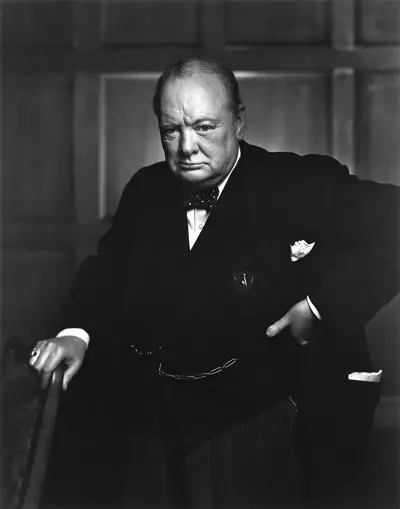
- Born: November 30, 1874
- Died: January 24, 1965
- Nationality: English
- Profession: Statesman
Sir Winston Leonard Spencer Churchill, KG, OM, CH, TD, DL, FRS, RA was the Prime Minister of the United Kingdom from 1940 to 1945, during the Second World War, and again from 1951 to 1955. Apart from two years between 1922 and 1924, Churchill was a Member of Parliament (MP) from 1900 to 1964 and represented a total of five constituencies. Ideologically an economic liberal and imperialist, he was for most of his career a member of the Conservative Party, as leader from 1940 to 1955. He was a member of the Liberal Party from 1904 to 1924. Churchill was also well known for his military career and as a historian, painter and writer, and among his many awards was the Nobel Prize in Literature.
