Condoleezza Rice Quotes
Ultimately, we didn't go to Germany to create a democracy. We went to overthrow Adolf Hitler. But once a democracy was there, Germany was a much bigger supporter of and help to our national interests, both economic and security than had ever been before.
Rice, Condoleezza. Democracy: Stories from the Long Road to Freedom. Twelve, 2017.

Hitler ridiculed the letter after receiving it in public speech.


This is an important quotation because it shows that Franco was not only a Fascist but one who supported and approved of Hitler personally and his criminal programs. Most Spaniards have thereafter regretted that the Spanish Dictator could take such a murderous and inhumane position on behalf of the Spanish people. Franco was supported only by some of the very wealthy, part of the military and the Catholic Church leadership. The latter also makes this quotation important, in that it is very doubtful that the Spanish church leaders would support Hitler if the Pope and the Vatican were opposed to Hitler and the Nazis. Yet some Vatican representatives have maintained that the Pope was definitely opposed to Hitler and Nazism, but the evidence for this is not strong. This quotation tends to lend more credence to the Papal critics.


He had given a speech and then was accused by several representatives He then returned to the podium with this denial. Throughout history many political leaders have started wars to distract the public from the poor economy of other domestic failures. Many others would never do so. All the former, claim that they are the latter.


The Japanese heavily resented the attitude of must Westerners where the Japanese were seen as an inferior and backward race and culture. They did not however believe in equality for the world. They simply wanted to be equal to the West and not in the category of primitive people or backward countries. They wanted to be considered one of the Great Powers. To them for example, the Koreans and Chinese were backward people, but not they. They wanted parity for themselves only of the Asian countries.


The “proofs” were diplomatic assurances—treaties—that England would guarantee the territorial integrity of Belgium. The British made strong diplomatic efforts to persuade Germany not to occupy Belgium. The German’s none the less send armies in under the excuse that if they did not, the French would occupy the country and have a strategic advantage over them. Diplomacy could do no more good. England had to send troops or renege on its obligations. So England was in WWI.


The military security people were so used to ferreting out communists in the 1930s that they had a hard time adjusting to the fact that the security risks or people who might have German connections or backgrounds. Many immigrant scientists were recruited for work on the Manhattan project to build the atomic bomb and they only did security clearances. The military security people kept checking on any communist background they might have had as opposed to possible connections with fascist organizations. By the end of the war they had adjusted but then had to go back to looking for communists as the Cold War evolved.


There were many who thought that the Russians would view the Mutual Security Act as aggressive and they might respond with some kind of aggressive retaliation and this could lead to war. Others felt that containment would reduce the likelihood of war.

After the sneak attack on Pearl Harbor, Stimson drafted the Declaration of War that President Roosevelt would ask Congress to vote for. However, there was a small but very vocal group of extreme Republican conservatives who opposed assisting England against Hitler and saw German and Italian Fascism as positive forces. They would oppose any administration declaration of war against Germany and Italy who had not yet attacked any American facilities. The President realized that German and Italy had a Mutual Defense Treaty with Japan, and when we declared war against Japan, would have to ally with Japan or reneg on their treaty. So FDR removed Germany and Italy from the Declaration and Congress just declared war against Germany. In the next days, Germany and Italy declared war against the United States, and the de facto situation was as Stimson had drafted it, but FDR had not given the right wing American Fascist sympathizers any issue to criticize the administration.

The then Attorney General had established a back channel to the Russian agent. There was genuine fear by the Russians and some in America that there were still many Nazis and German nationalists who would try and influence, if not take over, German politics to produce another aggressive German fascist state. The Russians had lost 22 million citizens to the Germans in the war and had faced a defeated Germany where virtually every German over the age of 30 had been cheering for and supporting Hitler a decade ago. Neither the Russians nor we and the other allies had not yet seen the remarkable turn-around that the German nation would make and the intense anti-fascist, non-military ethos that would be brought by the younger German generations. The direction of Germany was then very unpredictable.


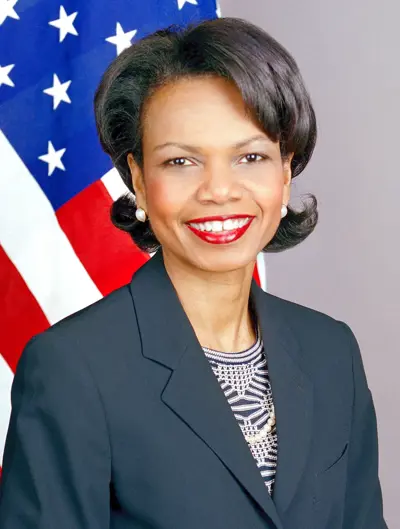
Condoleezza "Condi" Rice is an American diplomat, political scientist, civil servant, and professor who is the current director of the Hoover Institution at Stanford University. Rice served as the 66th United States Secretary of State from 2005 to 2009 and as the 20th United States National Security Advisor from 2001 to 2005. A member of the Republican Party, Rice was the first female African-American secretary of state and the first woman to serve as National Security Advisor. Until the election of Barack Obama as president in 2008, Rice and her predecessor, Colin Powell, were the highest-ranking African Americans in the history of the federal executive branch (by virtue of the secretary of state standing fourth in the presidential line of succession).
