Leslie Richard Groves Jr. Quotes
The communists are our allies in this war. That's the Nazis we are fighting. Go look at them.
The military security people were so used to ferreting out communists in the 1930s that they had a hard time adjusting to the fact that the security risks or people who might have German connections or backgrounds. Many immigrant scientists were recruited for work on the Manhattan project to build the atomic bomb and they only did security clearances. The military security people kept checking on any communist background they might have had as opposed to possible connections with fascist organizations. By the end of the war they had adjusted but then had to go back to looking for communists as the Cold War evolved.
Leslie Richard Groves, Jr., 1896–1970, Army General of the Corps of Engineers, Commander of the Manhattan Project to build the atom bomb, Project Director for the Building of the Pentagon, Hand written note to the Manhattan project chief of security
Sourced by: Eigen's Political and Historical Quotations

The security system at Los Alamos while the atomic bomb was being developed was absurd. Scientists from all over the country had to be hired quickly. Many of them had friends and relatives who had various left-wing associations; some came from Germany or had German connections. A number of the key scientists were German refugees from Hitler's persecution. The military security people, using their traditional standards, would not clear people if they had any left wing friends or associates or they came from Europe and there were no records to prove that they were not fascists or communists. Most of the refugees got out with their lives and had no records, but they were among the best scientists in the world. J Robert Oppenheimer, the scientific director, and General Leslie Groves needed the scientists as the work had to be done. Groves approved important personnel for hire pending security clearance which never came and which Groves knew would never come. Nonetheless the people were working by the time intelligence officers outside the project realized what was going on. People without clearance had some of the most sensitive jobs at Los Alamos. Not a single one of those people turned out to be a security risk or a spy. There was a spy however who had come the English scientific delegation, but the security people had cleared him. Barnett however, as Oppenheimer’s personal assistant had access to almost everything having to do with the development of the bomb. She never did get cleared for her job.

The Scientific Project that developed the Atomic Bomb. Oppenheimer, like most sophisticated intellectuals and scientists of the time had acquaintances who were communists or Communist sympathizer in Oppenheimer's case his brother and wife were both members of communist organizations. They too severed their connections. At the time Russia was on major ally in the war against Hitler and fascism. However since the Communist Revolution of 1917 there had been an animus between the American and Russian governments. The work on the atomic bomb was so secret that everybody was a potential suspect and security risk, even our allies. In the final analysis it was a spy in the Manhattan project who was there as part of the British contribution to the project. The security people were chasing after all the scientists who had friends or acquaintances who were communists and missed the real spy who had no such connections.

Donovan had been criticized for utilizing "leftists" for intelligence activities. Precursor to CIA. Donavan was a prominant attorney, banker and financier as well as a Medal of Honor Winner when he was asked to organzie the OSS. America was far behind the axis and even our allies in spy craft. J Edgar Hoover focused the FBI on leftists and had veritually no capability for spying in Western Europe and Asia. Donavan's OSS produced almost all of the actionable intelligence and did a wonderful job in organziaing covert operations. He used people who would normally never be considered by an espionage agency including many scholars, intellectuals, scientists, and entertainers. His agents ranged from Julia Child, the gourmet chef. to Moe Berg, a New York Yankee Baseball Player who spoke many languages. Hoover and some if the military intelligence agencies were jealous of his success and his access to President Roosevelt, and complained about anything they could find and hisi agents were an easy target for their wealth, societal connections, sexual indescretions, liberal politics, Bohemians, upper class right wing politics and culture. None of thus phased Donavan. After the war and FDR's death, Donavan's enemies got the OSS disbanded. Soon, something was needed, and the CIA was organized along the lines of Donavan's recommendations.


This new form of patriotism, this encouragement of pregnancy—even outside of marriage—was just too controversial. Himmler withdrew the order. It illustrates that even in a brutal dictatorship, public opinion can influence government.

The general was replacing George S. Patton as commander of the Third Army. Patton had opposed the deNazification policy of the allies and caused a great deal of public relations difficulty for the army command and the administration, as reporters would frequently print his views. Truscott was one of Patton’s loyal assistants. The minute he took over, the press wanted to find out if his views were the same as his former boss regarding the Nazis. They were quite different. Reporters had no story.

Oppenheimer was cleared but many of the rest of the staff were including those with access to the highest, most critical secrets in the land. See {629854} for a greater understanding of the situation.


The Professor was explaining the explanation of the so-called “Frankfurt School” of WWII policy advisors Franz Neumann, Herbert Marcuse, and Otto Kirchheimer.


Although a fervent Nazi, he detested Hitler. When Hitler consolidated power, one of the first things he did in 1934 was to order his guards to murder Strasser, just as Strasser had feared.


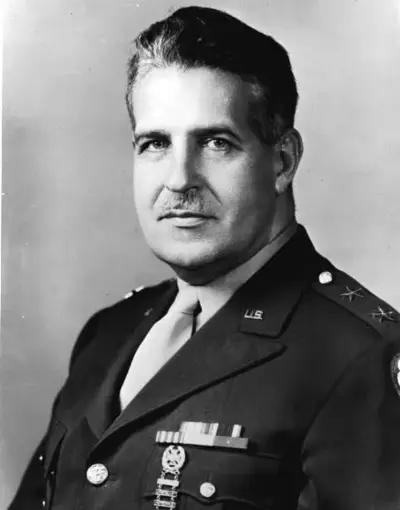
Lieutenant General Leslie Richard Groves Jr. was a United States Army Corps of Engineers officer who oversaw the construction of the Pentagon and directed the Manhattan Project, a top secret research project that developed the atomic bomb during World War II.
