Noam Chomsky Quotes
George Kennan is another extreme case. He was the American consul in Berlin until the war between Germany and the United States broke out in December 1941. And until then he was writing pretty supportive statements back stressing that we shouldn't be so hard on the Nazis if they were doing something we didn't agree with - basically repeating the idea that they were people we could do business with.
Chomsky, Noam. Understanding Power: The Indispensable Chomsky. Edited by Peter R. Mitchell and John Schoeffel, The New Press, 2002, p. 159.

This speech to over 100,000 people galvanized the Indian nationalists They had been asking the British to change the constitution to give India more independence. Churchill was opposed to any policy that would diminish the British Empire, but needed the Indians as men of India served in the British Army in every major theater of WWII. So instead of saying "No" Churchill held out the possibility but at a later time. He argued that it was inopportune to alter the Constitution in the midst of a world war.


This was very much a minority opinion at the time, and has much historical significance as he was the father of the British Prime Minister, Neville Chamberlain, 1869-1940, whose appeasement of Germany led to Word War II. . See {585941}.

He was shot as a traitor when de Gaulle returned. See {587231} and {587230}.

The elder Kennedy was an admirer of Hitler and Fascism and was convinced that democracy was finished in England. As the U. S. Ambassador to England, his views—see also {610124} and {610122}—destroyed his own political career in the United States, and he thereafter kept a low profile and maintained his political aspirations through his children.

Roosevelt had withdrawn his Ambassador to Berlin, publicly reprimanded Joseph P. Kennedy, his Ambassador to England who was pro Fascist and who had said complementary things about Hitler and Mussolini. FDR made anti-German statements to a degree unknown for a country not at war. Hitler publically stated that the Germans would not be pressured. Dictators who U. S. leaders have tried to isolate and pressure, have made similar statements ever since. The American intervention was certainly effective against Hitler.
This telegram was one of the more bizarre episodes leading up to WWII. The “solution” that Rothermore was praising was the German Army seizing and occupying a large part of Czechoslovakia – the Sudetenland -- in violation of the WWI Peace Treaty that Germany had signed. Further, Rothermere knew perfectly well that England and France were bound by treaty to come to the military aid of Czechoslovakia and war between Britain and Germany could break out at any moment. Yet he sent the telegram encouraging Hitler in his aggression. The Daily Mail, Rothermore’s very conservative newspaper supported English Fascist Oswald Mosley and wrote articles favorable to Mussolini and Hitler. There was a small but powerful part of English Aristocracy who were pro German and pro Fascist including the King, Edward, Duke of Windsor {584507} who was persuaded to abdicate and relegated to the Bahamas where his views were not so public. The Daily Mail catered to that part of the English Aristocracy.

The then Attorney General had established a back channel to the Russian agent. There was genuine fear by the Russians and some in America that there were still many Nazis and German nationalists who would try and influence, if not take over, German politics to produce another aggressive German fascist state. The Russians had lost 22 million citizens to the Germans in the war and had faced a defeated Germany where virtually every German over the age of 30 had been cheering for and supporting Hitler a decade ago. Neither the Russians nor we and the other allies had not yet seen the remarkable turn-around that the German nation would make and the intense anti-fascist, non-military ethos that would be brought by the younger German generations. The direction of Germany was then very unpredictable.
The United States and England maintained officially that their stance was moral and ethical. And it was for most Americans and Britons. However, there were some, whose motivation was economically self-serving as this quotation suggests. The less control Japan had over China, the more other countries could freely trade with China.

In 1938 Germany had rearmed and resumed its aggressive designs of expansion. Hitler wanted the Sudetenland part of Czechoslovakia and threatened an invasion of that country. England had France had a treaty obligation to militarily support Czechoslovakia if it were attacked. British Prime minister Neville Chamberlain and the French were desperately trying to avoid war, not realizing that with Hitler, that position was the very thing that would bring on war. So they agreed to Hitler’s demand and allowed Czechoslovakia to be partitioned and the Sudetenland was annexed to Germany. This craven appeasement emboldened Hitler who then decided to conquer all of Europe as he had no serious opposition from France and England—the two powers that might have stopped him. (At the time, the French had a larger army than the Germans.)


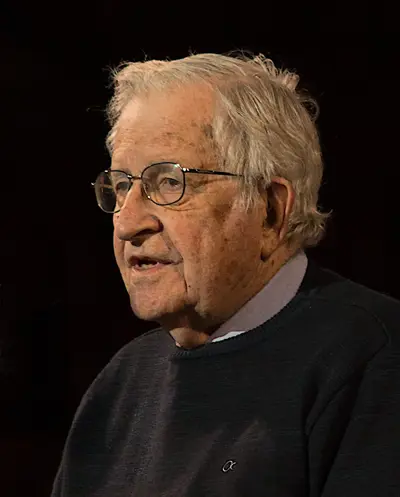
Avram Noam Chomsky is an American linguist, philosopher, cognitive scientist, historian, social critic, and political activist. Sometimes called "the father of modern linguistics", Chomsky is also a major figure in analytic philosophy and one of the founders of the field of cognitive science. He is Laureate Professor of Linguistics at the University of Arizona and Institute Professor Emeritus at the Massachusetts Institute of Technology (MIT), and is the author of more than 150 books on topics such as linguistics, war, politics, and mass media. Ideologically, he aligns with anarcho-syndicalism and libertarian socialism.
