Irvin McDowell Quotes
It is with the deepest mortification the general commanding finds it necessary to reiterate his orders for the preservation of the property of the inhabitants of the district occupied by the troops under his command. The troops must behave themselves with as much forbearance and propriety as if they were at their own homes.
Irvin McDowell, 1818–1885, Civil War Union General, General Order, July 18, 1861
Sourced by: Eigen's Political and Historical Quotations

He was explaining his repudiation of General John Fremont’s military proclamation in Missouri confiscating rebel property and emancipating their slaves. See {633732} .


Few high ranking officers, or officials of civilian organizations, take the responsibility for subordinates not understanding instructions.

Rush ran the hospitals for the Revolutionary Army and talked to many officers and enlisted men, and also observed much of the British military practices. These suggestions were discussed but never passed as regulations. They are fascinating insights into the problems of the general officers of the time who were generally selected for their socioeconomic status rather than other qualifications. Note the drunkenness limitation for a commanding general was proposed to be limited to only 1 allowed bout of drunkenness every 24 hours. It was, he thought, totally unrealistic to require generals to be always sober when on duty. With the mediocre quality of senior officers, Washington had to depend on foreigners like Lafayette, Von Steuben and others. And Generals who were leading attacks out in front of their men like Benedict Arnold immediately became heroes and one of the reasons he ended up as a traitor was that he thought that he was badly treated relative to the “society” Generals who would not accept him and denigrated his exploits when they themselves had never been close to a battle front.

During WWII, the Japanese militarists maintained what they euphemistically described as “brothels” of “comfort women.” They Japanese forced 200,000 Korean Women to become sex slaves for the Japanese Troops in addition to Dutch and other white civilians interned by the Japanese in Asia. For years after the war, the Japanese Governments denied this or maintained a discrete silence. Finally some of the Korean women demanded an apology and restitution and it became a world-wide scandal. Unlike Germany which went through a public nationwide assessment of their WWII atrocities, Japan’s apologies for their war crimes have always been very muted and discrete and Japanese students are not even taught about the Japanese atrocities. Worse, nationalist Japanese politicians have either denied the facts about the sex slavery or as in this quotation, attempted to justify the horrid behavior. See {632770} for an American approach to the same problem.

Lincoln and the Union leaders were still hopeful of ending the rebellion and getting things back to a pre-war footing economically. At this point they were trying to preserve components of the Southern Economy at no small cost. As that hope was shown to be futile, the Total War strategy of Grant and Sherman prevailed to the satisfaction of men like Opdycke. That actually ended the war quickly, but the Southern Economy was devastated in the process.
The Shakers were an American religion and pacifists Lincoln learned. He was so impressed with their sincerity and way of life that he exempted Shaker men from the draft—the first conscientious objectors formally recognized in America. However, Lincoln made the statement to the Shakers which greatly impressed them and caused much reflection. Quakers had been pacifists also, but until the Civil War Draft there was no mechanism to test.

He was convicted as a War Criminal, sentenced to death, and then his sentence was commuted to life imprisonment. His quote is important because this was the defense that was totally rejected by the Nuremberg Tribunal—a solder is not required to obey an order to commit a war crime and if he does, he is as guilty as the person who gave the order.

The Creeks—the Cherokee traditional rivals and enemies were under a different command but all the other Indians were under Stand Watie’s command. In this quotation, we see the negative reaction that many Southerners had toward Quantrill and his cutthroats. This quote and others show that the Quantrill atrocities were generally known throughout the South. The Confederate command structure however, did nothing to rein in Quantrill’s atrocities much less discipline him for his war crimes. It is not clear to whom Waite referred as “enemies”—the Union troops or the Creeks, their traditional enemies. The slavery issue of the Civil War divided more than the nation. The Cherokee’s were badly divided over social class, aristocracy, strategy in keeping their land and tribal sovereignty, and slavery. A number of the older families had Black slaves. Stand Waite was one of the old, traditional, Cherokee, families, who were not happy losing their traditional power and influence when Jon Ross was elected tribal leader. He and his majority faction would not support the South in the Civil War. Stand Waite did, and after Ross was murdered Waite became the Second Cherokee Tribal leader.


Eggleston was an accomplished writer who had served in the Confederate army of the Civil War. 20 year after the war he wrote a series of articles for the prestigious Northern Atlantic Monthly trying to convey the war from the Southerner’s point of view.

The deportations were the massive relocation of Armenians by the Turkish Government in 1915. In the late 19th century some Armenians tried to gain independence and were put down and massacred by the Sultan’s troops. A few decades later Russia battled Turkey. Russian Armenians and Turkish Ottoman Armenians had defected and fought for the Russians who beat the Turks badly. The Turks blamed the traitorous Armenians for the defeat and saw the Ottoman Armenians as a hostile force among them. Many Armenians were brutally massacred. Finally the Turks decided to brutally deport by foot, without sufficient provisions, the Armenians from the critically strategic area they occupied, and a huge number of Armenians died in what has been referred to as the Armenian Genocide. See {51838}, and {61904}.


When the Confederate Government realized that the Union was planning to arm escaped slaves and induct them into the Union Army, they quickly passed a law that declared any escaped slave who joined the Union Army or wore its uniform was guilty of Treason and would be executed. Most Union Generals one way or another got word to the Confederate Officers that they had better treat all Negro Union Soldiers as prisoners of war. Even President Lincoln warned the South. Butler, however, had a large number of Negro troops in his area and had heard threats of some of the Southerners to execute Black prisoners of war. He had a way of making things very clear, and he was able to prevent murder of any of his Negro troops despite the Treason law.

He had no authority to do this. He just took it upon himself. This was one of the incidents which caused later Congresses to pass very strict laws limiting the authority of all Federal Military and other intelligence and police forces so that they have little or no authority within the United States. President Lincoln did not allow the order to stand, although he repudiated it very delicately and as privately as possible. Many in his own party strongly favored this proclamation as it cracked down on the Southern Rebels and emancipated slaves—both objectives of many Republicans. In addition, Fremont was very popular with the people and had strong political connections. (He would later run for President.) See {635739}.

At this point, there had hardly been any fighting and no outrages or war crimes were yet committed by either side. These would come later—more on the Confederate side as they did not want to take the limited resources they had from their troops to fulfil abstract obligations to prisoners of war or to civilians. A few deliberately chose to use terror tactics. The Union troops also at various points in the war got out of hand and looted personal property of civilians. But at this point, this proclamation was just lies and propaganda.

His aggressive tactics which had served him so well in the West got his army into trouble at the Second Battle of Bull Run, where he was out maneuvered by Stonewall Jackson and Robert E. Lee. He was sent back to the West.


The Seminole Wars were one of the low points in American military behavior. With the specific permission of Commanding General Jesup, the soldiers were to loot the homes and personal possessions of the enemy civilians as well as fighters, but he favored extermination and there were many atrocities. He even seized the Seminole Leaders who had been invited for Peace Talks.

Both the Republican and Democratic Parties were ripe with graft—the Democrats in control of many large city machines and the Republicans getting bribes and “donations” from the corporations.

If a military loses a war, it has shown to be insufficient quality; if it wins, the evaluation is good. With all the talk about what makes for an effective and quality military, as the General states, it is war that is the final arbitrator. So ideally we never want to really know how good our military is.

Ivan Khrfistoforovich Bagramyan. Most militaries including ours have generally been trained and equipped for the last war and not the next war.
Ivan Khrfistoforovich Bagramyan. Mikhailovich was looking for military scapegoats for the very unsuccessful defense of Russian Soil against the onslaught of the invading Nazis in WWII. He was given command of a combat division and became one of the Russian heroes in slowing the German Forces, taking enormous losses, and finally repulsing the Germans.
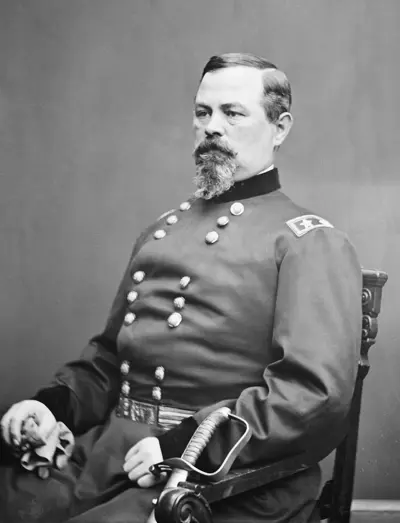
Irvin McDowell was a career American army officer. He is best known for his defeat in the First Battle of Bull Run, the first large-scale battle of the American Civil War. In 1862, he was given command of the I Corps of the Army of the Potomac. He fought unsuccessfully against P.G.T. Beauregard's troops during the Valley Campaign of 1862, and was blamed for contributing to the defeat of United States troops at the Second Battle of Bull Run in August.
