Aga Khan IV Quotes
Islam is probably the one that places the greatest emphasis on knowledge. The purpose is to understand God's creation.
Aga Khan IV. Interview. Der Spiegel, 12 Oct. 2006.


In early Islam, scholarship and science was encouraged in all fields and in most areas the Muslims state of knowledge was greater than that of Christian Europe. However, over time the fundamentalists restricted the concept of knowledge to the Koran under the theory that anything worth knowing was in the Koran and that which was not should not be studied. In modern times Islamic nations, holding this very narrow view of education and learning, have intellectually stagnated—especially in modern science, technology, politics and philosophy. Most Islamic universities and madrasses teach only theological subjects and Koranic prescriptions of life and law and the few exceptions tend to be in strongly secular countries like Turkey.


Legal Religious Ruling. This is an example of a source of tension between some Muslims and others. Non-Muslims are required to have a Muslim Education in Muslim countries, but they insist that any required Christian or secular education in a non Muslim country is anti-Islamic.

Nowhere else in the world was there this large a number and density of sophisticated learning institutions. These colleges were midway between a college and a high school in the learning level and student ages of modern times.


This is a very important point as most Muslims believe that the actual wording of the Sharia—Islamic Law—comes from the Prophet directly and are not the words of various legal scholars which is just what they are. Needless to say, there are many differences and even contradictions depending on time and the particular scholar. Islam however has no authority that religiously is higher than any other. In that respect, it is like Judaism. There is not a recognized religious hierarchy as there is in Christian churches.
This quotation is fascinating but sad. In 1902, Aga Kahn III and other Muslim reformers gathered to improve the terrible state of Muslim education. Muslims could attend the English operated public schools which were excellent, but the Imams fought these schools as they were purely secular and not under their control. Yet the Madrassas religious schools that then existed taught by rote and only Islamic religious content—no mathematics, science, other literature, art or anything else. Much of the teaching was religiously extreme with not even modern religious content. Over a century later the Schools of Pakistan—the Islamic nation carved out of India and those of most of the Arab nations are little better and despite a century of progress, the curriculum is the same.
He had a great deal of respect for the views of scholars and people who had little self or vested interest.

This is another of De Tocqueville’s prescient statements that in retrospect seem so amazing given the time. This quotation could serve as an op ed in a newspaper of any of the industrial democracies of the early 21st century. However, he did not have the information of the details we have today that showed Islam as the pinnacle of scientific, philosophical, literary and medical achievement at the beginning of the second millennium, while the Christian nations of Europe were mired in the Dark Ages. It was the same Koran but a very different interpretation and framework that led to the decadence while it was the Protestant Reformation that triggered a Christianity that was hospitable to modernity and enlightenment.


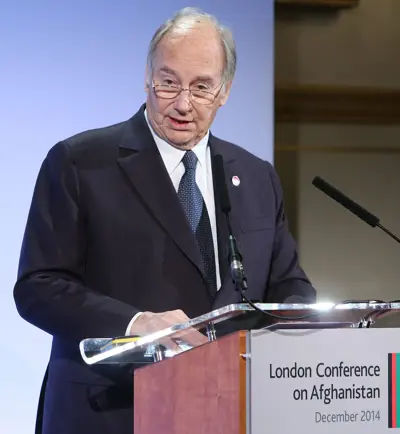
Prince Shāh Karim al-Husayni (شاه كريم الحسيني Shāh Karĩm al-Ḥussaynĩ), known by the religious title Mawlana Hazar Imam within Ismaili Muslim circles and as Aga Khan IV (آقا خان or آغا خان) elsewhere, is the 49th and current Imam of Nizari Ismailism, a denomination of Isma'ilism within Shia Islam. He has held this position of Imam since 11 July 1957, when, at the age of 20, he succeeded his grandfather, Sir Sultan Muhammad Shah Aga Khan III. Aga Khan claims to be a direct lineal descendant of the Islamic prophet Muhammad through Muhammad's cousin and son-in-law, Ali, considered Imam in Shia Islam, and Ali's wife Fatima, Muhammad's daughter from his first marriage.
