William Lyon Mackenzie King Quotes
In the twelve months immediately preceding the outbreak; of war, the quantity of spirits, both domestic and imported released for sale in Canada, amounted to over three and a half million proof gallons.
King, William Lyon Mackenzie. Temperance and a Total War Effort: Broadcast by Right Hon. W. L. Mackenzie King, M.P., Prime Minister of Canada, Wednesday, December 16, 1942. Director of Public Information, 1942.

To this day efforts to regulate alcohol, the nation’s most frequent drug of choice and cause of addiction and violence, are met with the same “virtues” of employment and tax revenue. It was not until the 1990s that we learned that the revenue from alcohol taxes was far less than the cost of society coping with the problems of drinking and addiction.


Sunday Excise Laws, sometimes called “Blue Laws”, prohibited commercial activity on Sunday, the day most Christians believe to be the Sabbath. Then such laws had not been constitutionally tested and when the were later were they were all found to be unconstitutional. Some Christian sects believe that Saturday is the Sabbath as do most Jews. Muslims believe Friday is the Sabbath. So any state determination on the Sabbath favors some religious viewpoint and discriminates against others. Today, decisions about Sabbath are left to individual consumers and store owners. Saloon keepers were particularly hard hit if they catered to the working man as in those days people worked a 6 day week and Sunday was the only day that people had leisure time. When TR became Police Commissioner, the law was on the books but rarely enforced as they were unpopular with most of the population—the orthodox Christians excepted. He felt obligated to enforce it even if he thought it too strict himself.


Father of Harriet Beecher Stowe and Henry Ward Beecher. Father of Harriet Beecher Stowe and Henry Ward Beecher
Father of Harriet Beecher Stowe and Henry Ward Beecher. Father of Harriet Beecher Stowe and Henry Ward Beecher


1st Earl Baldwin of Bewdley. Though members of the same Conservative Party, Churchill was a major opponent of Baldwin’s peace and “appeasement” efforts and publicly castigated Prime Minister Baldwin. Yet Baldwin, if he could not stave off war, wanted his critic to serve as Prime Minister if war was inevitable. Churchill never had much respect for Baldwin. See {626930}.


Samuel Langhorne Clemens, 1835-1910. The Congressmen who voted for Prohibition in the next century had not read or believed this quotation of Twain’s.


He was not aware of it but the Union War Department had prepared well and additional ironclad ships under construction of which the Monitor was just the first. Lincoln had approved the construction of ironclads on October 4, 1861. The Confederate Merrimack was larger and to the layman was the stronger ship but the Monitor did some damage and drove the Confederate Merrimac from the field to make repairs. The Confederacy, with minimal industrial steel-making capacity could not produce enough steel to protect more ships than the one ironclad Merrimack. The Union Navy, not only were building more Monitor class ships, but also, had a few Merrimack type wooden ships being iron clad as well as their Monitors as Strong had called for. The Union soon totally dominated the seas and as important, the rivers with which they could supply Union troops and bombard Confederate cities built thereupon.


The poem was his summary of the Wickersham Commission’s (National Commission on Law Observance and Enforcement) conclusion regarding Prohibition.

This is a wonderful historical quotation which illustrates the effect of Prohibition on Norway—most of which was negative. Despite the fact that this article had been published in a leading American journal, virtually no one paid attention to it when Prohibition was being debated and instituted in America a few years later. Another aspect of the quotation is the economic effect. It illustrates how easy it is to start a trade war that was completely unintended. Also how a country, in this case Portugal and Spain, will make foreign policy decisions of which their poorer people bear the brunt.

stating that war was obsolete See {640087} for the quotation of exactly what Angell wrote.

In the American Civil War, civilian weapons production first became a factor in the outcome of a war. In WWI, it became a significant factor. And in WWII it was THE MAJOR factor when America became the “Arsenal of Democracy”. At one point, a single Ford factory was producing an entire B24 (our heaviest) bomber every single hour on a 24/7 schedule—over 600 every month.
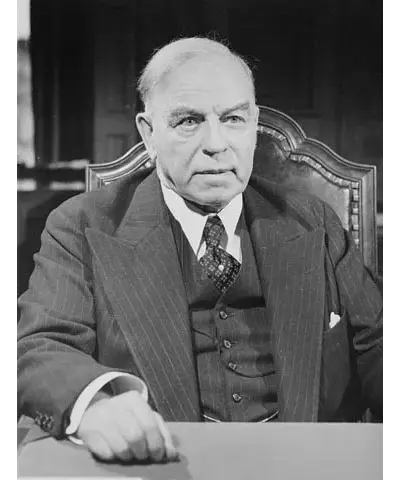
William Lyon Mackenzie King OM CMG PC, commonly known as Mackenzie King, was a Canadian statesman and politician who served as the tenth prime minister of Canada for three non-consecutive terms from 1921–1926, 1926–1930 and 1935–1948. A Liberal, he was the dominant politician in Canada during the interwar period from the 1920s through the 1940s. He is best known for his leadership of Canada throughout the Second World War (1939–1945) when he mobilized Canadian money, supplies and volunteers to support Britain while boosting the economy and maintaining morale on the home front. With a total of 21 years and 154 days in office, he remains the longest-serving prime minister in Canadian history.
