Winston Churchill Quotes
Never, never, never believe any war will be smooth and easy, or that anyone who embarks on the strange voyage can measure the tides and hurricanes he will encounter. The statesman who yields to war fever must realize that once the signal is given, he is no longer the master of policy but the slave of unforeseeable and uncontrollable events. Antiquated War Offices, weak, incompetent, or arrogant Commanders, untrustworthy allies, hostile neutrals, malignant Fortune, ugly surprises, awful miscalculations — all take their seats at the Council Board on the morrow of a declaration of war. Always remember, however sure you are that you could easily win, that there would not be a war if the other man did not think he also had a chance.
Winston Churchill, 1874-1965, British Prime Minister (Conservative), My Early Life: A Roving Commission, 1930
Sourced by: Eigen's Political and Historical Quotations

Some say that President Roosevelt had instructed the war department to issue warnings to the military forces in the Philippines and the Pacific. Military intelligence argued against the Japanese attack on the Philippines—and did not think any attack anywhere very likely. When the president insisted, warnings went out and this is what was sent to General Short. The warning was ambiguous and Short did very little and was caught unprepared shortly thereafter. How much reliance should be placed on intelligence estimates has been a question that has been argued before World War II and after.


The War Plan that the Germans had developed--{642092}—had gone awry at the battle of the Marne in late 1914.


This observation was made when Commander-in-Chief for the 13 American Colonies, General Edward Braddock had organized a military expedition to destroy some of the forts that the French had constructed. (See {37008}.) Braddock and the other military officers thought that the force Braddock had organized what he thought would be overwhelming force that could easily accomplish the objective. But unfortunately for Braddock, Franklin was prescient, See {583428}.

In both the First and Second World Wars the Western nations had a multilateral defense pact which did little good in the face of German aggression.


As an educational and military leader, he saw the importance of each in a nation’s welfare.


Clausewitz’book is one of the political classics that is read bby the George by almost every national leader and senior military officer in the world. This basic principle was totally violated George W. Bush and his administration team when, in the aftermath of September 11, they ordered the invasion of Afghanistan, and then before they could get that nation stabilized, ordered the invasion of Iraq which was very successful but there was no plan for the occupation after the initial victory. The Bush administration not only did not plan the last step of either war, but they had almost no planning for the any of the steps after the initial invasions.


3rd Viscount Palmerston


After the U. S. entered World War I, the issue of military conscription was debated and opposed by many of the congressional leaders:

The Muslims had internal wars but they had—and still have--two sets of morality as to the laws of war. This illustrates the classic Islamic discrimination against non-believers to which the minority of Muslim terrorists still adhere,


1st Earl Baldwin of Bewdley. Though members of the same Conservative Party, Churchill was a major opponent of Baldwin’s peace and “appeasement” efforts and publicly castigated Prime Minister Baldwin. Yet Baldwin, if he could not stave off war, wanted his critic to serve as Prime Minister if war was inevitable. Churchill never had much respect for Baldwin. See {626930}.

Up to that time U. S. policy was to provide training and assistance to the South Vietnamese government and military, but not to attack the North. America had backed a corrupt and incompetent South Vietnamese government and Bundy and other policy makers were convinced that the North Vietnam would win, if the fighting and governing were solely left to the South Vietnamese. Johnson, who had resisted this policy for several weeks finally acceded. It was a major escalation of the Vietnam War.


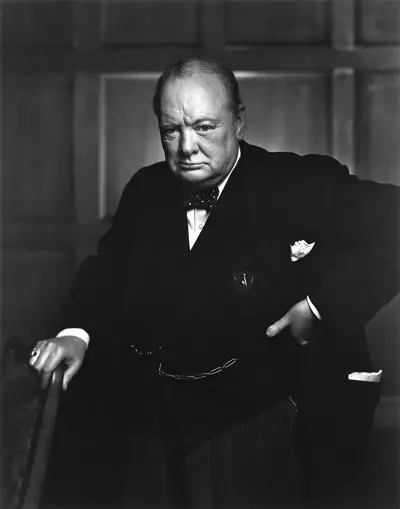
Sir Winston Leonard Spencer Churchill, KG, OM, CH, TD, DL, FRS, RA was the Prime Minister of the United Kingdom from 1940 to 1945, during the Second World War, and again from 1951 to 1955. Apart from two years between 1922 and 1924, Churchill was a Member of Parliament (MP) from 1900 to 1964 and represented a total of five constituencies. Ideologically an economic liberal and imperialist, he was for most of his career a member of the Conservative Party, as leader from 1940 to 1955. He was a member of the Liberal Party from 1904 to 1924. Churchill was also well known for his military career and as a historian, painter and writer, and among his many awards was the Nobel Prize in Literature.
