Ibn Khaldun Quotes
There is no certainty of victory in war, even when the equipment and numerical strength that cause victory exist. Victory and superiority in war come from luck and chance.
The histories and analyses of war have almost always been written by the victors. They naturally ascribe the victory to their, strategy, superiority, character and rightness of their cause—not to luck and fortune. Khaldun was one of the few, non modern historians to recognize luck as a major factor in war. That is one of the reasons he is so admired by modern scholars.
Ibn Khaldun, 1332-1406, Tunisian Arab Islamic astronomer, economist, historian, Islamic jurist, Islamic lawyer, Islamic scholar, Islamic theologian, mathematician, military strategist, nutritionist, philosopher, social scientist and statesman Quoted in Roger Crowley, 1453
Sourced by: Eigen's Political and Historical Quotations

See {635101} for a much ealier view of war’s uncertainty.


This observation was made when Commander-in-Chief for the 13 American Colonies, General Edward Braddock had organized a military expedition to destroy some of the forts that the French had constructed. (See {37008}.) Braddock and the other military officers thought that the force Braddock had organized what he thought would be overwhelming force that could easily accomplish the objective. But unfortunately for Braddock, Franklin was prescient, See {583428}.


Ruling group of France during the French Revolution. The purchase and transportation of an army in the field was a very expensive element of war and was very difficult as well. The Directory urged its generals to live off the land and get their food from the enemy country they were invading. Rarely did they pay for it but typically just took it from the civilians. Napoleon who served under the directory took this principle one step further. He also stole the invaded country’s art—paintings and statues mostly. These he sent back to Paris where they were sold to rich people. This way he could pay the salaries of the troops and buy more weapons and ammunition. Napoleon could conquer so much territory because France did not have to pay for the military effort as other countries did. This is one of the major reasons for example that the Louvre Museum in Paris has so many great Italian and Spanish paintings.


Although jihad was a duty of Muslims, it was not a duty to die in a fight against overwhelming odds which was determined to be 2 to 1. So 2 Muslims could run from 4 but not 3.

Note that even then, De Gaulle’s nationalist ego focused not only on glory but glory that need not be shared. It was always a great strength and a great weakness for him. He and many French officers were so fixed on the glory of beating the Germans, that they did not focus on their ½ million casualties and were not prepared for the German countermeasures that turned the battle from a French victory to a long standoff and stalemate of the “Western Front” where neither side could advance much. Note also that De Gaulle failed to mention the British Expeditionary Force that twice saved the French from being overrun. Denial for the honor of France was always one of De Gaulle’s characteristics. See {642233} for the English commander’s view of the outcome of the Battle of the Marne.


Note that he assumes that not only will there be another World War, but he assumes that we will be on opposite sides.
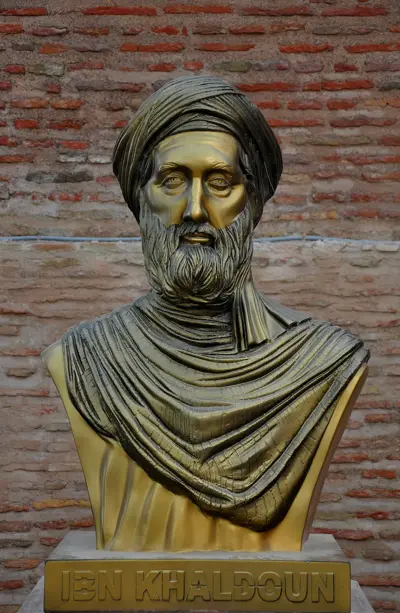
- Born: May 27, 1332
- Died: March 18, 1406
- Nationality: Arab
- Profession: Sociologist, Philosopher, Historian
Ibn Khaldun was an Arab sociologist, philosopher and historian who has been described as the founder of the modern disciplines of historiography, sociology, economics, and demography. Niccolò Machiavelli of the Renaissance and the 19th-century European scholars widely acknowledged the significance of his works and considered Ibn Khaldun to be one of the greatest philosophers of the Middle Ages.
